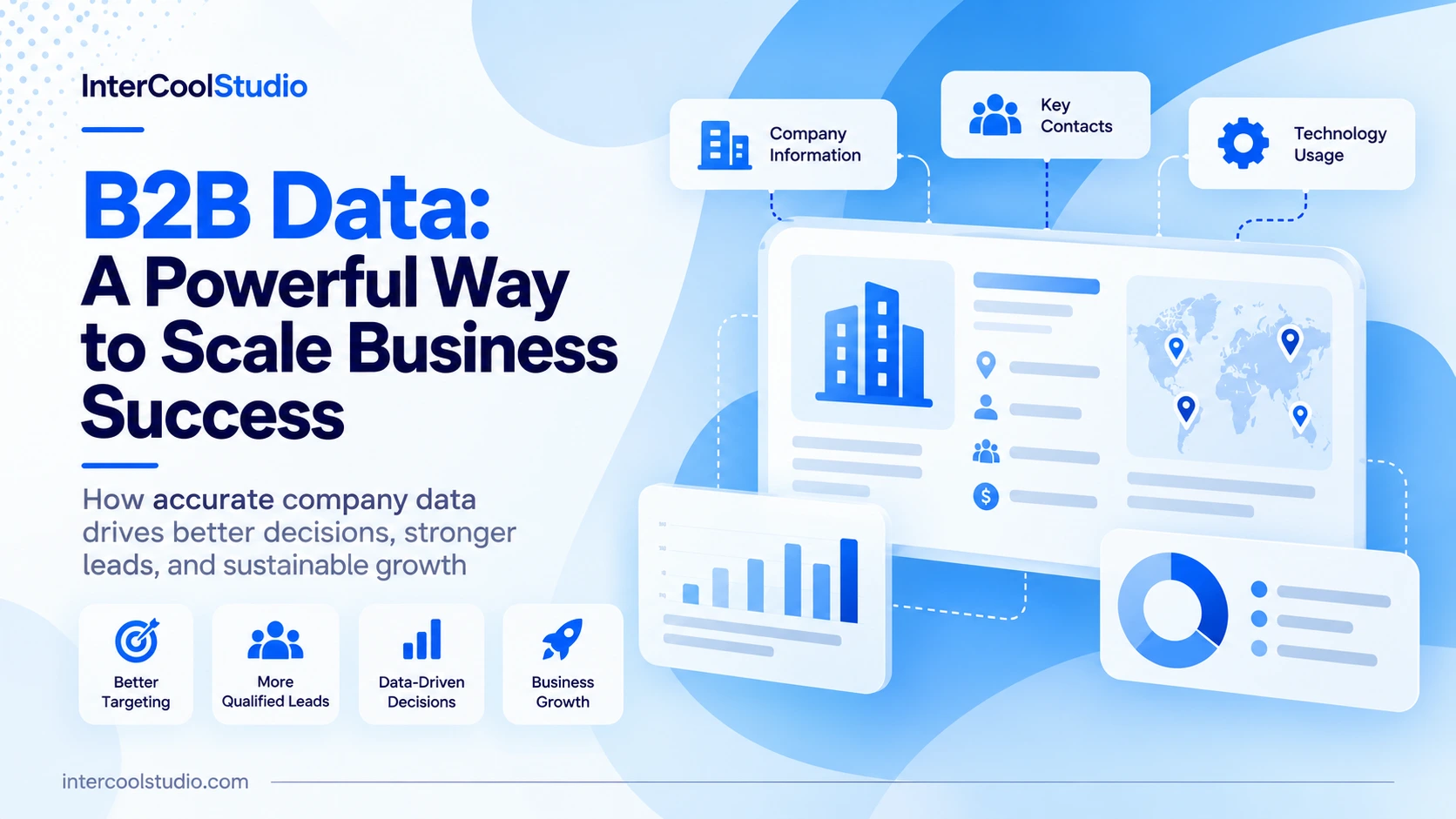
B2B data helps companies identify potential customers, understand their needs, and reach the people responsible for purchasing decisions. Instead of contacting hundreds of businesses at random, sales and marketing teams can narrow their search using information such as company size, industry, location, annual revenue, and technology usage.
For example, a software provider selling inventory management tools could identify retailers with multiple locations, filter them by business size, and prioritize companies using outdated systems. That creates a more focused prospect list than buying thousands of unverified email addresses.
However, collecting more data doesn’t automatically produce better sales results. Outdated contacts, duplicate records, and inaccurate company information can waste sales resources and undermine otherwise promising campaigns.
This guide explains how businesses use B2B data for prospecting, lead generation, and market expansion, along with practical examples of where data quality makes a measurable difference.
B2B data includes company details, business contacts, technology usage, and other information used to identify and evaluate potential customers. Sales teams use it to build targeted prospect lists, while marketers rely on it for audience segmentation and personalized campaigns. Reliable data can reduce wasted outreach, but results depend on accuracy, regular updates, and responsible handling of personal information.
How Businesses Use B2B Data to Improve Their Strategies
B2B data becomes valuable when companies use it to make specific sales, marketing, and operational decisions. A database containing thousands of company records accomplishes little unless those records help teams identify suitable prospects, prioritize opportunities, or reduce unnecessary work.
Improve Customer Targeting
Firmographic data, including industry, employee count, annual revenue, and company location, allows marketers to divide potential customers into relevant groups.
Example: A cybersecurity provider targeting mid-sized healthcare organizations could filter its prospect list to companies with 100–500 employees operating in selected regions. Its marketing team could then develop campaigns that address healthcare-specific security requirements rather than sending identical messages to businesses in unrelated industries.
This approach helps sales teams prioritize accounts that match their ideal customer profile.
Generate More Qualified Leads
Lead generation becomes more efficient when sales teams can distinguish between companies that match their target market and those unlikely to purchase.
Useful B2B data may include company size, industry, business location, corporate relationships, and verified contact information where lawfully available.
Example: A logistics software company could identify manufacturers operating multiple warehouses, then prioritize accounts expanding into new regions. Sales representatives would have a stronger reason to contact those businesses than simply working through an alphabetical list of manufacturers.
Data quality is particularly important here. An incorrect company size, outdated business address, or duplicate account can distort lead scoring and waste sales time.
Make Better Business Decisions
B2B data is useful beyond marketing and prospecting. Organizations can analyze industry distribution, geographic coverage, corporate ownership, and financial information to evaluate expansion opportunities and business risks.
Example: A commercial equipment supplier considering expansion into another state could examine how many businesses operate in its target industries, where those businesses are concentrated, and whether the market already contains major competing suppliers.
The company could use this research to compare potential sales territories before investing in new locations or additional sales representatives.
However, company data should inform these decisions alongside customer research, operating costs, and market conditions, not replace them.
B2B Data: A Foundation for Organizational Growth
As a company expands, manually researching every potential customer becomes increasingly difficult. Sales teams need consistent company records, marketing departments need reliable segmentation, and management needs accurate information about markets and business relationships.
This is where structured business databases become useful.
For example, InfobelPRO provides B2B company data covering firmographics, company locations, registration information, corporate structures, and financial details.
Such information can support several business operations:
- Market expansion: Identify companies operating in a particular industry or geographic region before entering a new market.
- CRM enrichment: Update incomplete company records and reduce duplicate or outdated information.
- Account-based marketing: Segment organizations by business characteristics and coordinate outreach around specific target accounts.
- Business verification: Check company identity, registration details, and ownership information during onboarding or partnership evaluations.
These applications require different datasets. A company researching market size may need industry classifications and location data, while a sales team may also need appropriate business contact information.
Before choosing a data provider, businesses should review geographic coverage, update frequency, available fields, and the information source.
Privacy and regulatory requirements also matter. Business records may contain personal data, particularly when they identify individuals. Companies must assess their lawful basis for processing that information and comply with applicable privacy and marketing rules.
Final Thoughts
Reliable B2B data can make business development more focused, but the objective is not to collect the largest possible database.
A smaller set of accurate, relevant company records is often more useful than thousands of outdated prospects. Sales teams can concentrate on suitable accounts, marketers can create more relevant campaigns, and managers can evaluate opportunities using consistent information.
Before investing in additional data, identify the decisions it needs to support. Then evaluate whether the available records are accurate, regularly updated, and detailed enough for those decisions.
The value of B2B data ultimately depends on how effectively a company turns information into action.
What is B2B data, and what does it include?
B2B data is information about companies, their operations, and their business relationships. Common examples include industry, company size, annual revenue, business location, and corporate ownership.
Some datasets also contain technology usage, business contact details, and signals such as recent funding or company expansion.
How does B2B data improve lead generation?
B2B data helps sales teams filter potential customers by industry, employee count, location, and other characteristics associated with their ideal customer profile.
Instead of contacting companies indiscriminately, teams can prioritize relevant accounts, identify suitable decision-makers, and tailor their outreach to specific business needs.
What is the difference between firmographic and technographic data?
Firmographic data describes a company’s business characteristics, including its industry, revenue, employee count, and geographic location.
Technographic data describes the technologies a company uses, such as CRM platforms, ecommerce systems, or marketing automation software. Combining both can help businesses identify prospects with relevant operational needs.
How can businesses check the accuracy of B2B data?
Start by checking when records were last updated, how the provider collects information, and whether company details can be verified against reliable sources.
Test a sample of records before purchasing a large dataset. Look for outdated companies, incorrect industry classifications, duplicate entries, and invalid contact details. Regular CRM cleanup can help maintain data quality.
Is using B2B data for marketing GDPR-compliant?
Using B2B data can be GDPR-compliant, but compliance depends on what information is processed, where it comes from, and how the business intends to use it.
Company-level information does not always constitute personal data. However, named employee contacts and identifiable professional email addresses can fall under GDPR. Businesses must establish an appropriate lawful basis, meet transparency requirements, respect individual rights, and follow applicable electronic marketing rules.

Andrej Fedek is the creator and one-person owner of three blogs: InterCool Studio, CareersMomentum, and Bettegi. As an experienced marketer, he is driven by turning leads into customers with White Hat SEO techniques. Besides being a boss, he is a real team player with a great sense of equality.