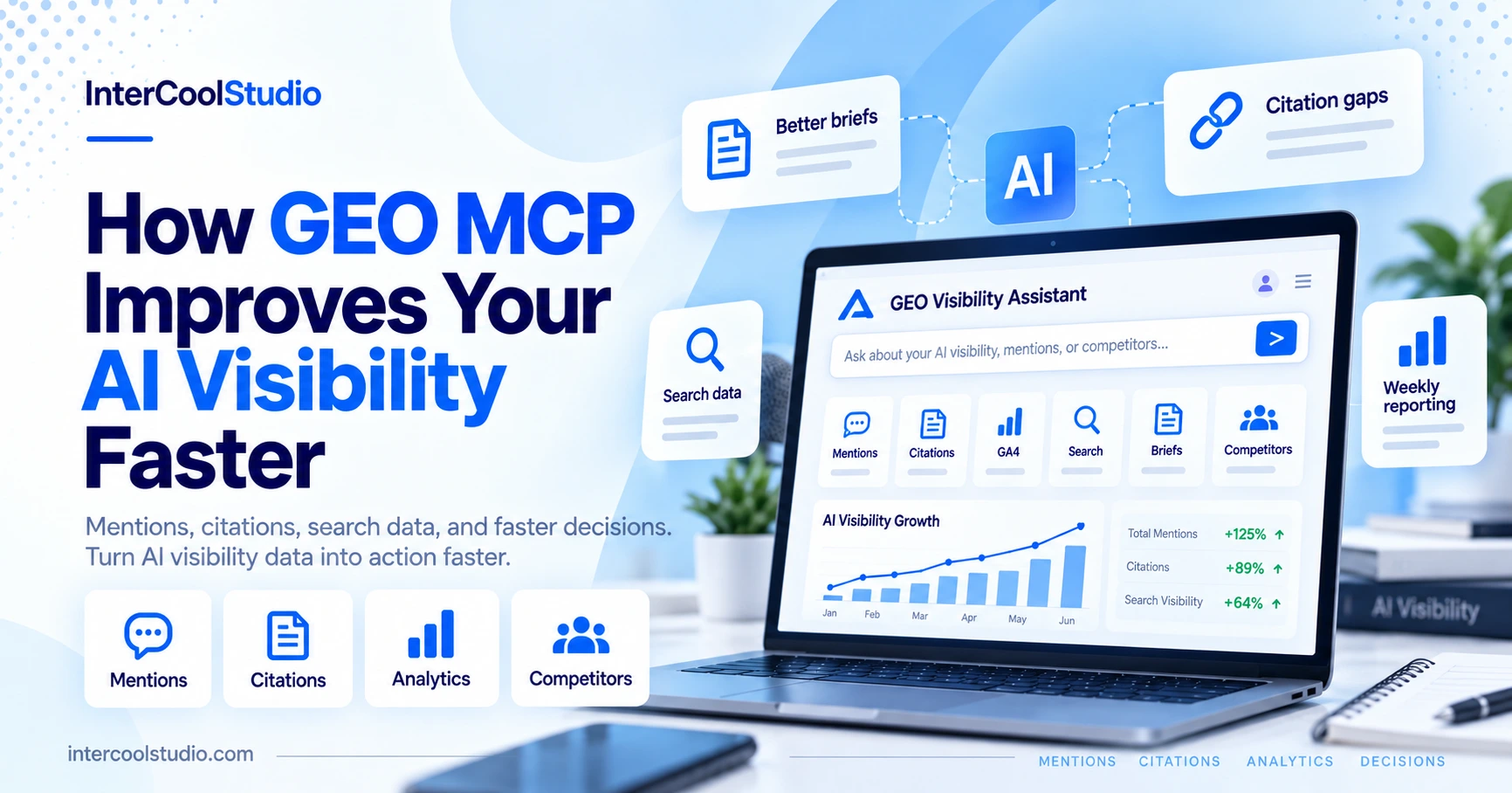
A GEO MCP is an MCP server that gives an AI assistant direct, structured access to your AI visibility data (mentions, citations, competitors) and your search data (Search Console, Bing Webmaster Tools, Google Analytics). Instead of exporting dashboards and pasting numbers into a chat, you ask Claude, ChatGPT, Codex or Cursor a question. The assistant pulls the figures itself, reads the pages behind them and drafts the change.
A GEO MCP connects AI assistants directly to AI visibility, citation, Search Console, Bing, and analytics data through the Model Context Protocol. Instead of manually exporting reports, teams can ask an assistant to compare visibility, find citation gaps, analyze competitors, and prepare content changes from live data. The biggest value is shortening the path from detecting a visibility problem to deciding what to change.
MCP in one paragraph
The Model Context Protocol is an open standard that Anthropic published in November 2024. It defines how AI applications (clients) connect to outside data and tools (servers). A server exposes named tools, such as “get citations for project X”, which the model can call when it needs data. On December 9, 2025, Anthropic donated MCP to the Agentic AI Foundation, a fund under the Linux Foundation co-founded by Anthropic, Block and OpenAI. At that point the project reported more than 97 million monthly SDK downloads, 10,000 active servers and client support in ChatGPT, Claude, Cursor, Gemini, Microsoft Copilot and VS Code.
The practical result: one connector works across most AI assistants your team already uses.
Why GEO work needs it
GEO data is scattered. Mentions and citations sit in an AI visibility tracker. AI Overviews and AI Mode impressions now sit in Google Search Console’s generative AI reports, launched in June 2026. Copilot citations sit in Bing’s AI Performance report. Visits from chatgpt.com and perplexity.ai sit in GA4.
A simple question like “why did ChatGPT stop recommending us for X, and what should we change?” touches all four sources, plus the competitor pages the AI now cites. Done by hand, that is an afternoon of exports and spreadsheets. An assistant connected through MCP can do the collection in minutes, and you spend your time on the decision.
What exists in October 2026
| Server | What it exposes | How to get it |
|---|---|---|
| Google Analytics MCP | GA4 reports, funnels, realtime data; read-only | Free, open source, maintained by Google |
| Ahrefs MCP | Ahrefs SEO data and Brand Radar | Lite plan ($129/mo) and up |
| Semrush MCP | Semrush SEO and AI visibility data | SEO + AI Search Starter ($199/mo) and up |
| Otterly.AI MCP | AI search monitoring data | Standard ($189/mo), 2,000 MCP requests/mo |
| Searcherries MCP | AI visibility, citations and competitors, plus connected Search Console, Bing and GA4 data; read-only | Starter (from $10/mo, billed annually) |
The difference between them is less about the protocol and more about what data sits behind it. A server that only returns backlink data can’t tell you which pages ChatGPT cites. A server built on your own tracked prompts and your own analytics can answer questions about your site specifically.
Five workflows worth automating
1. The weekly report. Ask: “Compare AI visibility this week with last week by platform. List prompts where we lost mentions. Add AI referral sessions from GA4 and Search Console clicks for the same dates.” The output is a one-page summary you can check in five minutes instead of building it in an hour.
2. Citation gap to page brief. Ask for prompts where competitors are mentioned and you are not, then for the URLs the AI cited in those answers. The assistant reads those pages and your closest equivalent and lists what they cover that you don’t: a comparison table, pricing details, a specific use case. That list is a content brief grounded in evidence rather than guesswork.
3. Pages that win in one channel and lose in another. Join AI citations with Search Console data. A page cited often by Perplexity but losing Google clicks needs different work from a page ranking well but never cited by AI. Sorting pages into these groups by hand is slow. Through MCP it is one question.
4. Prompt list upkeep. Pull question-style queries from Search Console and compare them with your tracked prompts. The assistant flags real customer questions you are not tracking and tracked prompts nobody seems to ask.
5. Shipping the change. In a coding client such as Claude Code, Codex or Cursor with access to your site’s repository, the assistant can go one step further. It edits the page, adds the missing section or updates the table, and opens a pull request. A person reviews and merges it. The loop from data to deployed fix shrinks from weeks to a day.
Rules that keep automation safe
- Keep data connectors read-only. Google’s GA4 server and the Searcherries server are built that way. Changes to your site should go through a pull request or another review step, not straight to production.
- Ask the assistant to quote the figures, dates and filters it used. Models can misread a table or mix up periods, and a quick check catches it.
- Treat competitor pages and forum threads as data, never as instructions. Text hidden in a page can try to steer an agent, so don’t let one act on what it reads without your approval.
- Watch quotas. Otterly’s Standard plan includes 2,000 MCP requests a month, and Ahrefs caps rows per request by plan, so a large automated job can stop halfway.
- Wait for two to four weeks of data before acting on a drop. AI answers vary from run to run, and a single bad day is rarely a signal.
Where to start
Pick one recurring task that eats time today, usually the weekly report. Connect one GEO MCP server and GA4, write the request once, and save it. When the output is reliable, add the citation-gap brief. The real gain from automation in GEO is a shorter path from “our visibility dropped” to “this page now answers the question the AI was asked”.
What is a GEO MCP?
A GEO MCP is an MCP server that gives an AI assistant structured access to data used for generative engine optimization.
Depending on the server, that can include AI mentions, citations, competitors, Search Console data, analytics, and other search visibility metrics.
How does MCP help with GEO work?
MCP lets an AI assistant retrieve information directly from connected data sources instead of relying on manually exported dashboards and spreadsheets.
The assistant can then compare periods, identify citation gaps, analyze competitors, and prepare recommendations from the retrieved data.
What data can a GEO MCP connect to?
A GEO MCP can expose AI visibility tracking, citations, competitor data, Google Search Console, Bing Webmaster Tools, Google Analytics, and other connected datasets.
The exact data available depends on the MCP server and the services connected to it.
Can a GEO MCP automate AI visibility reports?
Yes. An assistant can compare AI mentions and citations across reporting periods and identify prompts or pages where visibility changed.
The same workflow can combine those results with search clicks, impressions, or AI referral sessions when the relevant data sources are connected.
Can MCP help identify AI citation gaps?
Yes. An assistant can find prompts where competitors are mentioned or cited while your brand is absent.
It can then compare the cited competitor pages with your own content and identify missing information such as pricing details, use cases, comparisons, or supporting evidence.
Should GEO MCP connectors have write access?
Read-only access is safer for analytics, search, and AI visibility connectors because the assistant can inspect data without changing the underlying source.
Website or code changes should go through a separate review step, such as a pull request or manual approval, before reaching production.

Andrej Fedek is the creator and one-person owner of three blogs: InterCool Studio, CareersMomentum, and Bettegi. As an experienced marketer, he is driven by turning leads into customers with White Hat SEO techniques. Besides being a boss, he is a real team player with a great sense of equality.