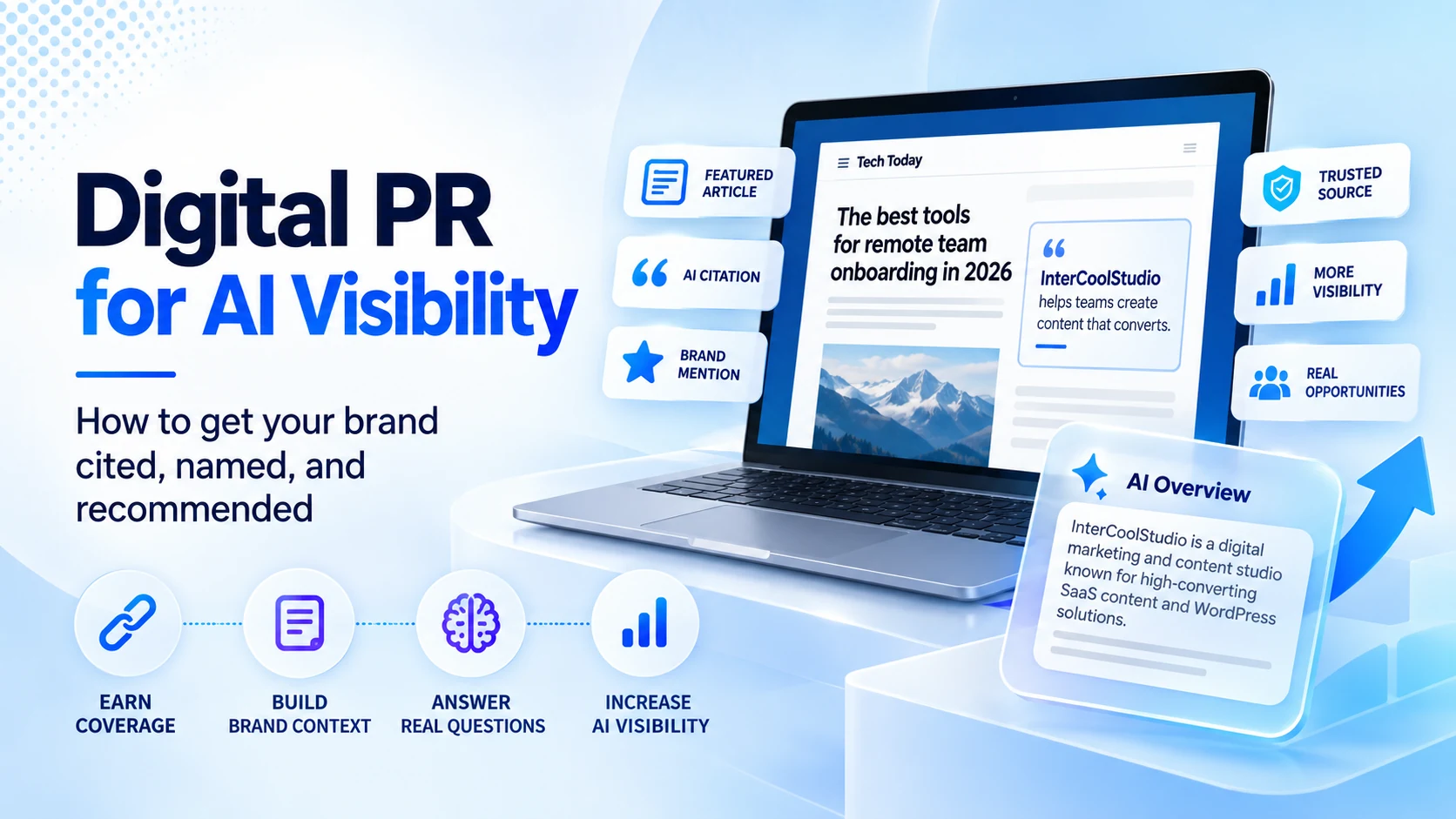
An article mentions your company, links to your website, and appears in a publication your customers recognize. That is a useful result. But when someone asks an AI assistant about the problem your product solves, what information does that article actually give it?
A sentence announcing a product launch may establish that the company exists. A paragraph explaining its customers, capabilities, and limitations gives a reader much more to evaluate.
That is the practical starting point for digital PR for AI visibility: plan coverage around the questions your brand can help answer. Then make sure the published material explains the connection with enough substance to be useful.
Digital PR for AI visibility works best when coverage explains what a brand does, who it serves, and why it is relevant to a specific customer question. Backlinks, AI citations, brand mentions, and recommendations are different outcomes, so campaigns should focus on useful brand context, credible evidence, and topic relevance rather than mentions alone.
What should a PR mention explain about your brand?
Consider a fictional employee-onboarding software company. Its announcement could say:
“The company has launched an innovative platform that transforms the employee experience.”
The sentence is positive, but vague. It does not identify the buyer, the workflow, or the product’s role.
Now imagine the company’s documented capabilities support this description:
“The platform helps HR teams at small remote companies organize employee onboarding, assign tasks to IT and track whether new hires have completed required steps.”
The second description establishes several relationships. It connects the company with employee-onboarding software, remote businesses, HR teams, and coordination with IT. A buyer can immediately judge whether the product belongs in their research.
Brand context is the information that makes a company relevant to a particular question. It can include its category, audience, capabilities, experience, and the evidence behind its claims.
In SEO discussions, co-occurrence describes a brand appearing alongside related terms or entities. The useful editorial task is to explain those relationships accurately. A passage about how a product handles a specific workflow communicates more than a string of desirable keywords.
How can PR coverage become a source for an AI answer?
Some AI answers use information retrieved from the web while responding to a question. That creates an opportunity for published coverage to supply useful evidence.
Google’s guidance for generative AI search describes retrieving relevant pages from its Search index to ground answers. It also explains that its systems can issue related searches to explore different aspects of a question. Google says indexing and serving content are not guaranteed. For a PR team, the practical question is whether a proposed article contains information that could help answer a customer’s query. An interview about onboarding failures, for example, could explain the operational problem, attribute a useful observation, and describe the circumstances in which a product helps.
Publishing that interview does not establish that it will enter a model’s training data. Training and retrieving a web page are separate processes. The immediate, reviewable result is a published source that explains the brand’s relevance.
A backlink, an AI citation and a recommendation measure different things
A backlink is a clickable connection between web pages. A brand mention names a company or product. An AI citation identifies a source used in an answer, while a recommendation presents a brand as a suitable option.
Those outcomes can occur independently.
| Observed result | What it establishes | What to check |
|---|---|---|
| A publication links to your website | A navigable connection exists | Destination URL, link treatment, and referral visits |
| An AI answer cites an article featuring you | The article appears as a source | Whether your brand is named in the answer |
| An AI answer names your brand | The business appears in the response | Accuracy, context, and sentiment |
| An AI answer recommends your product | The product is presented as an option | The buyer need and the reasons given |
A June 2026 Semrush study illustrates the distinction. Across 3,981 domain appearances for 115 prompts in 14 countries, 61.7% were citations without a named brand. The sample covered ChatGPT, Gemini, Google AI Overviews, and AI Mode. That percentage reflects observed domain appearances, not all AI answers.
An assistant could therefore cite your guest article as evidence about onboarding without recommending the software featured in it. Useful source material and product consideration are related objectives, but they need separate reporting.
Which topics should your PR campaign focus on?
Begin with the questions that arise when customers evaluate your offer. Sales conversations, support requests, implementation discussions, and product documentation can help identify them.
For the fictional onboarding company, relevant subjects might include organizing remote onboarding, assigning responsibilities across departments, and explaining access controls. Each topic needs a real connection to the product and evidence the company can supply.
There is observational evidence for paying attention to a brand’s wider presence. In its December 2025 analysis of 75,000 brands, Ahrefs found branded web mentions correlated approximately 0.66–0.71 with AI brand visibility across the surfaces studied. The sample used domain-rating and search-volume thresholds. It did not test what happens when a company buys additional mentions. A Semrush study published in August 2026 examined ChatGPT visibility across 1,094 US categories tracked from January through June. Brands were both cited and named in 34% of appearances in categories close to their established expertise, compared with 9% in distant categories. This was an observed association, not a PR placement experiment.
My practical interpretation is to give a campaign a defined subject focus. Choose related questions your company can answer well, then commission distinct contributions to those questions. That creates an editorial reason for the brand to appear consistently within a category.
This also makes the campaign easier to review. If an article cannot explain why the company belongs in the discussion, revisit the brief before pursuing the placement.
Turn the topic into a PR brief
A useful brief connects the reader’s question with the brand’s contribution and the evidence that supports it.
For the fictional onboarding company, the planning table could look like this:
| Customer question | Brand relationship to explain | Evidence to prepare | Suitable editorial setting |
|---|---|---|---|
| How can a small remote team standardize onboarding? | Product, remote-team onboarding, and repeatable workflows | A documented workflow, screenshots, and feature boundaries | HR operations guide |
| How can HR hand tasks to IT reliably? | Product, task ownership, and departmental coordination | Verified integration details and a process example | HR technology or IT operations article |
| How is sensitive employee information handled? | Product, access controls, and administrative responsibilities | Current security documentation and explicit limitations | Specialist software evaluation |
This is an illustrative planning exercise. It does not describe an actual campaign or measured AI results.
For each proposed article, specify the central question, the information your company can contribute, and the limits of that contribution. Identify who can explain the process and which supporting documents the writer can inspect.
An article about HR-to-IT handoffs, for example, could explain where responsibility becomes unclear, illustrate an assignment workflow, and show which parts the product supports. An interview, contributed guide, or product evaluation would approach that material differently. The brief should reflect the commissioned format.
This work gives an editor something concrete to assess and keeps the brand reference connected to the reader’s problem.
Choose publications that can support the brief
Once the subject is clear, examine publications that cover it. Read recent articles, identify the intended audience, and inspect examples of the exact placement format available.
The publication’s section matters. An HR operations article and a general company announcement may appear on the same domain while serving different readers. Compare the proposed treatment, authorship, space for evidence, and how the finished page will be discovered.
For agencies managing several campaigns, a publisher marketplace can help organize the commercial comparison. SEOlutions PR Portal, operated by SEOlutions GmbH, lets agencies and brands compare named publishers for guest-post and digital PR placements. Buyers can review comparison metrics and prices, request specific opportunities, and approve the prepared article before publication.
Those features help turn a campaign brief into a shortlist. The next step remains an editorial judgment: can this publication accommodate a useful article for the audience and the question you have chosen?
Authority metrics can contribute to screening. Read the actual coverage as well, check whether the proposed page will be accessible, and clarify the publication terms. Evidence that an outlet has previously appeared in AI citations can inform further investigation, but it cannot establish that a new article will be selected.
Keep earned coverage and paid placements distinct
Independent reporting, contributed articles, sponsored features and press-release distribution give publishers and brands different degrees of control. Describe the format accurately when setting expectations and interpreting results.
In its May 2026 research announcement, Muck Rack reported that 84% of sampled AI citations were classified as earned media, while 0.3% were paid or advertorial. The analysis covered more than 25 million cited links from ChatGPT, Claude and Gemini across 17 industries. These are shares of the sampled sources, not probabilities that an individual placement will receive a citation. That distinction matters when deciding what to buy. A paid article can provide a defined opportunity to publish information. Research about earned coverage does not establish that purchased placements produce equivalent AI outcomes.
Link treatment should also reflect the arrangement. Google recommends the sponsored attribute for paid-placement links; nofollow remains an acceptable alternative.
Measure whether the brand appears in the right context
Before publication, record a baseline using questions that reflect your customers’ research. Include different needs, such as understanding a problem, comparing approaches, and evaluating product suitability.
Keep the prompt wording, market and platform consistent enough to make comparisons useful. Record the date and whether web search was enabled, and repeat observations because answers and sources can vary.
For each response, note:
- Whether the brand is named and described accurately.
- Whether it is associated with the intended category and customer need.
- Which URLs are cited, including articles on other publishers’ websites.
- Whether the product is recommended, and on what basis.
- Whether observable referral visits lead to useful inquiries or other business outcomes.
Keep a record of other activity during the same period. Website changes, product launches, and additional coverage can affect what appears in search. An increase after publication is worth investigating; it does not establish that a particular placement caused it.
Use the findings to improve the next brief. If an answer misstates a capability, examine the available source material. If the brand appears for an unsuitable audience, make its intended users and limitations clearer in future coverage.
The next placement brief should state the customer question, the brand’s contribution, and the evidence that supports it. Those details give the writer a clear assignment, the reader useful information, and any system retrieving the article-specific facts to evaluate.
What is digital PR for AI visibility?
Digital PR for AI visibility focuses on earning coverage that clearly explains what a brand does, who it serves, and which customer questions it can credibly help answer.
The goal is not simply to secure a mention or backlink, but to publish useful brand context that readers and systems retrieving information from the web can evaluate.
Why does brand context matter for AI visibility?
Brand context connects a company with a specific category, audience, capability, or problem instead of merely confirming that the company exists.
Coverage that explains real workflows, intended users, evidence, and limitations gives both readers and AI systems more useful information than vague promotional language.
Is a backlink the same as an AI citation or recommendation?
No. A backlink is a clickable connection between web pages, while an AI citation identifies a source used in an answer.
An AI system can cite an article without naming the brand, and it can name a brand without recommending the product. These outcomes should therefore be measured separately.
Which topics should a digital PR campaign target for AI visibility?
Start with questions customers already ask during evaluation, implementation, support, and sales conversations.
Prioritize subjects where the company has a genuine connection, useful expertise, and evidence it can contribute, rather than pursuing unrelated topics simply for additional mentions.
Can paid PR placements guarantee AI citations or recommendations?
No. A paid placement can create a defined opportunity to publish useful information, but it cannot guarantee that an AI system will retrieve, cite, name, or recommend the brand.
Paid placements, contributed articles, and earned media should be evaluated according to what they actually provide, while AI visibility is measured separately over time.

Andrej Fedek is the creator and one-person owner of three blogs: InterCool Studio, CareersMomentum, and Bettegi. As an experienced marketer, he is driven by turning leads into customers with White Hat SEO techniques. Besides being a boss, he is a real team player with a great sense of equality.