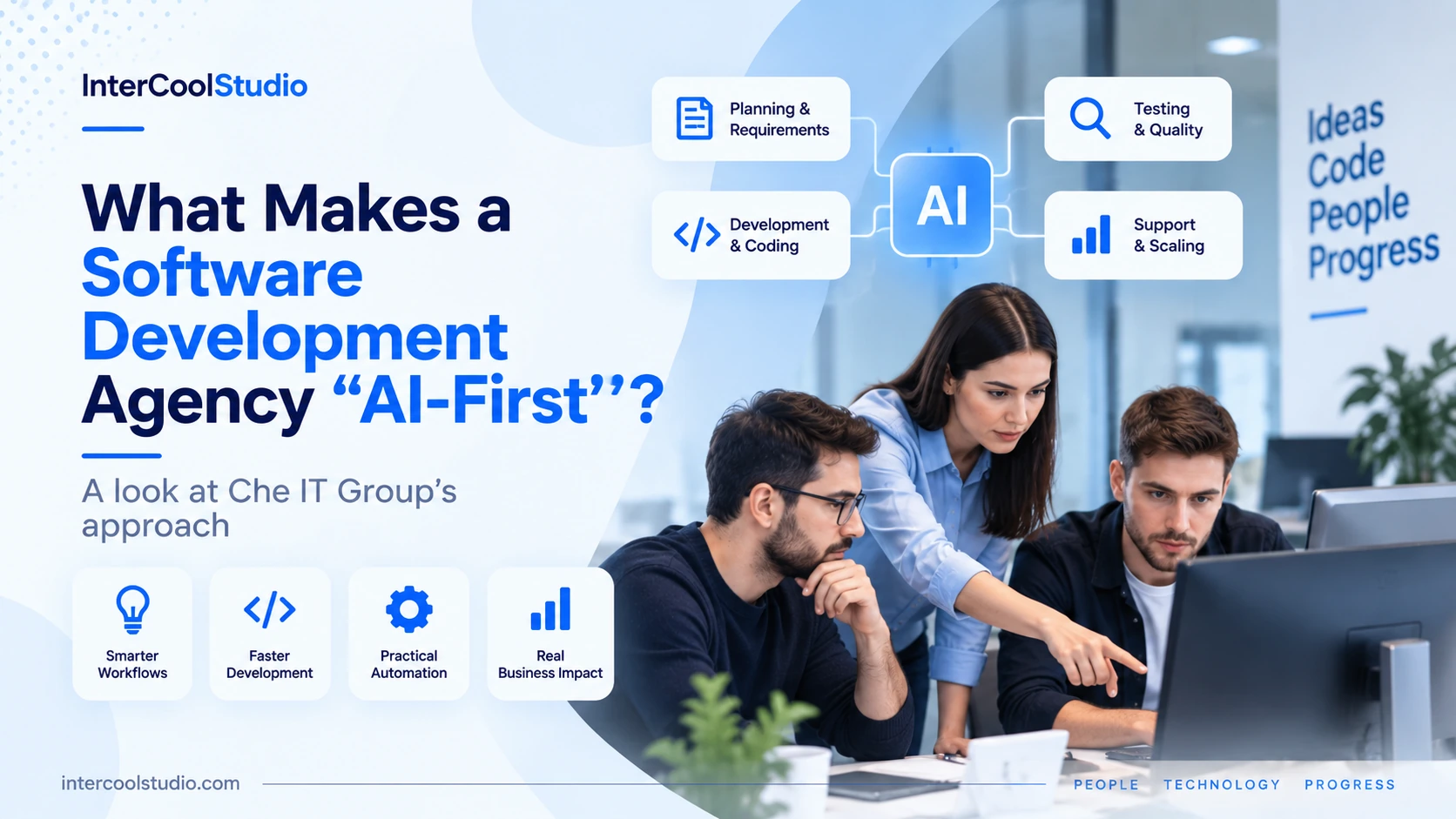
An AI-first software development agency uses AI across the development process, not just as a coding assistant.
This raises an important question for anyone hiring a software partner: is the agency just giving developers AI tools, or has AI changed the entire delivery process?
The difference matters, so let’s explore it.
An AI-first software development agency uses AI across the delivery process, not just for writing code. AI can support planning, testing, documentation, research, automation, and repetitive development work, while engineers remain responsible for architecture, security, and production decisions. The strongest partners combine faster AI-assisted workflows with experienced technical judgment.
What an AI-first agency actually means
An AI-first agency isn’t simply a team that uses an AI coding tool to write an entire application.
A better definition is that AI becomes a regular part of how the agency plans, builds, tests, and supports software.
This can include AI-assisted coding, automated testing, document analysis, workflow automation, code review support, research, and internal project management.
The goal is not to take engineers out of the process. Instead, it cuts the time they spend on repetitive tasks so they can focus on architecture, business logic, security, product decisions, and complex technical challenges. Market research confirms that developers value AI output, but few trust it completely and still think human review is necessary.
Three traits to look for
If you are considering an AI-first development agency, look past the list of tools on its website.
First, see how the team actually uses AI in their workflow.
Does AI help with requirements, estimates, research, testing, documentation, and code? Or does the agency just mention a few coding assistants?
Second, ask how the agency automates repetitive tasks.
A mature team looks for manual tasks that repeat across projects. This could include processing documents, moving data between systems, generating reports, checking requirements, preparing test cases, or handling routine support work.
Third, see how the team balances speed with good engineering judgment.
Faster development doesn’t help if it creates technical debt, security issues, or software that is hard to maintain.
Why AI-first changes the team model
AI-first development also changes the way businesses use outside engineering talent.
Staff augmentation usually means adding developers to your team to increase capacity. This approach still works when you need a certain skill or extra help on a project.
AI can help you get even more out of that extra capacity.
Picture a startup with a product manager, a designer, and two engineers. Instead of hiring more developers for every new feature, the team can use AI for first drafts, repetitive coding, test generation, documentation, and technical research. A specialist can then review the work and handle the parts that need more expertise.
The same idea works for an SME with an internal IT team. You may not need a large permanent development department. You may need two experienced engineers for a specific portal, automation project, or product release, supported by AI-enabled workflows.
This is where staff augmentation and AI automation can work together. You get access to specialist skills without building a large team for every project.
This is the model Che IT Group’s AI-first development teams use: AI handles repetitive work while experienced engineers lead technical decisions, product requirements, and delivery.
Where the approach works in practice
The main point is not the AI model itself. The real value comes when you connect AI to an actual business process.
AI-first agencies can also bring AI into a project much earlier.
For a startup, this could mean quickly building a working prototype, testing an idea with real users, and then deciding what needs more engineering work. For an agency, it might mean trying out several technical approaches before spending a lot of time on development.
A prototype can be built quickly but still be a weak foundation for a product. An AI-first partner should know when a quick solution is enough and when the team needs solid architecture, testing, security controls, or custom development.
How to assess an AI-first partner
Before you sign a contract with a development partner, ask a few questions that show how the agency really works.
- Which development tasks do you automate today?
Ask for specific examples. “We use AI” does not tell you much. “We use AI to generate test cases, review repetitive code patterns, summarize technical documentation, and support internal research” gives you something you can actually evaluate.
- Where do engineers make the final decisions?
You should know who checks AI-generated code, architecture, security decisions, and production changes.
- How do you protect client data?
AI tools can bring privacy and security risks. Ask which models and third-party services the team uses, what data they send to those services, and how they control access.
- Can you work with my existing team?
For staff augmentation, this matters as much as technical skill. Ask how engineers communicate with your team, document their work, and share knowledge.
- What happens after the first release?
A good partner should be able to explain how they handle bugs, monitoring, technical debt, new features, and changes in requirements.
The real test is not the number of AI tools
The market is quickly moving toward AI-assisted software development, but that doesn’t mean every development agency has become AI-first.
An AI-first agency brings together AI tools, automation, experienced engineers, and a delivery process built for faster feedback. It can use a smaller team when it makes sense, bring in specialists as needed, and automate repetitive work.
What does AI-first mean in software development?
AI-first means AI is built into the development workflow instead of being used only as a coding assistant.
It can support planning, coding, testing, documentation, research, automation, and other repetitive development tasks.
Does an AI-first agency replace developers with AI?
No. AI can handle repetitive work, generate first drafts, assist with testing, and speed up research.
Engineers still make decisions about architecture, security, business logic, production changes, and complex technical problems.
How can you tell whether a development agency is really AI-first?
Ask how the agency uses AI across requirements, development, testing, documentation, research, and internal workflows.
Specific examples tell you much more than a list of AI coding tools on a services page.
How does AI-first development affect staff augmentation?
AI can help a smaller augmented team handle repetitive coding, testing, documentation, and technical research more efficiently.
Specialist engineers can then spend more time on work that requires deeper technical knowledge and judgment.
What should you ask an AI-first software development agency before hiring it?
Ask which tasks the team automates, where engineers make final decisions, and how client data is protected.
You should also ask how the agency works with existing teams and how it handles support, bugs, and changes after launch.

Andrej Fedek is the creator and one-person owner of three blogs: InterCool Studio, CareersMomentum, and Bettegi. As an experienced marketer, he is driven by turning leads into customers with White Hat SEO techniques. Besides being a boss, he is a real team player with a great sense of equality.