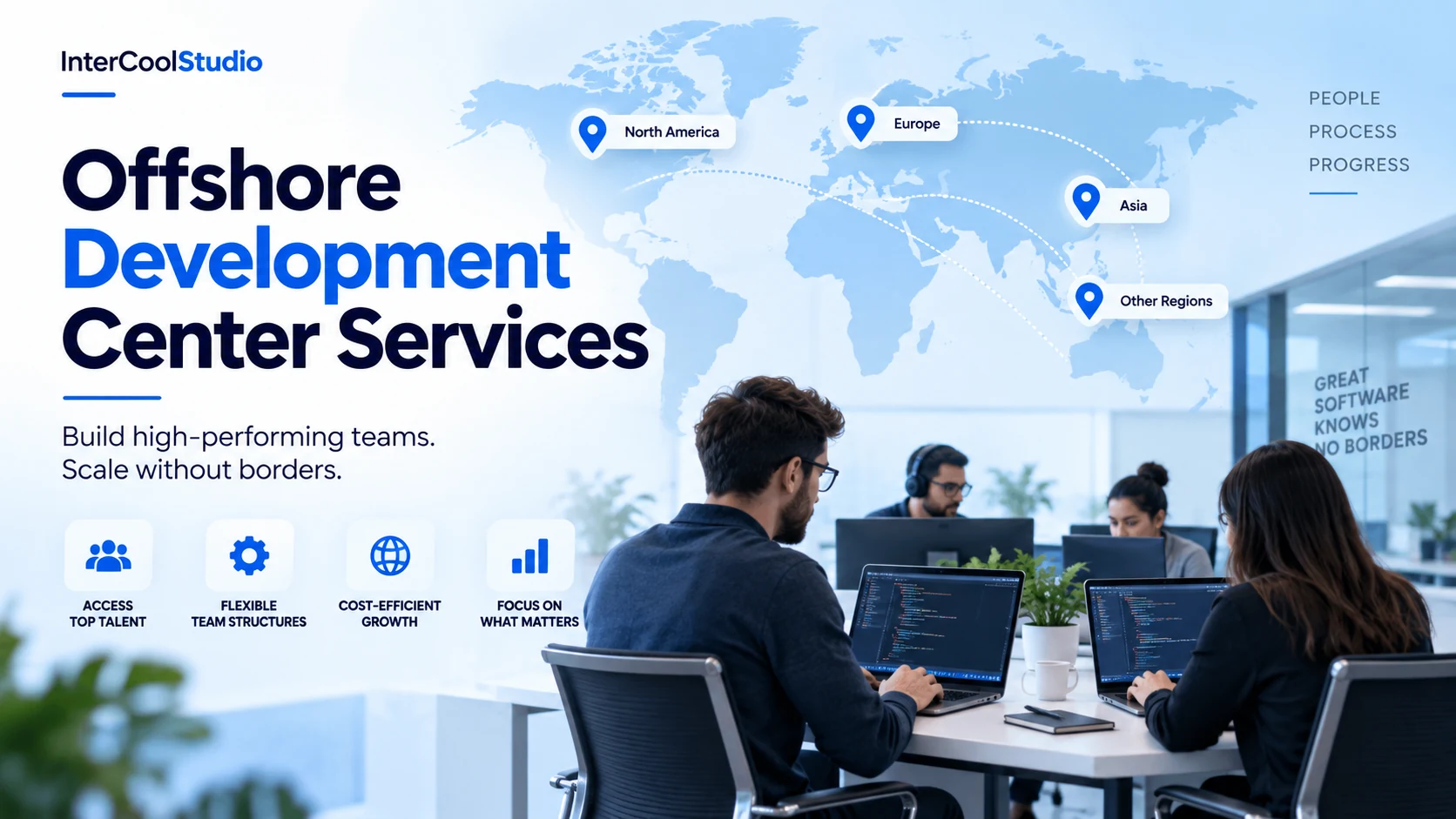
Search “offshore development center companies” and most of the results are staff augmentation shops and dedicated-team providers, not offshore development centers in the strict sense. The two terms describe genuinely different structures, but they cover overlapping ground, engineers based outside a client’s home country working on that client’s product, so they get used loosely across the market.
That overlap costs a buyer real time: a technical hiring manager who assumes every name on a shortlist runs the same semi-permanent, locally managed setup ends up comparing proposals that turn out to be built very differently once the details arrive on the table. None of that means any one provider is doing something wrong by appearing on the list; the terms genuinely overlap in the market, and every name here, us included, benefits from the same search traffic. It means the buyer’s own homework has to happen before the sales call, not during it.
This piece checks three names that regularly surface in that search against our own approach: Uptech, Mobilunity and Codify. All three, and we, offer some version of a dedicated engineering team built for a client outside its home country; the difference across all four is the structure behind that offer, the reporting line, the management layer, the facilities cost, not which name is more legitimate than another.
A buyer’s job is matching that structure to what the situation needs, not ranking four reasonable approaches against each other as if only one could be right. We build embedded engineering teams through IT staff augmentation services, which puts us on the list being judged, not outside it looking in. Facts about the other three companies below come from what they publish about themselves; facts about ours come from our own operating history.
Offshore development center services are often grouped together with staff augmentation and dedicated-team providers, but the delivery models are not the same. A true offshore development center includes local management, facilities, and a longer-term operating structure, while staff augmentation keeps engineers embedded directly in the client’s existing team. The right provider depends less on the label and more on team size, management needs, bench depth, contract terms, and whether the buyer actually needs a permanent local setup.
What counts as an offshore development center
An offshore development center, properly run, is a semi-permanent team a vendor sets up and manages on a client’s behalf, usually with its own local office, its own on-the-ground management layer, and its own HR and admin functions, functioning as an extension of the client’s engineering organization but operated day to day by the vendor rather than the client. It suits a company planning a multi-year presence in a region, building a team large enough to need its own local leadership, without wanting to open a legal entity itself.
It is a heavier commitment than most growing teams need, and that gap between the label and the reality is exactly where most of the confusion in this market lives. Done properly, it comes with a management structure a smaller staff augmentation engagement doesn’t carry, and that structure is worth paying for only when the scale justifies it.
A center built this way usually shows up in the contract itself, not just the pitch: a lease or shared office in the client’s name or the vendor’s, a named local director reporting on headcount and delivery, and a budget line for facilities and local compliance that a lean augmentation engagement never has to carry.
None of that makes the heavier model wrong for the buyer who genuinely needs it; it just means the price tag reflects a different amount of infrastructure than a staff augmentation quote does. A buyer who has seen one of these contracts up close knows the facilities line item alone can run to a meaningful share of the total quote, which is exactly the cost a staff augmentation engagement skips by design. None of the four compared here run that model as their core offer.
All four are closer to staff augmentation or dedicated-team providers that get pulled into offshore development center searches because the underlying need looks similar from a distance: engineers, based offshore, working on a client’s product. The distance matters once a buyer starts comparing line items rather than homepage copy.
What this comparison comes down to
- Uptech, Mobilunity and Codify, like us, are closer in structure to staff augmentation or dedicated-team providers than to a classic offshore development center.
- A real offshore development center carries its own local management layer and its own facilities budget; a staff augmentation engagement reports directly into the client’s own team instead.
- Founding year and headcount vary widely across the four companies here, from roughly a hundred employees to several hundred, which changes how deep a bench each can offer for a given stack.
- The right choice depends on whether a buyer needs a semi-permanent local presence or a smaller number of engineers embedded directly in an existing team.
How the three named companies compare on paper
Public information about founding year, scale, and core model is a reasonable filter before a longer sales conversation, even though it only tells part of the story. Here’s how Uptech, Mobilunity, and Codify stack up against our own approach, as of 2026.
| Criteria | Newxel | Uptech | Mobilunity | Codify |
|---|---|---|---|---|
| Founded | 2017 | 2016 | 2010 | 2016 |
| Core model | Staff augmentation and Employer of Record | Custom mobile and web development plus staff augmentation | Dedicated development teams, majority IT staff augmentation work | IT staff augmentation specialist |
| Scale | 500+ engineers placed to date | Around 114 employees, per its own listings | Around 216 employees across three continents | A 50 to 249 employee band, per Clutch |
| Where they operate | Hiring hubs across Europe and Israel, extended to other countries on a client’s request | Los Angeles, California, with delivery out of Ukraine, Poland, and Estonia | Kyiv, Ukraine | Kyiv, Ukraine |
Two things stand out when reading across the row. None of the four discloses anything resembling a dedicated ODC product with its own local leadership team; all four describe staff augmentation or dedicated teams instead. And scale ranges more than fourfold between the smallest and largest of the four, which matters more for bench depth in a specific stack than any label on a homepage does.
What each provider offers, in its own words
We’re built narrower by design, not just by scale: staff augmentation and Employer of Record work, with 500+ engineers placed to date and nothing else competing for the same recruiting pipeline’s attention. A client names the role, the stack, and the seniority, and the engineer who fills it reports to the client’s team from day one, with no local management layer and no separate delivery organization in between.

Where an offshore development center bills for a local director’s time and a facilities line whether or not the team is fully staffed that month, our side of the relationship stays limited to recruiting, HR administration, payroll, and legal compliance in whichever country the hire is based, which keeps the cost structure tied to headcount placed rather than to overhead a client never asked for. It’s a narrower offer than a full offshore development center, and for a buyer who doesn’t need that heavier structure, the narrower offer tends to be the cheaper and faster one to stand up, with fewer approvals needed before someone starts.
Uptech, founded in 2016 and headquartered in Los Angeles, built its name on custom mobile and web app development, with staff augmentation offered alongside its product design and build work. At roughly 114 employees delivering out of Ukraine, Poland and Estonia, a client hiring Uptech for staff augmentation draws from the same pool that also staffs its product studio work, worth asking about directly if the studio side happens to be running at capacity that quarter, the same question worth asking any provider whose engineers split time across internal and client work. That multi-country footprint also gives it flexibility across time zones that a single-hub provider doesn’t have, useful for a client running standups across several regions rather than one.
Mobilunity, founded in 2010 and headquartered in Kyiv, is the most explicit of the three about its model: dedicated development teams, with IT staff augmentation making up the bulk of its service mix. At around 216 employees serving clients across more than 30 countries, it has the deepest bench of the three named here, and its positioning through fullstack dedicated development team services is close to what a buyer searching this space is usually looking for. Its longer track record means a longer history of client references to check against a specific stack, which is worth more than any headcount figure on its own, a check worth running against any of the four names in this comparison, not just this one.
Codify, founded in 2016 and also headquartered in Kyiv, positions itself around IT staff augmentation services rather than a broader software house, with a reported headcount in the 50 to 249 employee band. That narrower focus is closer to our own shape than either of the other two, at a comparably smaller scale. As with any specialist this size, ourselves included, it’s worth confirming which technologies the bulk of that headcount covers before assuming coverage matches a client’s own roadmap.
What the contract should spell out, regardless of which name is on it
The label on a proposal matters less than four line items buried in the contract behind it. The first is who signs the local employment agreement and in which country, since that answer determines who carries statutory liability if the arrangement ends badly.
The second is whether facilities, equipment, and local admin costs sit inside the quoted rate or get billed separately once the engagement is live, which is exactly where a lean staff augmentation quote and a heavier offshore development center quote can look deceptively similar on page one and diverge sharply by page four.
The third is what management layer, if any, sits between the client’s engineering lead and the engineer doing the work, since that layer is the clearest single signal of which model a buyer is being sold.
The fourth, easy to skip when a deal is moving fast, is what happens to intellectual property and access credentials the day the engagement ends, since a vendor running its own local office has different offboarding mechanics than one whose engineers work inside a client’s own systems from day one.
A vendor that can’t answer these four questions in writing, regardless of whether it calls itself a staff augmentation shop, a dedicated-team provider, or an offshore development center, is not ready to be signed.
Questions worth asking before any of these four signs anything
Start with a direct one: ask whether the engagement being proposed is staff augmentation, a dedicated team, or offshore development center services complete with local leadership on the ground, and get the answer in the contract language, not the sales deck. Ask how many engineers in the specific stack a client needs are currently on the bench versus how many would need to be freshly recruited, since the gap between those numbers predicts the real timeline better than any advertised time-to-hire figure.
Ask which entity legally employs the engineer, in which country, and how notice periods and severance work if headcount needs to shrink. Ask, too, what the escalation path looks like when an engineer underperforms: some providers swap the person within days at no extra cost, others treat replacement as a new sourcing cycle that resets the clock and the invoice both. A provider that answers all four without redirecting to a sales call is showing a buyer more than its case studies page ever will.
Matching the model to the actual need
A buyer who needs a semi-permanent local presence, its own office, and a management structure the client doesn’t have to run itself should be pricing offshore development center services properly, not a staff augmentation engagement wearing that label. A buyer who needs a handful of engineers embedded directly into an existing team, answering to an engineering lead the company already employs, is better served by a provider built around IT staff augmentation services rather than a heavier local setup.
Of the three named companies here, Mobilunity’s dedicated-team framing comes closest to that second need at meaningful scale, Codify matches it at a more boutique size, and Uptech fits best when the ask includes product build work alongside the augmentation itself, since its studio background covers design and build work the other two aren’t positioned around. Each of the three is a reasonable choice for the buyer it’s built for; the work is matching the buyer to the structure rather than picking a winner from the four.
None of the three run a full offshore development center as their core offer, and our own version of that structure skips the vendor-run local management layer each of them would add, keeping the client’s own team in charge day to day, and that’s a fair thing for a buyer to know going in rather than assume from a search results page.
A buyer who genuinely needs that specific structure is better served looking beyond staff augmentation and dedicated-team providers altogether, toward a firm built for that heavier model, and there’s no shortage of legitimate options built exactly that way, several of them named in a separate comparison focused specifically on that heavier structure.
Reading the contract structure, not the page title that led to a search result, is what settles which of these fits a given need, and that’s true whether the shortlist has three names on it or thirty.
Why do staff augmentation companies show up when someone searches for an offshore development center?
Because the search terms overlap even though the delivery models don’t. Both involve engineers based outside a client’s home country working on that client’s product, so search engines and marketing pages treat the terms as close enough to compete for the same traffic. The buyer’s job is to check the actual contract structure, not the page title, before assuming a provider runs a true offshore center.
Is a dedicated development team the same thing as an offshore development center?
No, though they’re often marketed as interchangeable. A dedicated team, in the staff augmentation sense, reports directly into a client’s own engineering lead, with the provider limited to recruiting, HR and payroll. An offshore development center adds a local management layer the vendor runs on the client’s behalf, which suits a larger, longer-term presence more than a lean engagement.
When does it make sense to pay for a full offshore development center instead of staff augmentation?
When the team is large enough, and expected to stay large enough for years, that it needs its own local leadership and office rather than reporting into a manager back at headquarters. Below that threshold, the extra management layer an offshore center bills for tends to add cost without adding proportional value, and a leaner staff augmentation engagement usually gets the same engineers working the same way for less. A useful rule of thumb: if the plan is to grow past twenty or thirty people in one country within the next two years, price both models and compare; below that, the local-office overhead rarely pays for itself.
How should a buyer compare four providers this different in size?
Not by headcount alone. Ask each one for its bench depth in the exact stack the role requires, not a company-wide total, and ask how many of those specific engineers are available this quarter rather than theoretically on staff. A 200-person company with three available backend specialists in the right stack beats a 5,000-person company with none free for another two months, and the only way to know which situation a given provider is in this month is to ask directly rather than infer it from the size of the logo on its homepage.
What happens if a client outgrows a staff augmentation engagement and later needs a full offshore development center?
Some staff augmentation providers can grow an engagement toward that heavier structure over time, adding local management as headcount grows, though it’s worth asking directly whether a specific provider offers that path or whether the client would need to switch vendors to get it. Providers built narrowly around staff augmentation, ours included, are generally more useful for staying lean than for growing into a full local office setup.
Can a buyer negotiate an offshore development center down to something closer to staff augmentation pricing?
Sometimes, but the negotiation usually strips out the parts that made it an offshore development center in the first place, such as the dedicated local office or the named on-site management layer. What’s left is closer to a dedicated team engagement at a discount off the original quote. It’s often simpler, and more transparent, to ask directly for a staff augmentation proposal instead of negotiating a heavier structure down to a lighter one after the fact.
Does founding year matter when comparing providers this different in age?
Less than it looks like it should. A longer track record usually means more client references to check and more time to have worked out delivery kinks, but a company founded more recently can still have deeper, more current expertise in a specific modern stack than an older firm still staffing older projects. Age is a starting filter for due diligence, not a substitute for it.

Andrej Fedek is the creator and one-person owner of three blogs: InterCool Studio, CareersMomentum, and Bettegi. As an experienced marketer, he is driven by turning leads into customers with White Hat SEO techniques. Besides being a boss, he is a real team player with a great sense of equality.