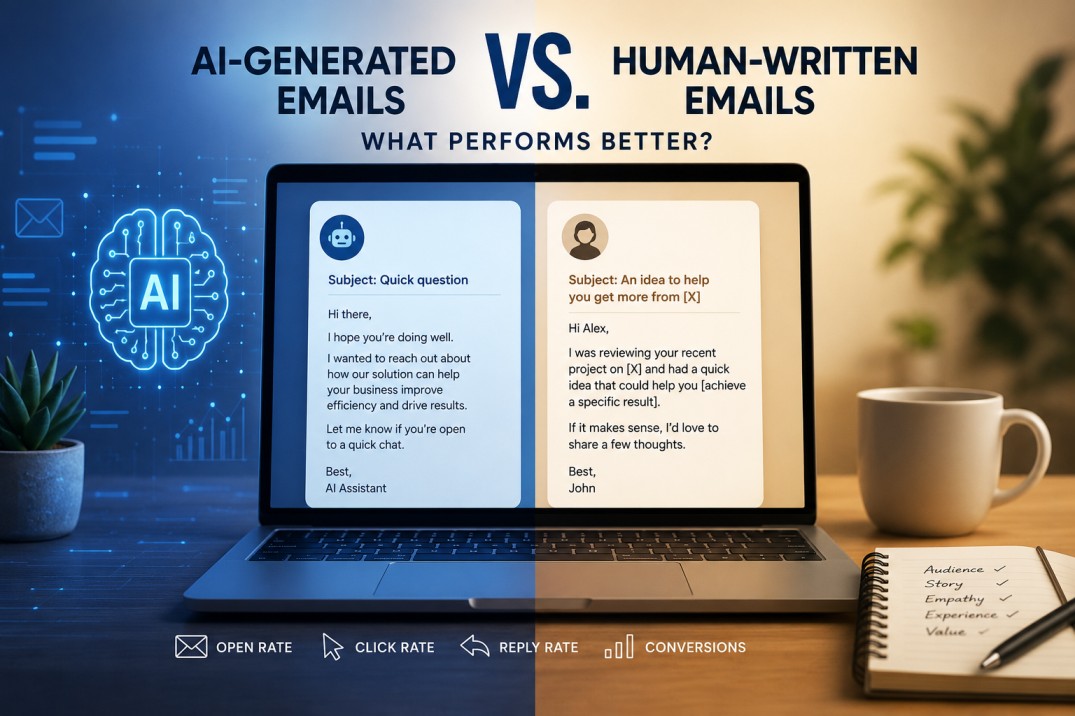
Email teams are having the wrong argument. They keep asking whether AI-generated emails are “better” than human-written emails, as if the answer sits inside the writing tool. Not really. A better question is this: when the reader does not know who wrote the email, which version makes them stop, trust the message, and click?
That is where the debate gets useful.
A fast AI draft can sound clean and still miss the buyer’s actual worry. A human-written email can feel warmer and still wander for 180 words before making a point. So, instead of treating this like a moral fight between machines and copywriters, let’s treat it like what it is: a performance question.
AI-generated emails are marketing emails drafted or assisted by artificial intelligence tools, usually to speed up subject lines, personalization, structure, and campaign production. The best results usually come when teams test AI output against human-written emails using opens, clicks, replies, conversions, spam risk, clarity, and brand fit rather than judging by tone alone. For most SaaS and content teams, AI works best as a scoring, drafting, and revision layer, while humans still own the offer, customer insight, and final judgment.
Email Teams Are Past the Experiment Stage
AI is already inside the email workflow. Some teams use it for subject lines, some for full drafts, and some only when the writer gets stuck.
McKinsey puts the possible productivity lift in marketing at 5 to 15 percent of total marketing spending, which makes sense. Email has endless small jobs: drafts, variants, segments, follow-ups, edits, and rewrites.
Still, faster writing does not mean a better email.
You can ship more campaigns and still get the same tired click rate. That is where AI-generated emails get risky: they can look clean enough to approve, while saying nothing a buyer would remember 20 seconds later.
So the test is not “can AI write?” Of course it can.
The better question is whether the email gives the reader a real reason to stop.
What AI-Generated Emails Reveal in a Blind Test
Comparing AI-generated emails with human-written emails by “vibe” is not enough. People say they like one version, then click another.
That is why a blind test helps. Hide the author, remove the bias, and judge the email as if it had to survive a normal inbox.
Would you open it? Would you click? Does the offer feel real, or does it sound like another polished message from a company trying too hard?
A blind test still has limits.
Your reader is busy, half-distracted, and probably scanning on autopilot. So treat the blind score as an early warning system, then let the live campaign settle the argument with opens, clicks, replies, and revenue.
The Four Metrics That Actually Decide the Winner
Open rate tells you whether the promise gets noticed. It does not tell you whether the email is good.
Click rate tells you whether the body connects curiosity to action. Even then, it can be distorted by list quality, offer strength, and timing.
Reply rate is more useful for sales and founder-led emails. A reply usually means the message felt specific enough to deserve human effort.
Conversion rate is useful, but it comes too late to save a bad send. Once the campaign is live, the list has already seen the weak version.
So check the draft before it leaves.
Read the subject line out loud. Then read the first sentence. If the email still sounds like it could have been sent by any brand to any list, stop there and rewrite it.
The same goes for the CTA. If the reader has to search for the next step, or the proof feels thin, the email is not ready for a real audience yet.
That is where one extra review step helps. You can run your email through an AI scorer before sending and catch weak spots while the draft can still be fixed.
The Trust Problem With AI-Generated Emails
People do not open brand emails with a clean slate anymore.
They have already seen too many AI-looking posts, fake personal openers, recycled ads, and “quick question” messages that go nowhere. Gartner’s 2026 consumer research backs that mood: among 1,539 U.S. consumers, 50 percent said they prefer brands to avoid GenAI in customer-facing messages, ads, and content. Another 61 percent often question whether everyday information is reliable, while 68 percent often wonder whether what they see is real.
That makes the bar higher for AI-generated emails.
The danger is not that every reader will detect AI line by line. Most will not bother. They will just feel the message is too smooth, too vague, or too detached from anything they actually care about.
And once that feeling appears, the CTA is already in trouble.
This matters even more in SaaS. Your buyers already see too many cold emails with the same rhythm: fake compliment, generic pain point, inflated promise, calendar link.
AI-generated emails can make that pattern worse when teams use them lazily. Yet, with a strong brief and a real review process, they can also make testing sharper and faster.
Where AI-Generated Emails Usually Win
AI is strong when the task is varied.
Need 20 subject line angles for a webinar? AI can help. Need a sharper version for CFOs, product leads, and agency owners? AI can help there, too.
It also performs well on structure. For example, it can shorten a rambling product update, pull the CTA closer to the top, or turn one general email into three clearer versions.
That matters for small teams.
A founder who would normally send one “good enough” announcement can test three angles: one focused on time savings, one focused on risk reduction, and one focused on revenue impact. As a result, the campaign becomes less dependent on one tired draft written at 11:40 p.m.
Where Human-Written Emails Still Beat AI-Generated Emails
Humans still win when the email depends on lived context.
A human marketer understands why a customer hesitates after the second demo. A founder knows the weird objection that never appears in survey data. A good copywriter hears the difference between “save time” and “stop losing Fridays to manual cleanup.”
That kind of texture is hard to fake.
AI-generated emails often sound fluent, but fluency can become a trap. The sentence works. The paragraph moves. Still, nothing in it proves that the sender understands the buyer’s day.
That is why human review should not be a pass for grammar. It should be a relevance pass.
Would this email make a busy reader feel seen, or would it feel like another smooth message from a company that wants something?
Which Email Would You Trust?
Same offer, different framing. The stronger version does not win because it sounds “more human.” It wins because it names a real moment the reader recognizes.
| Email situation | Weak AI-style version | Stronger human-edited version | Why the second one works better |
|---|---|---|---|
| New SaaS reporting dashboard | “Our new dashboard helps teams unlock insights, improve visibility, and make data-driven decisions faster.” | “Your weekly report should not require three exports and a Friday afternoon cleanup. The new dashboard pulls campaign spend, pipeline movement, and conversion notes into one view.” | It names the actual work pain instead of hiding behind broad marketing language. |
| Cold outreach to a busy founder | “I noticed your company is growing and wanted to share a solution that can help you scale more efficiently.” | “Looks like your team is hiring while still running founder-led sales. That usually creates a messy handoff problem before anyone calls it a process issue.” | It feels specific enough to earn a second look, without pretending to know everything. |
| Newsletter promoting a new guide | “In this guide, we share actionable strategies to help marketers improve email performance.” | “If your email looks clean but still gets ignored, the issue is probably not grammar. This guide shows where drafts usually lose the reader before the click.” | It gives the reader a sharper reason to care before asking for the click. |
A Better Testing Method for Your Team
Do not choose a winner by gut feel. Score the draft first, because the weak spots usually appear in the same four places: clarity, relevance, trust, and action.
Do not run one AI email against one human email and call it science.
Run clusters instead.
Can a reader understand the offer in 5 seconds?
If the value needs three paragraphs of setup, the email is already working too hard.
Does it name a real reader problem?
Generic pain points make AI and human copy fail in exactly the same way.
Does the claim feel earned?
Numbers, context, and plain limits usually beat oversized promises.
Is the next step obvious?
A strong email should make one action feel natural, not offer five possible exits.
Take one campaign and create three versions: a human-written control, an AI-generated email from the same brief, and a hybrid version where AI drafts but a human rewrites the insight, proof, and CTA.
Then split the list fairly.
Keep the same audience segment, send window, offer, sender name, and landing page. Otherwise, you are testing everything except the copy.
Test the hybrid draft, not only the pure AI draft. In many teams, the winning workflow is AI for speed and structure, then human editing for customer truth, proof, and restraint.
Next, score the emails before launch.
Give each version a 1 to 5 rating for clarity, relevance, proof, CTA, tone, and risk. After that, compare the pre-send score with actual opens, clicks, replies, and conversions.
This matters because the real value may not be “AI beats human.” It may be “AI helps us reject weak drafts faster.”
So, Who Actually Wins?
AI-generated emails win when the job is speed, structure, segmentation, and variation.
Human-written emails win when the job is judgment, lived customer knowledge, emotional accuracy, and knowing what not to say.
The strongest teams will not frame this as a cage match. Instead, they will build a workflow where AI produces options, scoring tools flag weak spots, and humans decide what deserves to reach the list.
That is less dramatic than “AI replaces copywriters.” However, it is far closer to how good marketing work actually happens.
If your email looks clean but says nothing specific, it will lose. If it sounds personal but takes too long to reach the point, it will also lose.
The winner is not the writer. The winner is the draft that understands the reader fastest.
What are AI-generated emails?
AI-generated emails are email drafts created or assisted by artificial intelligence tools, usually from a prompt, campaign brief, or existing message.
Teams use them for subject lines, outreach drafts, newsletters, product updates, follow-ups, and email variations for different audience segments.
Do AI-generated emails perform better than human-written emails?
Not always. AI-generated emails can help with speed, structure, and testing, but performance still depends on the offer, audience, timing, and message quality.
The best results usually come from testing AI drafts, human drafts, and hybrid drafts against real email metrics like opens, clicks, replies, and conversions.
What is the best way to test AI-generated emails?
The cleanest approach is to compare a human-written control, an AI-generated version, and a hybrid version using the same audience segment, offer, sender, and send window.
Blind scoring can help before launch, but the final decision should come from real campaign data.
Which email metrics matter most when comparing AI and human drafts?
Open rate, click rate, reply rate, and conversion rate all matter, but they answer different questions.
Open rate shows whether the subject line earned attention, while clicks, replies, and conversions show whether the body and offer were strong enough.
Why do some AI-generated emails feel weak?
Many weak AI-generated emails sound clean but lack real customer context, proof, urgency, or a clear reason for the reader to care.
They often fail because the message is too broad, too polished, or too close to a generic marketing template.
Should marketers use AI to write emails?
Marketers can use AI for drafting, scoring, rewriting, and testing variations, but the final email still needs human judgment.
The strongest workflow is usually AI for speed and structure, then human editing for customer insight, proof, tone, and restraint.

Andrej Fedek is the creator and one-person owner of three blogs: InterCool Studio, CareersMomentum, and Bettegi. As an experienced marketer, he is driven by turning leads into customers with White Hat SEO techniques. Besides being a boss, he is a real team player with a great sense of equality.