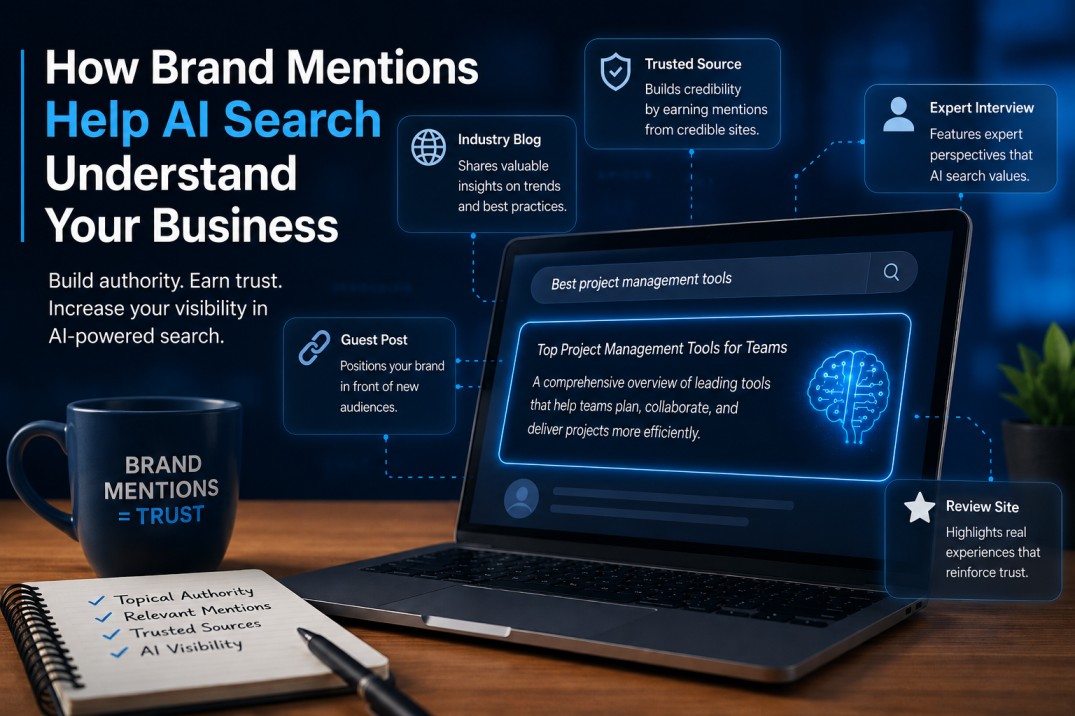
Search is changing. We’re moving from ten blue links to AI-powered answers. Platforms like ChatGPT, Perplexity, and Gemini are increasingly used by users to get quick, summarized, and contextual information — often without ever clicking a traditional search result.
That shift changes the way brands need to think about visibility. Ranking on Google still matters, but it is no longer the only place where discovery happens. If an AI tool summarizes a topic, recommends a company, or pulls information from trusted sources, your brand either appears in that conversation or it does not.
This is why AI visibility is becoming a serious part of modern SEO. It is no longer just about backlinks, keywords, or traffic.
It is also about whether your brand is mentioned, cited, and recognized across the web in places that AI systems can understand and trust.
AI visibility means making a brand easier for AI-powered search tools to recognize, understand, and reference when they generate answers. As users move from traditional search results to tools like ChatGPT, Perplexity, and Gemini, brands need more than rankings alone. They need useful content, clear topical authority, credible third-party mentions, structured data, and a consistent presence across trusted websites.
Guest posting can support AI visibility by expanding where and how a brand appears across the web. When a business is mentioned in relevant, high-quality content and connected to a clear niche, AI systems have stronger signals to understand what the brand does, who it serves, and why it may deserve to appear in AI-generated summaries, recommendations, or citations.
The New SEO Frontier: AI Visibility
If you want your website to be mentioned, cited, and referenced in these tools, you need to be where AI systems look for information. That’s where Posticy.com becomes your most powerful asset.
AI tools pull their knowledge from public web sources, Wikipedia, news outlets, and high-authority websites. If your content is being referenced or cited in these places, your brand is more likely to show up in AI-generated answers.
Unlike traditional SEO, where you optimize for page rankings, here you’re optimizing for citation, recognition, and credibility.
1. Build Topical Authority
AI systems favor websites that go deep on specific subjects. Instead of surface-level coverage across many topics, aim for:
- Topic clusters (pillar content + supporting articles)
- Consistent coverage of one niche
- Clear, structured, and educational language
Your goal is to become a known source in that domain.
2. Be Present on the Right Websites
To get visibility in AI results, being mentioned on high-authority websites is crucial. These include:
- News outlets
- Well-known blogs
- Educational or government domains
- Niche industry websites
One of the best ways to secure placements? Guest posting.
3. Use Posticy.com to Expand Your Digital Footprint
Posticy.com is a platform that helps you get published on real, high-quality websites across industries and languages. No middlemen, no agency fees – just direct collaboration between marketers and publishers.
With Posticy, you can:
- Build backlinks and brand mentions across credible domains
- Expand your entity footprint in the eyes of AI crawlers
- Increase your chances of being referenced in AI outputs like ChatGPT answers, Perplexity citations, or Gemini overviews
4. Use Schema and Structured Data
Just like with classic SEO, structured data helps AI understand your content better:
- Use Article, FAQ, and HowTo schema
- Mark up authors, reviews, and ratings
- Maintain consistency across your brand’s digital presence (social, About pages, etc.)
5. Think Beyond Clicks — Focus on Mentions
AI tools don’t always link — but they mention. This means your brand or website name needs to appear in trusted content:
- Write with a clear brand voice
- Include your business name naturally
- Be cited by others (case studies, partnerships, testimonials)
How Brand Mentions Support AI Search Visibility
AI search systems need context to understand what a business does. Your own website provides them with a single source of information, but external mentions can provide confirmation from other parts of the web.
When your brand appears in relevant articles, industry websites, publisher pages, interviews, guest posts, or partner content, it creates clearer associations between your name, your niche, and the topics you want to be known for.
AI search is already changing how people discover brands. McKinsey reported in 2025 that about half of surveyed consumers intentionally use AI-powered search engines, and many users now treat them as a top source when making buying decisions.
Semrush also found that Google AI Overviews appeared for 6.49% of keywords in January 2025, rose to nearly 25% in July, and settled around 15.69% in November 2025. That volatility shows why brands cannot rely only on classic rankings anymore.
There is also a click problem. Bain reported that around 80% of consumers rely on zero-click results in at least 40% of their searches, reducing organic web traffic by an estimated 15% to 25%. In plain terms, more answers are being consumed before a user reaches a website. For brands, that makes mentions, citations, and visibility inside trusted third-party content more important.
Final Thought
AI is not just a trend — it’s a new discovery layer that is quickly becoming mainstream. SEO professionals and marketers who adapt now will enjoy the benefits of early visibility.
Guest posting is no longer just about link building — it’s about shaping how AI sees your brand. Posticy.com gives you the placement power to be seen and cited in the AI tools that define the future of search. Don’t just optimize for Google — optimize for AI.
What is AI visibility in SEO?
AI visibility is the process of making a brand easier for AI-powered search tools to recognize, understand, and reference in generated answers.
It goes beyond traditional rankings by focusing on topical authority, trusted mentions, structured data, credible content, and clear brand signals across the web.
How is AI visibility different from traditional SEO?
Traditional SEO focuses mainly on ranking pages in search results, while AI visibility focuses on whether a brand is understood, mentioned, cited, or recommended by AI search systems.
Both still depend on quality content and authority, but AI visibility puts more emphasis on entity recognition, brand mentions, topical consistency, and trusted third-party references.
Do brand mentions help with AI search visibility?
Brand mentions can help AI search systems connect a business with a specific topic, niche, product, or service.
When those mentions appear in relevant and trusted content, they can strengthen the signals that help AI tools understand what the brand does and where it fits.
Can guest posting support AI visibility?
Yes, guest posting can support AI visibility when it places a brand in useful, relevant, and credible content across the web.
Platforms such as Posticy.com can help brands expand their digital footprint through publisher placements, which may support both traditional SEO and AI search visibility when used strategically.
What should brands focus on to appear in AI-generated answers?
Brands should focus on clear content, strong topical authority, consistent business information, structured data, relevant backlinks, and credible third-party mentions.
There is no guaranteed way to appear in AI-generated answers, but these signals can make a brand easier for AI systems to understand and reference.

Andrej Fedek is the creator and one-person owner of three blogs: InterCool Studio, CareersMomentum, and Bettegi. As an experienced marketer, he is driven by turning leads into customers with White Hat SEO techniques. Besides being a boss, he is a real team player with a great sense of equality.