For decades, customers have tolerated the monotony of DTMF-based phone menus—those frustrating “Press 1 for billing, Press 2 for support” loops. By 2026, these old-school systems are no longer just inconvenient—they are a major friction point in the customer experience.
Modern consumers expect interactions that feel natural, effortless, and fast. They want to speak their needs, get understood, and receive immediate solutions, all without waiting on hold.
This is where Conversational AI IVR and the AI Call Center Agent step in. Together, they replace rigid menus with intelligent, human-like interactions that can understand natural language, detect intent, and even interpret sentiment. While the AI Call Center Agent handles complex tasks or escalations seamlessly, Conversational AI IVR ensures that routine requests are resolved instantly, creating a zero-queue experience.
This combination not only improves efficiency but also elevates the overall customer experience, turning phone support into a strategic advantage rather than a source of frustration.
Conversational AI IVR replaces outdated phone menus with natural, AI-powered voice interactions that understand intent, reduce wait times, and resolve routine requests faster. In this guide, we explain how Conversational AI IVR improves customer experience in 2026, which providers stand out, what features matter most, and why businesses are adopting it to lower costs while delivering smarter support.
Table of Contents
- Top Conversational AI IVR Providers Transforming Customer Experience in 2026
- Key Features of Modern Conversational AI IVR Systems
- How Conversational AI IVR Transforms the Customer Experience
- The Business Case: ROI of Conversational AI IVR in 2026
- Implementation Strategy: Moving to Leading-Edge Conversational AI IVR
- Conclusion: Conversational AI IVR Makes Every Call Count
Top Conversational AI IVR Providers Transforming Customer Experience in 2026
The Conversational AI IVR market has matured rapidly. Enterprises now have multiple options, each excelling in specific areas such as scalability, AI intelligence, and ease of deployment. Here’s a detailed look at the top providers leading the charge in 2026.
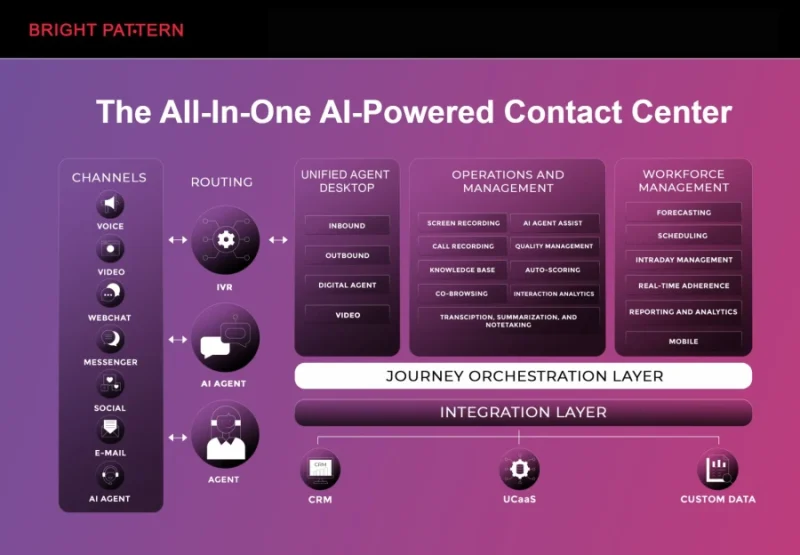
1. Bright Pattern: Leading Omnichannel Conversational AI IVR
Bright Pattern has become synonymous with enterprise-grade Conversational AI IVR. Its platform combines omnichannel automation with intelligent routing and robust analytics:
- True Persona-Based Routing – Bright Pattern uses AI to assess caller sentiment and intent, connecting them with the best-suited agent or bot. For example, a frustrated customer calling about a billing error can be immediately routed to a senior agent while routine inquiries are handled by an IVA.
- Unified Workspace Integration – Agents have a single pane of glass to monitor calls, chat, and social media messages. This reduces handoffs and creates seamless customer experiences.
- No-Code Deployment – Business teams can update IVR flows quickly, without relying on IT resources, making it easier to adapt to seasonal campaigns or regulatory changes.
Bright Pattern’s approach demonstrates how Conversational AI IVR can scale across multiple channels while keeping customer satisfaction high.
2. Ultimate AI: Precision-Focused Conversational AI IVR
Ultimate AI specializes in complex, multi-lingual intent recognition, making it ideal for global organizations:
- Intent Precision – Ultimate AI can parse multi-step requests accurately. For instance, a caller saying, “I want to check my balance and schedule a payment,” receives one streamlined response instead of navigating multiple menus.
- Deep CRM Synchronization – The system automatically updates customer records and triggers post-call workflows. This reduces manual data entry and accelerates follow-ups.
By focusing on precision and CRM integration, Ultimate AI positions itself as a platform that turns every IVR interaction into actionable insight.
3. Genesys Cloud CX: Scalable Global Conversational AI IVR
For enterprises with global operations, Genesys Cloud CX provides robust, scalable Conversational AI IVR:
- Global Scalability – Genesys Cloud CX manages high volumes of calls and interactions across regions, ensuring consistent service.
- Multilingual Capabilities – Supports multiple languages, allowing enterprises to offer seamless voice experiences to international customers.
- AI-Enhanced Analytics – Provides insights into call drivers, customer sentiment, and automation success rates.
This makes Genesys ideal for multinational corporations seeking a reliable, large-scale Conversational AI IVR solution.
4. Five9: Collaborative Conversational AI IVR for Human Agents
Five9 focuses on augmenting human agents rather than replacing them:
- Intelligent Virtual Agent (IVA) Collaboration – Five9’s IVAs handle repetitive tasks, like password resets or account lookups, while escalating complex issues to human agents.
- Seamless Handoffs – AI provides a summary of interactions to human agents, minimizing friction and customer frustration.
This approach reduces agent burnout while maintaining high-quality customer experiences.
5. Talkdesk: Proactive Conversational AI IVR for Self-Service
Talkdesk is designed for proactive, customer-centric automation:
- Self-Service Innovation – AI anticipates needs and offers solutions before callers ask. For example, if a customer calls during an outage, the system can provide updates and potential workarounds immediately.
- Integrated Knowledge Base – Combines AI with existing resources to answer complex questions quickly, reducing reliance on human agents.
Talkdesk exemplifies how Conversational AI IVR is evolving from reactive to proactive customer engagement.
Key Features of Modern Conversational AI IVR Systems
Modern Conversational AI IVR platforms offer far more than automated call routing. These features are critical for enhancing customer satisfaction, efficiency, and security:
- Advanced Natural Language Understanding (NLU) – Handles messy human speech and multi-intent queries. This allows users to say, “I need to pay my bill and update my address,” and get a single, streamlined response.
- Real-Time Sentiment Analysis – Detects emotions like frustration or confusion and routes callers to human agents when necessary, ensuring high-value interactions receive extra care.
- Voice Biometrics & Security – Replaces outdated security questions with secure, frictionless voice verification, reducing the risk of fraud.
- Continuous Contextual Memory – Retains information from prior interactions across channels—calls, chats, emails—so customers never need to repeat themselves.
These capabilities highlight why Conversational AI IVR has become indispensable for forward-thinking customer experience strategies.
How Conversational AI IVR Transforms the Customer Experience
The true power of Conversational AI IVR lies in its ability to elevate every customer interaction from transactional to thoughtful and personalized. Modern AI-driven voice systems are no longer just tools for routing calls—they actively enhance the customer journey in meaningful ways:
- Eliminating Hold Times – Traditional call centers often struggle with long queues during peak hours, leaving customers frustrated and impatient. Conversational AI IVR enables a near 1:1 support ratio by handling routine inquiries automatically, ensuring callers get instant assistance. Even during unexpected surges in traffic, the system adapts, significantly reducing wait times and improving first-contact resolution.
- Hyper-Personalization – By analyzing real-time data, previous interactions, and customer preferences, Conversational AI IVR can suggest the “Next Best Action” tailored to the individual. For example, a returning caller might be offered a loyalty reward, an account update, or a personalized solution for a previously reported issue. This level of personalization creates an experience that feels intuitive and anticipates the customer’s needs rather than simply responding to them.
- Empathetic Transitions – Even when AI cannot fully resolve an issue, it ensures the human agent who takes over has all the necessary context. The AI generates a concise summary of the caller’s history, current concerns, and emotional tone, so the agent can address the problem efficiently without requiring the customer to repeat themselves. This seamless handoff builds trust, demonstrates attentiveness, and maintains a high level of customer satisfaction.
By combining instant support, intelligent personalization, and empathetic handoffs, Conversational AI IVR transforms the customer experience into one that is not only efficient but also thoughtful and human-centric. Each call becomes an opportunity to strengthen the relationship between the brand and its customer, making interactions feel intentional, engaging, and truly seamless.
The Business Case: ROI of Conversational AI IVR in 2026
Beyond improving customer satisfaction, Conversational AI IVR drives tangible business outcomes:
- Reducing Cost-Per-Call – By automating 70–80% of routine inquiries, businesses save significantly on labor costs while maintaining quality.
- Mitigating Agent Burnout – Freeing agents from repetitive tasks allows them to focus on complex, meaningful problem-solving, improving employee retention.
- Voice Data Mining – Every interaction is recorded, transcribed, and tagged to generate actionable insights. Companies can identify trends, optimize processes, and improve products or services.
The result is a measurable return on investment, combining lower operational costs with higher customer loyalty.
Implementation Strategy: Moving to Leading-Edge Conversational AI IVR
Adopting Conversational AI IVR requires careful planning to maximize benefits while minimizing disruption:
- AI-First Migration – Gradually replace touch-tone menus with AI-driven experiences while maintaining business continuity. Begin with high-volume, low-complexity inquiries before expanding to more complex scenarios.
- Training Your AI – Human-in-the-loop feedback is critical. Regular review of AI responses ensures accuracy, relevance, and customer satisfaction.
- Compliance & Ethics – As voice data is sensitive, organizations must ensure GDPR, CCPA, and other regional privacy regulations are met, maintaining transparency and trust.
A structured strategy ensures a smooth transition and positions Conversational AI IVR as a long-term competitive advantage.
Conclusion: Conversational AI IVR Makes Every Call Count
By 2026, Conversational AI IVR has fundamentally transformed the phone channel, evolving it from a traditional cost center into a powerful driver of customer loyalty and engagement. No longer just a tool for routing calls, modern AI-powered IVR delivers faster resolutions, intelligent personalization, and empathetic interactions that make every customer feel heard and valued. At the same time, human agents are freed from repetitive tasks, allowing them to focus on complex problem-solving and high-value interactions, which increases job satisfaction and overall team performance.
The “Press 1” era is officially behind us. Today, voice is no longer a rigid menu—it is a dynamic conversation. Conversational AI IVR enables businesses to understand customer intent, anticipate needs, and provide solutions proactively, creating a frictionless experience across every touchpoint. Organizations that embrace this technology are not only improving operational efficiency; they are building long-term customer trust, enhancing brand reputation, and unlocking new avenues for growth.
In a world where expectations for instant, intelligent service are higher than ever, Conversational AI IVR is no longer optional—it’s essential. By turning every call into a meaningful interaction, companies can strengthen relationships, foster loyalty, and position themselves as true leaders in customer experience.
What is Conversational AI IVR?
Conversational AI IVR is an intelligent voice response system that understands natural language instead of forcing callers through traditional press-1 phone menus.
It can recognize intent, respond more naturally, and help customers solve routine issues faster with less friction.
How is Conversational AI IVR different from traditional IVR?
Traditional IVR depends on rigid touch-tone menus and fixed call flows, while Conversational AI IVR allows callers to speak naturally.
The AI can understand intent, detect sentiment, and guide callers toward faster, more relevant resolutions.
What are the main benefits of Conversational AI IVR?
The main benefits include shorter wait times, faster self-service, better routing, more personalized support, and lower operational costs.
It also helps reduce agent burnout by automating repetitive requests and passing complex cases to human agents with context.
Which features should businesses look for in a Conversational AI IVR platform?
Businesses should look for strong natural language understanding, sentiment analysis, CRM integration, contextual memory, analytics, and secure caller authentication.
These features help create smoother voice experiences while improving efficiency and compliance.
Can Conversational AI IVR replace human agents completely?
No, the best use of Conversational AI IVR is usually to automate routine tasks and support human agents rather than fully replace them.
Complex or sensitive issues still benefit from human judgment, especially when empathy and problem-solving are required.
Why are companies investing in Conversational AI IVR in 2026?
Companies are investing in Conversational AI IVR because customers expect faster, more natural support and businesses need to improve efficiency at scale.
In 2026, AI-powered voice systems are helping brands reduce cost-per-call, improve customer satisfaction, and turn phone support into a competitive advantage.

Andrej Fedek is the creator and the one-person owner of two blogs: InterCool Studio and CareersMomentum. As an experienced marketer, he is driven by turning leads into customers with White Hat SEO techniques. Besides being a boss, he is a real team player with a great sense of equality.