Collect customer feedback before another customer disappears without saying a word.
That happens more often than most businesses admit. Someone struggles with the checkout, cannot find an answer, waits too long for support, and then leaves. You may see the abandoned cart or the canceled subscription later, but not the reason behind it.
We have all filled those gaps with guesses. Maybe the price was too high. Maybe the offer was unclear. Maybe the product simply was not right for them. Sometimes that is true. Sometimes one small, fixable problem caused the whole thing.
Customer feedback tools help you get closer to the real answer. You do not need to survey people after every click, either. A well-placed question, a quick call, or a simple feedback button may be enough.
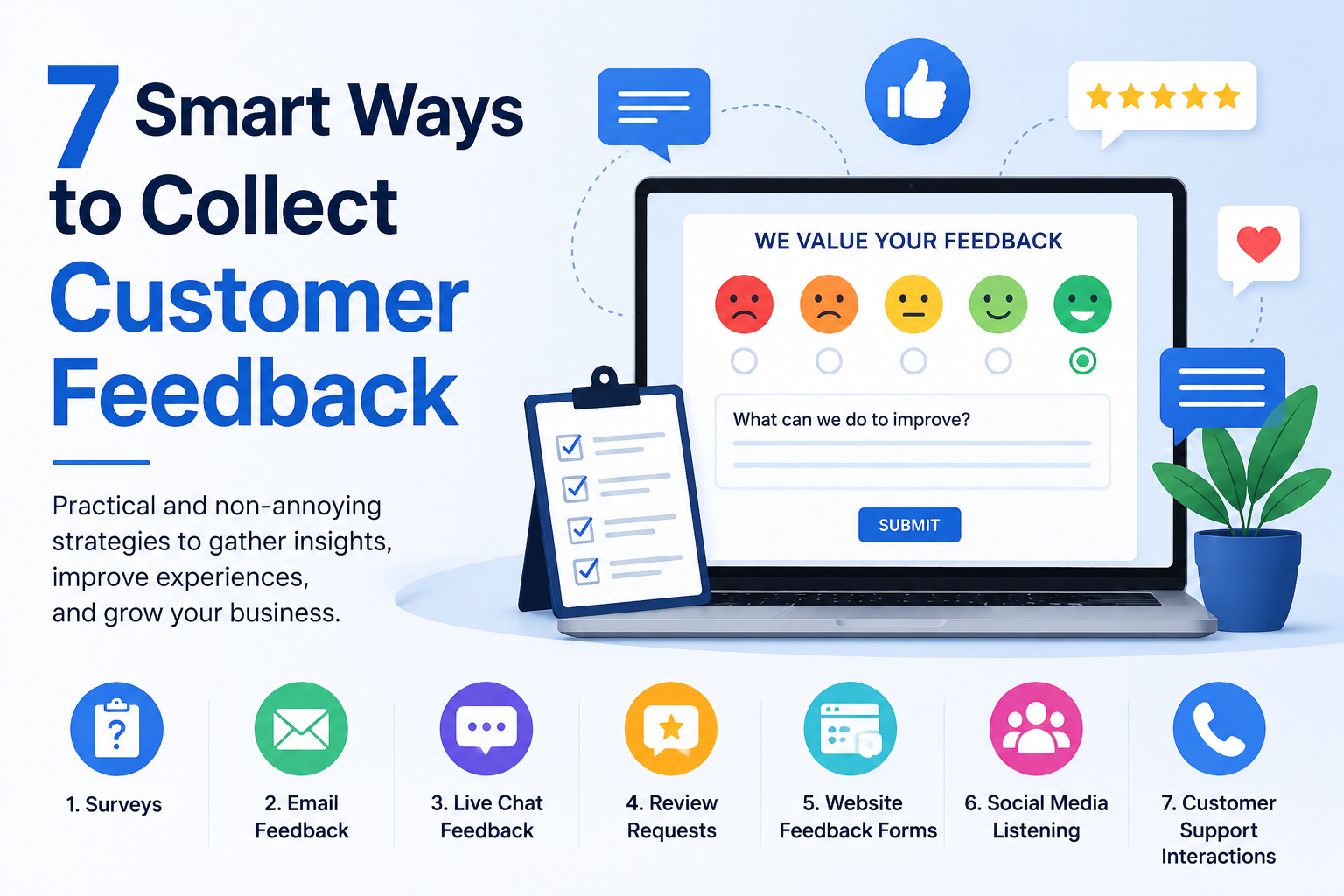
The next seven methods give customers several ways to tell you what happened, without making them work for it.
Customer feedback can be collected through long-form surveys, short in-app surveys, website feedback buttons, phone calls, direct conversations, social media monitoring, and usability tests. The best method depends on where customers interact with the business and how much detail is needed, but the process works best when requests are timely, brief, and respectful of the customer’s time.
Why Does Your Business Need to Collect Customer Feedback?
Customer feedback tools help you collect comments, complaints, ratings, and suggestions in one place instead of piecing them together from emails, support chats, and social media.
Metrics are great for understanding your audience’s interests and reactions, but they’re still just numbers. The reasons behind those metrics could easily be due to factors that weren’t directly related to how customers received your product or service.
Instead of blindly assuming your Google Analytics results have all the answers, why don’t you give customers the chance to communicate feedback in their own words? Here are seven reasons why brands should take feedback collection seriously.
- Truly improved products and services. One of the most memorable examples is the launch of a reimagined soft drink known as New Coke. The Coca-Cola brand granted little importance to surveying its customers, relying only on its metrics instead. As a result, the release led to a sales disaster, which forced the brand to return to its classic cola formula.
- Scalable satisfaction. Sales numbers can be good indicators of your success, but without learning what exactly the customers liked about the product or service, it’ll be hard to scale it. Learning directly from real customers what particular features make you different from your competitors avoids guesswork and helps you outline meaningful updates and improvements.
- Stronger customer relationships. As buyers, it feels good to be asked what we want to be different in an offer. Even if you simply make an Excel form for your customers to fill out and send back with their responses, it’ll be enough to make them feel important. However, if you request their feedback harshly, it can turn around and paint you as annoying, so don’t be too pushy.
- Easier customer retention. Brands that consider their customers mere numbers might lose their customer base quickly and go out of business. On the other hand, those that treat them genuinely and listen to their feedback build lasting relationships. Clients who feel heard and cared for will justify price increases just to keep receiving your products or services, making customer retention much easier.
- More new customers. Word of mouth travels quickly, and if the talk is positive, new customers will want to join the satisfied buyers. Most people won’t make a purchase without checking online reviews, so displaying honest positive feedback is likely to attract more customers. Meanwhile, you should make sure not to fake the reviews, as they might have side effects.You should add reviews to product pages or the homepage so potential customers can see social proof and gain confidence in your products before making a purchase.
- Well-informed customers. Maybe you’ve stated all the steps on how to use your product or service in your brochures, but the firsthand experiences of your customers are valuable for specific cases you might not have covered. People will be browsing for extra information, and discovering that another real person has used this product in similar circumstances will make it easier for them to do so too.
- Smarter decisions. When businesses take the time to talk to customers, they receive feedback that can be leveraged to make better-calculated decisions in every aspect. Customer feedback helps you improve your offers and acquire new customers without drastically losing revenue or testing offers that are likely to flop.
- Customer Service Outsourcing. Customer service outsourcing is a way of providing customer service without needing an in-house team. Outsourcing can be a cost-effective solution for many companies, and it can also help them to focus on their core business. It is important to note that outsourcing customer service does not mean the company will lose control of its customer experience. They can still have a say in what happens and how it happens, but they will have to work with a third party instead of doing everything themselves.
Less than one-third of consumers give feedback directly to a company after a good or bad experience. Many tell friends or family instead—or say nothing at all.
Consumers pointed to service delivery problems in 46% of bad experiences, followed closely by communication problems at 45%.
PwC found that 52% of consumers had stopped buying from a brand after a bad experience with its products or services.
Another 29% said poor customer experience—online or in person—had caused them to stop using or buying from a brand.
Zendesk reports that three in four consumers will spend more with businesses that provide a good customer experience.
After learning about the benefits of collecting customer feedback, let’s explore some of the best non-annoying ways to do it.
The Seven Best Ways to Obtain Customer Feedback
Customers feel valued when a company listens to their feedback. Research from American Express indicates that they are willing to pay 17% more for businesses that provide excellent customer service.
However, they prefer to provide feedback through various channels, such as email (62%), phone calls (48%), live chat (42%), and online forms (36%). Seven of the most popular ways to request feedback include:
1. Long Form-Based Surveys
Surveys are probably the first method that comes to your mind when thinking about customer feedback. Long form-based surveys can easily be built with tools like SurveyMonkey, and they allow you to ask customers questions about their experiences using your product.
Don’t overdo it by asking too many questions or requiring ultra-detailed answers. Ten is the maximum appropriate number of questions for a survey that generates satisfactory results.
“Implementing, for example, a Salesforce survey can be an effective tool to gather insights about customer experiences and satisfaction levels. This integrated survey tool can help streamline data collection and simplify customer feedback management. However, it is important to remember to not overwhelm your respondents; a maximum of ten well-crafted questions can typically yield comprehensive and satisfactory results.”
Mix detailed questions with simple ones and combine open-ended and closed-ended questions to make the survey seem shorter than it actually is. Before collecting personal information from your customers, make sure to state this in your privacy policy to comply with the law and avoid legal issues. Using HIPAA compliant survey tools can help you ensure that you are collecting and storing sensitive information securely.
2. Short In-App Surveys
Apps need constant improvement, too. If your customers use an application for your services, that’s the best place to show short surveys and gather feedback about their experiences. In-app surveys can be made mandatory by interrupting the user experience and offering small rewards to incentivize customers.
You can present these surveys at any time, but the most optimal moments are precisely after implementing a new feature. Customers will be fresh with either satisfaction or frustration, and it’s best to capture that reaction before it’s gone because it’ll be an honest one. In this matter, when you add last-mile delivery to your efforts, survey users right after implementation to capture their authentic reactions while the experience is still fresh and honest.
3. Feedback Button
Don’t underrate the use of a built-in feedback button that pops up on the side of a webpage. It’s one of the best ways to lure your customers into leaving feedback because it resembles a feature, and when one is navigating a website, they want to check all the features. Another way to show all of those features off is by adding them to a changelog by using free changelog tools.
Plus, in most cases, when customers are searching for information, they’re likely to visit your webpage, and if the feedback button shows up there, they’re likely to express what they are struggling to find. Written feedback is more useful for certain products compared to the verbal feedback you can get by recording phone calls and studying them.
4. Phone Calls
Verbal feedback is the most authentic type of feedback, but it’s also the hardest to get without appearing intrusive. That’s because the traditional way of gathering such feedback is by phone, which can easily annoy customers (especially those who receive promotional calls from other businesses daily).
However, when you manage to get in touch with customers who use your product and care about improvements, they’re likely to listen to what you have to say. That is when you might want to start a virtual call center that can streamline this process. As long as you minimize their waiting time during a call (call-routing software helps), ask genuinely without sounding like a sales agent, and call during an appropriate time, you’ll get results.
5. Reach Out Directly
In-person meetups with your customers take more time than other methods, but they show a different level of attention to your customers, prompting them to give useful, real feedback. Not every company performs direct surveys on its user base, and that’s what will make them feel different and special.
When you reach out directly to your customers, the feedback you’ll gather is much more useful and closer to the truth because you can verify it by seeing their facial expressions and body language. For instance, you will notice whether your product is truly sophisticated or whether clients lack the general knowledge needed to use it.
6. User Activity
Most of the time, you can gather feedback without asking for it if you’ve put your brand in the middle of an audience of users. Social media offers just this. By monitoring your user activity, you’ll see how customers express their opinions in comment sections or by messaging. If you’re using social media to gather feedback, a messenger app for Windows makes it easier.
Social media platforms like Instagram, Facebook, and Twitter may be the first point of contact your customers recall when they want to complain about an issue or express concerns about a feature. From there, you can either send them to complete more detailed survey templates about their experiences or gather their feedback on the spot.
7. Usability Tests
The first-time impression and usability of your product from an inexperienced user provides plenty of useful feedback you can act on. That’s because they show whether the product is easy to navigate intuitively or needs extra guidance materials. At this point, it’s important to select users who match your ideal customers to ensure relatable feedback.
Such tests are usually distributed to independent platforms that employ experienced testers, but you can ask them to pick users with the features of your ideal customers. They’re quick to identify which features are worth keeping.
Conclusion
When you’re not fully sure about the implementation of a new feature, or you want to maximize the ROI of your investments, collecting customer feedback should be one of your main priorities. Whether you decide to use phone calls, surveys, feedback buttons, or usability tests, reach out directly, or monitor user activity on social media, respect your customers’ time, and they’ll help make your brand better. You can also collect customer feedback through multiple channels, since not every customer prefers the same way to respond.
The easiest way to collect customer feedback is to ask at the right moment and keep the process simple.
What is the best way to collect customer feedback?
The best method depends on where customers interact with your business and how much detail you need.
Short surveys, feedback buttons, phone calls, social media comments, and usability tests can all work well when you use them at the right moment.
How often should you ask customers for feedback?
Ask when the customer has enough experience to give a useful answer, such as after a purchase, support conversation, completed task, or product update.
Repeating the same request too often can reduce response rates and make the feedback less thoughtful.
How can you collect customer feedback without annoying people?
Keep the request short, explain why you are asking, and place it close to the experience you want the customer to review.
Give customers a clear way to skip the request and avoid interrupting important tasks with long or mandatory surveys.
What questions should you ask in a customer feedback survey?
Ask about the part of the experience you can actually change, such as ease of use, product quality, support, checkout, delivery, or missing information.
A mix of rating questions and one open-ended question usually gives you both measurable data and useful context.
What should you do after collecting customer feedback?
Group similar comments, look for repeated problems, and compare the feedback with support tickets, sales data, and user behavior.
Focus first on issues that affect many customers or block purchases, signups, renewals, or other important actions.

Andrej Fedek is the creator and one-person owner of three blogs: InterCool Studio, CareersMomentum, and Bettegi. As an experienced marketer, he is driven by turning leads into customers with White Hat SEO techniques. Besides being a boss, he is a real team player with a great sense of equality.