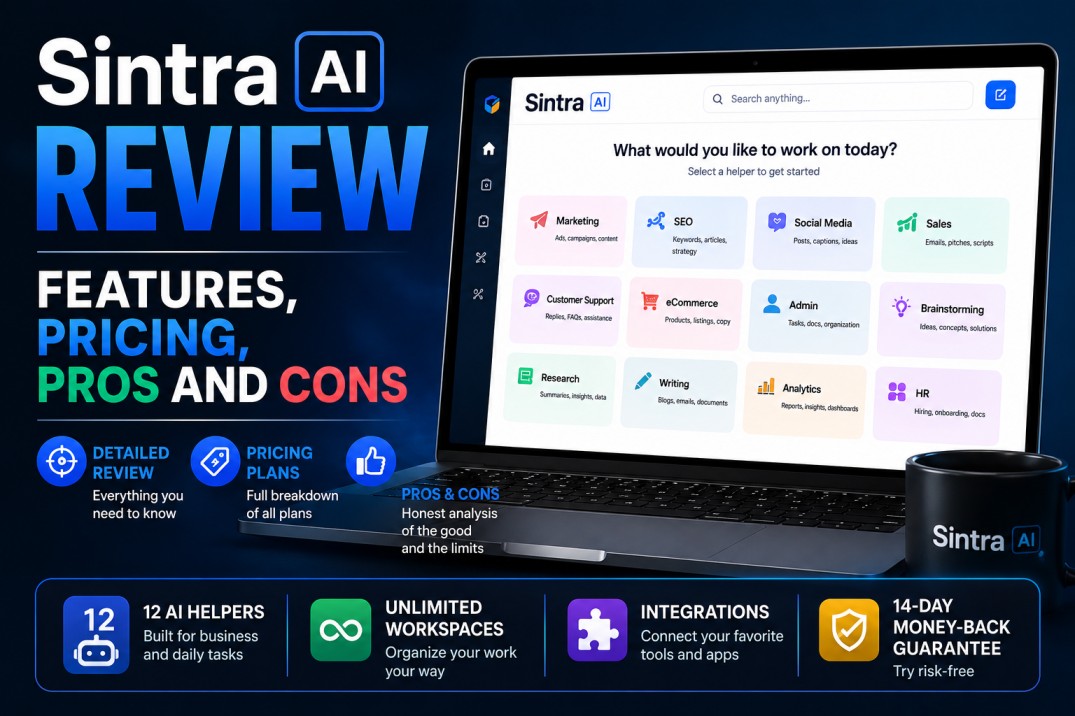
Most business owners do not need another tool that only gives them more tabs to manage. They need help with the small repeat jobs that keep piling up: emails, social posts, customer replies, research, product descriptions, support notes, campaign ideas, and all the unfinished tasks that sit between “I should do this” and “this is actually done.” That is a useful way to look at Sintra AI.
It is not a replacement for a real team member, and it should not be judged that way. It is better viewed as a business workspace with different AI helpers for common tasks.
This Sintra AI review looks at where the platform can save time, where it can feel limited, and who is most likely to get value from it.
Sintra AI is a business-focused AI platform with different helpers for tasks like marketing, SEO, social media, sales, support, admin work, and eCommerce. This Sintra AI review finds that it is most useful for small teams, solo founders, creators, and service businesses that need help turning repeat tasks into drafts, plans, and usable first versions. It is less useful if you expect deep custom automation, advanced technical control, or a tool that can fully replace human judgment.
What Is Sintra AI?
Sintra AI is a platform where you can work with different AI helpers for different business tasks.
Instead of opening one blank chat box and writing every prompt from scratch, you choose the type of help you need. One helper may be better suited for SEO work, another for social media, another for sales, another for support, and another for admin tasks.
That structure is the main point.
A lot of small business owners do not want to learn prompt writing. They just want help finishing work faster. Sintra AI tries to make that easier by giving each task a clearer starting point.
It also includes a business memory feature, which is meant to keep context about your company, audience, offer, and tone. In practice, that matters because repeating the same background information every time is one of the most annoying parts of using AI tools.
Who Sintra AI Is Best For?
Sintra AI makes the most sense for people who already have too many small tasks and not enough hands.
That could be a solo founder trying to manage content, sales follow-ups, customer replies, and basic operations. It could be a consultant who needs help turning ideas into emails, posts, outlines, and client notes. It could also be a small agency that wants faster first drafts without hiring another person for every small job.
The platform is also a good fit for people who want AI support but do not want to build their own custom agents or automation systems.
That does not mean Sintra AI is the right choice for every team.
If you already have developers, internal workflows, strict approval systems, and advanced automation needs, you may find it too packaged. Sintra AI is built more for practical daily business support than deep technical control.
These numbers show why tools like Sintra AI are getting attention, but also why small businesses still need to check trust, output quality, and real workflow fit.
McKinsey estimates that generative AI could increase marketing productivity by 5 to 15 percent of total marketing spending.
Source: McKinseyMicrosoft reported that 75 percent of knowledge workers were already using AI at work, with many adopting it quickly.
Source: Microsoft Work Trend IndexSalesforce reported that 91 percent of small and medium businesses using AI said it helped boost revenue.
Source: SalesforceHubSpot says more than 80 percent of marketers report using AI for content creation, including email copy.
Source: HubSpotGartner reported that half of U.S. consumers prefer brands that avoid GenAI in consumer-facing messages, ads, and content.
Source: GartnerWhat Sintra AI Does Well
Sintra AI is useful when the task is clear but still takes time.
Writing a first email draft. Turning one idea into several social posts. Outlining a blog article. Summarizing customer questions. Creating product copy. Preparing simple sales messages. Finding angles for a campaign.
These are the kinds of jobs where the tool can help.
The value is not that every output will be ready to publish. It usually will not be. The value is that you are no longer starting from an empty page.
That is where Sintra AI feels practical. It gives you a draft, a structure, or a direction. Then you edit it, correct it, and make the final call.
For small teams, that can still save a lot of time.
The Helper-Based Setup
The helper-based setup is probably the easiest part of Sintra AI to understand.
You do not need to think too hard about which prompt to write first. You pick the helper that matches the job and start there.
That sounds simple, but it helps.
A general AI chat can do many things, but it also puts more pressure on the user. You have to explain the role, the task, the format, the tone, and the context. Sintra AI removes some of that setup by organizing the experience around business roles.
It is not a perfect system, but it is easier for beginners.
For someone who already uses AI every day and writes strong prompts, this may not feel special. For someone who keeps opening AI tools and then giving up after two vague answers, the guided setup can make the difference.
Sintra AI Features
The main feature is the collection of task-based AI helpers.
That includes support for areas such as SEO, content, social media, sales, customer support, eCommerce, HR, admin tasks, and data work. The exact value depends on what you actually need to do each week.
The business memory feature is also important. If the platform keeps useful context about your business, it can reduce the amount of repeated explanation needed before each task.
Sintra also promotes integrations, which matter because business work rarely happens inside one tool. If you plan to use Sintra AI seriously, check the integrations that matter for your own workflow before you subscribe.
Pricing and credits also deserve attention.
Sintra’s pricing page mentions monthly credits, and that means usage can matter. A light user may never think about credits. A heavier user working across several brands or daily tasks should test how quickly those credits are used.
Where Sintra AI Can Save Time
Sintra AI can save time in the messy middle of daily work.
That is the space between having an idea and turning it into something usable.
For example, a founder may know they need to promote a new feature but still need the email, social posts, landing page notes, and customer reply templates. Sintra AI can help create those first versions faster.
A store owner may need product copy, customer support answers, shipping update messages, and promotional posts. Again, the tool can help turn scattered work into something more organized.
A consultant may need client follow-ups, proposal notes, LinkedIn posts, and rough article outlines. Sintra AI can help with that, too.
The tool is strongest when you give it a real task, not a vague request. “Write me some marketing content” will probably produce average work. “Turn this product update into a short email for existing customers who care about reporting speed” gives it a much better chance.
Where Sintra AI Falls Short
Sintra AI still needs a human editor.
That is the part people should not skip. The tool can help produce drafts and ideas, but it does not truly know your customer, your market, or the exact risk behind a bad message.
It may sound confident when it should be careful. It may use broad claims. It may make copy too smooth. It may miss the detail that a real customer would care about.
That is not unique to Sintra AI. It is a normal problem with AI writing tools.
You should be especially careful with anything that affects trust: pricing claims, legal language, health or finance topics, refund policies, customer complaints, and brand-sensitive messages.
Sintra AI can speed up the work, but it should not be the final approval step.
Sintra AI Pricing
Before paying for Sintra AI, look at how you plan to use it.
Do you need it once or twice a week for content ideas and drafts? Or do you want it involved in daily operations, support, sales, and marketing? That difference matters.
Let’s take a look at the current pricing.
| Plan | Current monthly price | Listed regular price | Best fit | What to watch |
|---|---|---|---|---|
| 1-Month Plan | $48.50/month | $97/month | Best for testing Sintra AI without committing to a longer billing period. | The monthly price is higher, so it makes sense only if you want a short trial period. |
| 3-Month Plan | $23.60/month | $59/month | Best for users who want enough time to test Sintra AI with real business work. | You still need to check whether the monthly credits are enough for your actual usage. |
| 12-Month Plan | $15.60/month | $52/month | Best for users who already know they want to use Sintra AI regularly. | The monthly price is lowest, but you are committing to the longest billing period. |
The pricing may look simple at first, but credits and usage limits can change the real value. A plan that works for one founder may feel tight for a small team using it every day.
The best way to judge the price is to test Sintra AI with real work.
Use it for one campaign, one SEO task, one support task, one sales message, and one admin task. Then ask a simple question: did this save enough time to justify the cost?
That answer is more useful than reading another feature list.
Pros and Cons
Sintra AI is not hard to understand, and that is one of its better points. It is built for people who want help with business tasks, not for users who want to spend half the day setting up prompts.
Sintra AI can help with repeat business tasks, but it still needs review, context, and clear instructions to produce useful work.
| Pros | Cons |
|---|---|
| Easy to use if you want task-based help instead of starting from a blank chat box. | The output still needs editing, especially for customer-facing content. |
| Useful for repeat work across marketing, support, sales, admin, SEO, and content. | It may feel too packaged for technical teams that need custom workflows or deeper automation. |
| The helper-based setup makes it easier to choose where to start. | The credit system is worth watching if you plan to use it heavily every day. |
| Good fit for solo founders, creators, consultants, and small teams that need faster drafts and planning support. | It should not be treated as a replacement for human judgment or real business experience. |
| Can reduce blank-page work when you need emails, posts, outlines, product copy, or support replies. | Some drafts may sound too general if the task is vague or the business context is weak. |
The simple trade-off is this: Sintra AI gives you structure and speed, but not full control. If you want quick business support, that can be enough. If you need advanced automation or deeply customized processes, it may feel limited.
Is Sintra AI Worth It?
Sintra AI is worth considering if you run a small business and spend too much time on repeat communication and content tasks.
It is not the kind of tool I would judge by one quick prompt. You need to test it against the work that actually slows you down.
Use it for emails, support replies, campaign ideas, product copy, social posts, and planning notes. Then compare the result with your normal workflow.
If it helps you move faster and the drafts are easy to edit, it can earn its place.
If you spend more time fixing the output than you would have spent writing from scratch, it is not the right fit.
Final Verdict
Sintra AI is a practical AI workspace for small business tasks.
Its strongest point is the organized helper setup. Instead of forcing users to start from zero every time, it gives them clearer places to begin.
That can be useful for founders, creators, consultants, small agencies, and store owners who need help with routine work.
This Sintra AI review would not describe it as a replacement for a real employee. That creates the wrong expectation.
A better way to see it is as a support layer for everyday business work. It can help you draft, organize, rewrite, and plan faster.
You still need to know what good work looks like.
But if you already have that judgment and only need a faster starting point, Sintra AI is worth testing.
What is Sintra AI?
Sintra AI is a business-focused AI platform with different helpers for tasks such as marketing, SEO, social media, sales, customer support, admin work, and eCommerce.
Instead of starting with a blank chat box every time, users can choose a helper that matches the type of work they want to complete.
Is Sintra AI good for small businesses?
Sintra AI can be useful for small businesses that need help with repeat tasks, first drafts, planning notes, social posts, email ideas, support replies, and basic content work.
It is most useful when the user already understands the business and needs a faster starting point, not a tool that makes every decision alone.
Can Sintra AI replace an employee?
No, Sintra AI should not be treated as a full employee replacement. It can help with drafts, ideas, organization, and routine business tasks, but it does not replace human judgment.
Important work still needs review, especially customer-facing content, pricing claims, support messages, legal language, and brand-sensitive communication.
What tasks can Sintra AI help with?
Sintra AI can help with marketing copy, SEO ideas, social media posts, email drafts, product descriptions, customer support replies, sales messages, admin notes, and simple planning tasks.
The quality depends on how clear the task is and how much useful business context the user provides.
Is Sintra AI better than ChatGPT?
Sintra AI is not simply better or worse than ChatGPT. It is more structured around business helpers, while ChatGPT is broader and more flexible.
Sintra AI may feel easier for users who want guided business support, while ChatGPT may suit people who already know how to write detailed prompts and build their own workflow.
Is Sintra AI worth it?
Sintra AI may be worth it for founders, creators, consultants, and small teams that spend too much time on repeat communication, content, planning, and support tasks.
The best way to judge it is to test it with real work for your business and see whether the drafts save time after editing.

Andrej Fedek is the creator and one-person owner of three blogs: InterCool Studio, CareersMomentum, and Bettegi. As an experienced marketer, he is driven by turning leads into customers with White Hat SEO techniques. Besides being a boss, he is a real team player with a great sense of equality.