Imagine being able to predict when a customer might churn before they even think about leaving. That’s what SaaS customer relationship management does: it lets you see the entire customer journey as an evolving story instead of a spreadsheet.
You’re not just managing users anymore. You’re nurturing relationships that renew themselves. So, how exactly does SaaS CRM create that kind of magic? Let’s explore.
This article defines SaaS customer relationship management, explores how it drives the SaaS customer journey, and reveals why engagement determines long-term revenue. It uses real statistics, examples, and a stylish responsive table to show how SaaS CRM tools elevate customer success and retention.
Table of Contents
- What SaaS Customer Relationship Management Really Means
- How SaaS CRM Transforms the Customer Journey and Engagement
- Key Stages of the SaaS Customer Journey
- Real-World Example: Turning Data into Renewal
- CRM-Driven Renewal Rates
- Why SaaS Customer Engagement Defines Profitability
- What SaaS Management Really Involves
- Measuring the ROI of SaaS CRM
- The Human Side of SaaS CRM
- Conclusion
What SaaS Customer Relationship Management Really Means
SaaS customer relationship management is cloud-based software that helps subscription businesses track, analyze, and improve every customer interaction, from acquisition to advocacy.
According to Gartner, over 91% of companies with more than 11 employees now use CRM systems, and the vast majority are cloud-based SaaS tools. (Gartner Research)
This model allows you to centralize customer insights, automate follow-ups, forecast renewals, and uncover churn risks—all without on-premise complexity.
In other words, SaaS CRM isn’t just software—it’s your organization’s nervous system.
How SaaS CRM Transforms the Customer Journey and Engagement
Think of your customer journey as a film reel. Awareness, onboarding, engagement, renewal, referral—each stage is a frame.
A SaaS CRM connects those frames, letting you watch the whole movie instead of isolated clips. That’s where SaaS customer relationship management shines: it turns disconnected actions into one coherent narrative.
Studies by McKinsey & Company show that companies using advanced customer relationship analytics outperform competitors by 126% in profit growth.
The reason? Data visibility equals strategic empathy.
Key Stages of the SaaS Customer Journey
Here’s a visual roadmap of how most subscription brands evolve their relationships:
| Stage | Objective | CRM Insight |
|---|---|---|
| Awareness | Capture leads through demos, SEO, or free trials. | Track origin, campaign source, and lead score. |
| Onboarding | Deliver visible value within the first 7 days. | Measure feature activation and first success milestone. |
| Engagement | Encourage habitual product use and feature exploration. | Monitor session frequency and in-app behavior trends. |
| Renewal | Reduce churn and secure contract extensions. | Predict renewal probability using health scores. |
| Advocacy | Convert loyal users into vocal promoters. | Identify satisfied accounts for referral programs. |
The more you refine this journey, the easier it becomes to personalize communication—and personalization drives retention.
Real-World Example: Turning Data into Renewal
Take a SaaS company offering workflow automation tools.
After mapping their SaaS customer relationship management data, they discovered that users who complete three automation templates within the first week are 67% more likely to renew after 12 months.
By automating onboarding emails and encouraging users to create those three templates, renewal rates increase by 22%.
No new features, no pricing change—just more intelligent engagement through SaaS CRM data.
CRM-Driven Renewal Rates
A bar graph comparing renewal percentages:
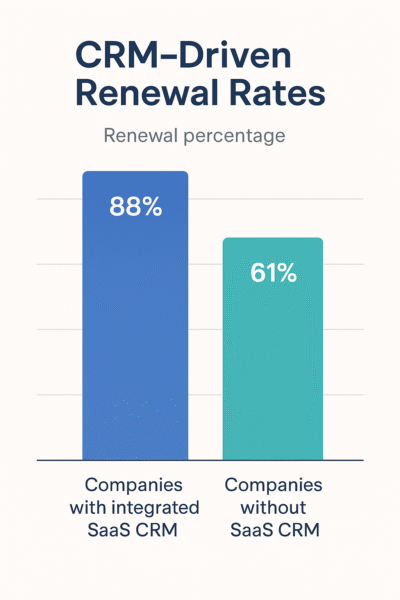
- Companies with integrated SaaS CRM: 88% renewal rate
- Companies without SaaS CRM: 61% renewal rate
Explanation:
The visualization would reveal how structured SaaS customer relationship management drastically lifts customer longevity by keeping engagement timely and proactive.
Why SaaS Customer Engagement Defines Profitability
Every touchpoint is a micro-moment of trust.
If you automate follow-ups without empathy, you risk alienation.
If you delay communication, you lose momentum.
That’s where SaaS customer engagement rooted in CRM insights wins. It ensures you’re not just reaching out—you’re reaching right.
High-performing SaaS brands track engagement intensity daily: logins, feature depth, support interactions, NPS changes. Those metrics, visible inside your SaaS CRM, become predictors of renewal health.
In other words, engagement isn’t marketing—it’s forecasting.
What SaaS Management Really Involves
People often confuse what is SaaS management with just “managing software subscriptions.”
In truth, it means managing the entire ecosystem—from licensing, onboarding, data privacy, and integration to customer relationship orchestration.
A mature SaaS management process combines governance, automation, and visibility into how every user interacts with your SaaS stack.
And yes, your SaaS customer relationship management platform is the anchor holding all that together.
Measuring the ROI of SaaS CRM
How do you prove your SaaS CRM is more than a shiny dashboard?
Measure these impact areas quarterly:
| Metric | Before CRM | After CRM | Lift |
|---|---|---|---|
| Lead conversion rate |
18%
Cold traffic under-nurtured
|
31%
Sequenced onboarding + scoring
|
|
| Customer retention | 72% Reactive renewals |
89% Health scoring + plays |
|
| ARPU | \$85 One-size pricing |
\$108 Usage-based upsell |
|
| Ticket resolution time | 42h Scattered context |
19h Unified timeline |
This simple table shows the operational ripple of using SaaS customer relationship management effectively, measurable uplift across marketing, retention, and service.
The Human Side of SaaS CRM
Technology without empathy still fails.
A system can automate reminders, but only humans can understand why a customer hesitates to renew.
So, use your SaaS CRM not just to trigger actions—but to listen.
Patterns in the data are stories. When you interpret them with curiosity, you build human trust at scale.
Conclusion
At its core, SaaS customer relationship management is the bridge between insight and empathy. It turns every byte of user behavior into a meaningful signal for growth.
Whether you’re running a five-person startup or managing an enterprise pipeline, the message is clear:
Manage your customers as people, not transactions. Let data guide you, but let intention lead.
And that’s how SaaS CRM quietly becomes the heartbeat of modern digital business.

Andrej Fedek is the creator and the one-person owner of two blogs: InterCool Studio and CareersMomentum. As an experienced marketer, he is driven by turning leads into customers with White Hat SEO techniques. Besides being a boss, he is a real team player with a great sense of equality.