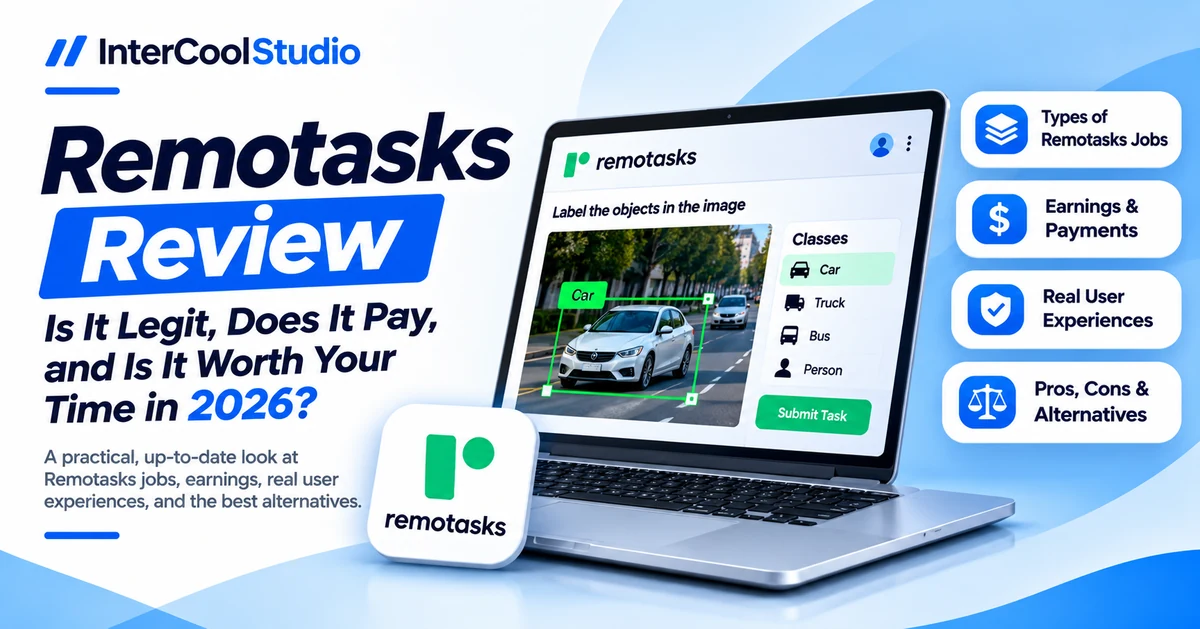
We started this Remotasks review with a simple test: could we register and see what work was available? From Serbia, we couldn’t get past registration. A separate attempt using a VPN also triggered a restriction. That’s not the experience you’d expect from a platform advertising flexible online work.
That’s not the whole story. Remotasks is a real AI training platform backed by Scale AI, and contributors have earned money completing data annotation tasks. But recent user reviews, independent investigations, and the platform’s changing availability raise serious questions about whether it’s worth your time.
We examined its payment policies, worker feedback, and independent research, along with our own access tests. Here’s what we found.
Remotasks is a legitimate AI data annotation platform, but we wouldn’t recommend relying on it for regular income. In our November 2026 test, we were unable to register from Serbia, and a VPN connection was also blocked. The platform advertises weekly payments, but work availability varies, while independent research and contributor reviews highlight concerns about compensation, account access, and support.
Our Verdict: Is Remotasks Worth It in 2026?
Our verdict: Legitimate platform, questionable earning opportunity.
Remotasks offers genuine AI-related work, including image annotation and transcription. You can learn useful skills, work without fixed shifts, and potentially earn extra money when suitable projects are available.
The problem is what happens between joining and getting paid. Training doesn’t guarantee assignments, your earnings depend on approved work, and contributors have reported payment and account-access problems.
We’d consider Remotasks only if you already have access to suitable projects and can afford inconsistent earnings. If you need reliable weekly income, we’d look elsewhere.
What we like: Real annotation work, flexible participation, free learning resources, and documented payment methods.
What concerns us: Regional restrictions, uncertain task availability, unpaid preparation time, payment disputes, and inconsistent support.
PROS
CONS
What Is Remotasks and How Does It Work?
Remotasks is a platform operated by Scale AI, where independent contributors help prepare data used to train artificial intelligence systems.
You might draw boxes around vehicles in images, transcribe speech, or annotate objects in three-dimensional sensor data. The exact work depends on the projects available to your account.
The company provides online training to prepare contributors for different assignments. Some tasks are relatively straightforward, while others require additional qualifications.
Here’s the catch: finishing a course doesn’t guarantee paid work. You still need an available project that matches your skills and location.
That’s where the experience can get frustrating. You may be willing to work, have time available, and still find no assignments.
For registration, dashboard access, and troubleshooting, we’ve covered the practical steps separately in our Remotasks Login Guide (2026).
Why Remotasks Jobs Can Disappear: The Empty Queue Problem
If you’ve read a Remotasks review and seen contributors mention EQ, they’re talking about an empty queue. In plain English, no paid tasks are available for them to complete. You might finish training, pass an assessment, and still find yourself staring at an empty dashboard.
An empty queue doesn’t automatically mean you’ve been banned. Your project may have run out of assignments, your qualifications might not match the available work, or your access to a particular queue may have changed.
Before spending another evening completing courses, check your project notifications and qualification status. If neither explains the problem, contact support and ask whether you’re eligible for any active projects. We wouldn’t keep repeating training in the hope that paid Remotasks jobs will suddenly appear.
Our Experience With Remotasks: What We Actually Tested
We attempted to register for Remotasks from Serbia on November 24, 2026.
Instead of reaching the dashboard, we received an HTTP 422 response:
“We are not currently accepting signups from your country. Please check back later.”
That immediately limited our review. We couldn’t proceed to training, accept tasks, or test payments through a newly registered account.
We also checked what happened when accessing the platform through a VPN. Remotasks detected the connection and displayed another warning:
“Please disable your VPN and refresh your page.”
The platform explicitly stated that it doesn’t support VPN use.
That’s a useful finding because older reviews often describe Remotasks as an international earning opportunity without explaining how restrictive access can be.
Our tests don’t establish that every Serbian contributor is blocked or that existing accounts have lost access. They do establish that our new registration was rejected and the VPN attempt didn’t provide access.
We haven’t completed paid tasks or received a payout, so we won’t pretend to have tested either.
How Much Can You Really Earn on Remotasks?
Remotasks advertises opportunities to earn by completing tasks, but we couldn’t establish a dependable average hourly income for contributors in 2026.
And frankly, quoting the highest advertised rates wouldn’t tell you much.
Suppose you earn $12 for two hours of approved work. That sounds like $6 per hour. But if you spent another hour learning the project requirements, your effective return falls to $4 per hour.
That’s a hypothetical example, not an earnings claim about Remotasks. It shows why we’d measure the entire time commitment, not just the minutes spent submitting paid tasks.
Training and qualification
Remotasks provides free courses and has advertised advanced training programs. However, free training isn’t the same as paid training.
Before spending several hours on a course, check whether the assessment is compensated and whether suitable projects are currently accepting contributors. We couldn’t verify that all training is unpaid or that every qualified contributor receives assignments.
Payments and approval
According to Remotasks’ official website, contributors are paid weekly through PayPal or AirTM, based on the quality and number of tasks completed.
But completed work isn’t necessarily approved work. The platform’s contributor terms include conditions for compensation and account compliance.
What if Remotasks rejects your work or a payment goes missing?
This matters more than the advertised payout schedule in any Remotasks review. First, check whether your task is marked as pending, rejected, or approved. A submitted assignment isn’t automatically an approved payment, and the platform’s terms allow quality checks and account restrictions.
If your earnings don’t match what you expected, keep the task ID, submission date, displayed rate, and any payment records you’re allowed to keep. Contact support with those details and ask for an explanation or review.
We can’t promise that a rejected task will be paid after an appeal. But a clear record gives you something concrete to refer to when disputing a decision. Don’t share confidential project instructions or client data in public complaints.
Is Remotasks Legit? What Independent Research and Workers Say
Yes, Remotasks is legitimate. But we think it’s more useful to ask whether the platform offers fair and dependable working conditions.
Fairwork: 2 Out of 10
The University of Oxford’s Fairwork Cloudwork assessment awarded Remotasks 2 out of 10 points in 2025.
Fairwork examines evidence of fair pay, working conditions, contracts, management, and worker representation.
That score doesn’t mean Remotasks pays only 20% of what it should, nor does it prove every contributor is treated poorly. It means researchers found verifiable evidence for only two of the ten available points under their assessment framework.
For us, that’s a substantial warning sign.
Trustpilot: 2.4 Out of 5
When we checked Remotasks on Trustpilot in November 2026, it had 810 reviews and a 2.4/5 rating. Approximately 60% were one-star reviews.
Complaints repeatedly mention limited assignments, payment difficulties, account restrictions, and slow communication.
The feedback isn’t entirely negative. Some reviewers appreciate the platform’s flexibility and report positive experiences. For example, one September 2026 review described the platform as easy to use while criticizing payment processing.
We wouldn’t treat Trustpilot as a representative survey of all contributors. Reviews are individual accounts, and allegations aren’t automatically verified.
Still, the pattern is difficult to ignore.
Documented Country Restrictions
Independent reporting also supports concerns about account access. In March 2024, Rest of World reported that Remotasks had discontinued operations in Kenya, Nigeria, and Pakistan. Workers described abrupt restrictions, while Scale AI cited security requirements and acknowledged communication failures.
That report describes historical events, not the current status of those countries.
But combined with our own rejected registration in November 2026, it reinforces an important point: don’t assume access to Remotasks will remain available simply because the platform advertises international work.
Remotasks vs. Outlier: What Changed?
Another reason older reviews can mislead you is the transition to Outlier.
Scale AI has been moving generative AI contributor work from Remotasks to Outlier, a separate platform focused on projects involving human expertise and AI model evaluation.
According to the official Remotasks migration notice, affected contributors can use their existing login, and their task information and pending payment data should transfer.
Remotasks continues to describe work involving image, video, and 3D sensor annotation.
If you’re interested in generative AI tasks, we’d check Outlier directly. But don’t assume you’ll automatically qualify there, either. Location, expertise, and project availability still matter.
For existing Remotasks contributors, the immediate priority is finding out which platform currently manages their assignments and earnings.
Two Remotasks Alternatives Worth Checking
If Remotasks isn’t accepting registrations from your country, you have other options worth investigating. But don’t assume another platform will automatically give you more work.
Clickworker offers microtasks involving AI training, surveys, recordings, and data processing. Its job listings show the compensation for available assignments. The downside? Clickworker also limits registrations in some countries when there isn’t enough work, so you still need to check eligibility.
Prolific takes a different approach. Instead of mainly offering annotation queues, it connects participants with paid research studies and specialized AI evaluation tasks. We particularly like its published minimum payment standard of £6/$8 per hour for studies, although that doesn’t guarantee you’ll qualify for enough work.
Neither is a direct replacement for every Remotasks project. We’d check regional eligibility, available work, and payment methods before completing another application.
Final Verdict: Should You Try Remotasks?
We wouldn’t call Remotasks a scam. It provides real AI annotation work, has an established company behind it, and publishes information about its payment process.
But we also wouldn’t recommend it as a dependable source of income.
Our registration attempt was rejected, the platform blocked our VPN connection, and independent evidence raises reasonable concerns about working conditions and contributor support.
Our Remotasks review doesn’t claim that nobody earns money on the platform. It shows why genuine projects and advertised weekly payments aren’t enough to establish whether you’ll find consistent, worthwhile work. That’s the uncertainty we’d consider before investing time in training.
If you already have an active account and consistent projects, judge Remotasks by your actual approved earnings. If you’re starting from scratch, we’d compare other opportunities before investing hours in training.
Our conclusion: Remotasks may suit occasional AI annotation work, but the uncertainty makes it a poor choice for anyone who needs predictable income.
Research and access tests: November 24, 2026. We personally tested registration and VPN restrictions, but not paid task completion or payouts.
Is Remotasks legit in 2026?
Yes. Remotasks is a real AI data annotation platform operated by Scale AI. However, our Remotasks review found significant concerns about task availability, account restrictions, and payment disputes. A legitimate platform doesn’t necessarily offer dependable income.
Does Remotasks pay real money?
Remotasks advertises weekly payments through PayPal or AirTM for eligible work. Your earnings depend on the tasks you complete and their approval status. We haven’t personally received a payout, so we can’t verify payment reliability through our own account. Contributor reviews report mixed experiences.
What does EQ mean on Remotasks?
EQ stands for empty queue. It means you currently have no tasks available to complete. This can happen when projects have insufficient work, your qualifications don’t match available assignments, or your project access changes. An empty queue doesn’t automatically mean you’ve been banned.
Are Remotasks training courses paid?
Remotasks provides free training, but that doesn’t mean every course or qualification assessment is paid. Compensation can depend on the project. Before committing several hours, check whether the training is compensated and whether qualifying leads to an available assignment. Completing a course doesn’t guarantee paid work.
Can I join Remotasks from Serbia in 2026?
Our registration attempt from Serbia on November 24, 2026, was rejected with the message: “We are not currently accepting signups from your country.” We also encountered a VPN restriction when testing access. This documents our experience with new registration, not the status of every existing Serbian account.
Is Outlier replacing Remotasks?
Scale AI has been moving generative AI contributor work from Remotasks to Outlier. The platforms are related, but they don’t offer identical projects. According to the official migration notice, affected contributors should use their existing login, and their task records and pending payment data should transfer. Not every account has necessarily completed the transition.

Andrej Fedek is the creator and one-person owner of three blogs: InterCool Studio, CareersMomentum, and Bettegi. As an experienced marketer, he is driven by turning leads into customers with White Hat SEO techniques. Besides being a boss, he is a real team player with a great sense of equality.