You have built something that works. Your product does what it says. Your support documentation is clear. Your onboarding emails convert.
Then you try to take it global.
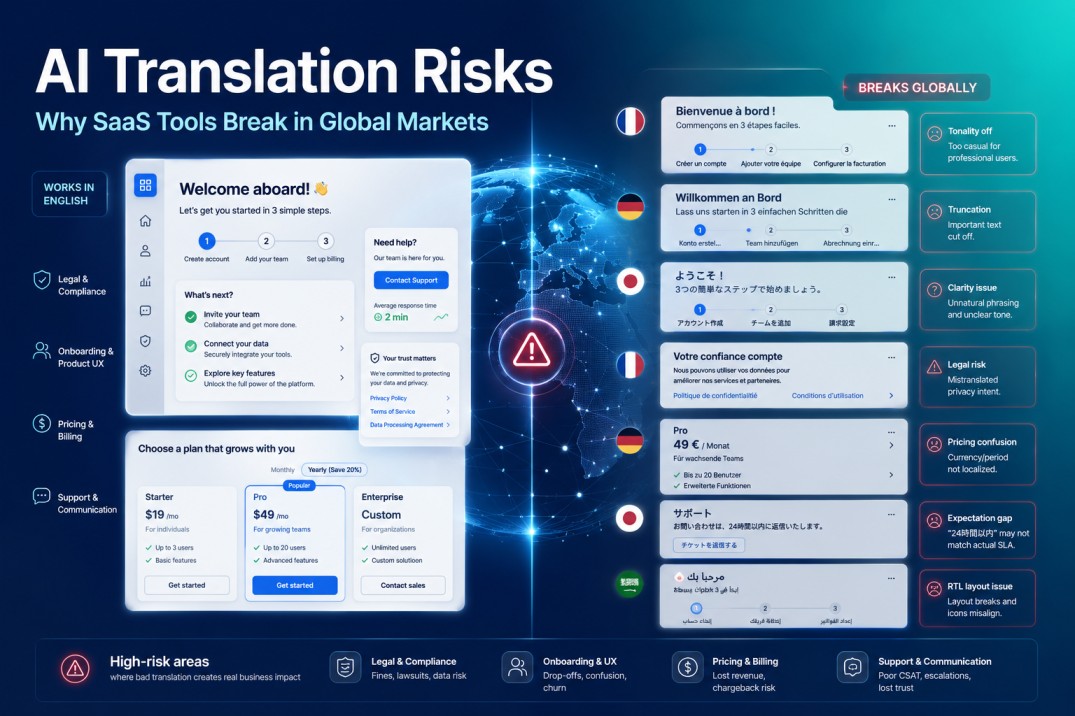
Suddenly, the product that felt polished in English feels hollow in French, inconsistent in German, and weirdly formal in Japanese. The interface text does not quite fit the buttons. The legal disclaimers read like they were written by someone who has never seen a contract. And the customer support flow that felt warm and direct in English now reads as cold, or confusing, or both.
This is not a translation problem in the traditional sense. It is a growth problem. And for small businesses, SaaS teams, and digital agencies trying to reach new markets, it is one of the most expensive problems to get wrong quietly.
AI translation can make that expansion look simple at first, but the real problems appear when product copy, legal language, onboarding flows, and support messages need to feel natural in each market.
AI translation can help SaaS teams and small businesses move faster, but it often fails when customer-facing content requires legal precision, cultural nuance, product voice, or trust-building tone. The safest approach is hybrid translation: use AI for speed and scale, then rely on human translators or domain specialists to review high-stakes content such as onboarding flows, pricing pages, legal terms, support messages, and market-launch materials before users see them.
What actually goes wrong when AI translates your business
The appeal of AI translation is obvious. You have content. A tool converts it. You move on. For quick internal notes or rough research, this works well enough.
For customer-facing content, it is a different story.
In a 2025 survey of nearly 2,000 translation and localization professionals compiled by Slator, 72 percent of respondents cited accuracy as a concern with AI translation, and 68 percent flagged quality issues. These are not numbers from a legacy industry defending old methods. They reflect what teams discovered when they actually deployed AI translation at scale, for real users, in real markets.
The failure mode is rarely dramatic. AI does not usually produce gibberish. It produces output that sounds plausible but is subtly off. A legal term translated into its statistical common meaning rather than its contextual correct one. A marketing headline that lands as neutral rather than compelling in the target language. A support message that answers the question but misses the tone entirely.
These errors do not trigger alarms. They erode trust slowly, quietly, across thousands of touchpoints.
The parts of your business most at risk
Not every piece of content carries the same cost when it goes wrong.
For a blog post or social caption, an imperfect translation might reduce engagement. Annoying, but recoverable. For the parts of your business where communication shapes reputation and long-term growth – your contracts, your onboarding, your pricing pages, your terms of service – the stakes are meaningfully higher.
Three areas where AI-only translation consistently creates problems for growing businesses:
Legal and compliance content
AI translation selects statistically likely meanings, not contextually correct ones. In documents where one word changes a legal obligation, that distinction matters. A term meaning regulatory authorization in a medical device manual can be translated as physical removal in another language. Both are statistically plausible. Only one is correct.
Customer-facing product copy
Buttons, tooltips, error messages, and onboarding flows carry a specific register and emotional tone. AI translates the words. It does not carry the voice. The result is copy that is technically correct but feels foreign to native speakers in a way that is hard to name but immediately obvious.
Support and trust-building communication
A refund policy or escalation email is not just information. It is a signal about how your business treats people. Flat, mechanical translations of these moments damage relationships in ways that are hard to trace back to the source.
Why “run it through AI” is not a translation strategy
There is a broader pattern worth naming here.
Many of the AI tools that businesses rely on daily are genuinely excellent at what they are designed to do. Writing assistants, SEO tools, productivity tools – these work well within defined tasks with clear outputs.
Translation is different because language is contextual in ways that resist single-model automation.
A 2026 enterprise survey conducted by Crowdin in partnership with ESADigital found that 20.4 percent of organizations reported quality incidents or regressions after introducing AI translation into their workflows. The problem was not that AI translation did not work. It was that it worked inconsistently, and the failures tended to cluster exactly where the stakes were highest: domain-specific content, long-tail languages, and tone-sensitive communication.
The industry response to this has been to move toward multi-model and hybrid approaches. A separate analysis from Slator noted that the most effective localization setups observed in 2025 were hybrid workflows, combining machine translation for speed with human review for quality and cultural fit. The question for a growing business is not whether to use AI in translation. It is how to make sure human expertise is present at the points where AI alone is not enough.
What hybrid translation actually looks like in practice
A few years ago, Tomedes, a translation company, was working with a tech client preparing a product launch across six European markets. The client had used AI to pre-translate their entire content library – not an unreasonable decision given the volume involved. The problem surfaced in the review.
The legal terms were technically accurate but carried the wrong legal weight in two of the target jurisdictions. The UI copy was grammatically correct but felt wrong to native speakers in a way that was difficult to articulate yet immediately obvious to the translators who reviewed it.
The Tomedes team caught both issues before launch. Domain-specialist linguists flagged the jurisdictional gaps in the legal copy and reworked the UI register for each market. The AI draft was the starting point. Human judgment was the quality control.
This is what hybrid translation means in practice. AI handles the volume and speed. Human translators with domain expertise handle the judgment calls that AI cannot reliably make: cultural fit, legal precision, tonal accuracy, and the moments when a technically correct word is still the wrong choice.
The result is not slower or more expensive than pure AI for most content. It is more predictable, which matters more to growing businesses than marginal cost reduction.
The decision that compounds
Most growth decisions have a moment where the cost of getting it wrong is manageable. Translation is one of the few where that window closes quietly.
A product that feels off in a new market does not always send a clear signal. Users do not file bug reports about tone. They just do not convert. They do not leave bad reviews about a legal disclaimer that felt ambiguous. They just do not renew. The feedback loop is long, and by the time it is visible in your numbers, the damage is already done across thousands of interactions.
For businesses preparing to enter new language markets, three questions are worth answering before choosing a translation approach:
- What content will users see first? First impressions set the register for everything that follows. Prioritize accuracy and cultural fit for these pieces, regardless of volume.
- What content carries legal or compliance weight? These pieces should always include human review, regardless of how confident the AI output looks.
- What does quality mean in this specific language and market? AI quality benchmarks are typically measured in aggregate across major languages. Your target market may be one where AI performance degrades noticeably, particularly in less-resourced languages.
The businesses that expand successfully across language markets are not the ones that avoid AI. They are the ones that know exactly where AI earns its place and where a human expert earns theirs. That combination is not a compromise. It is the strategy.
Before the next market launch, it is worth asking one honest question: does the translation workflow you are relying on have a human expert in the loop at the points where it matters? If the answer is unclear, that is usually the answer.
Why can a SaaS product work well in English but struggle in other languages?
A SaaS product can feel polished in English but weaker in other languages when interface text, onboarding emails, legal disclaimers, and support messages lose their tone or meaning.
The article explains that this is not just a translation problem, but a growth problem for teams trying to enter new markets.
What usually goes wrong with AI translation for customer-facing content?
AI translation often produces text that sounds plausible but is subtly off.
The article gives examples such as legal terms being translated incorrectly, marketing headlines losing impact, and support messages missing the right tone.
Which parts of a business are most at risk from AI-only translation?
The article identifies legal and compliance content, customer-facing product copy, and support or trust-building communication as the most vulnerable areas.
These areas carry higher stakes because they shape reputation, user trust, legal clarity, onboarding quality, and long-term growth.
Why is “run it through AI” not a complete translation strategy?
The article explains that translation is different from many other AI tasks because language depends heavily on context, tone, market expectations, and domain-specific meaning.
AI translation can work inconsistently, especially in high-stakes areas such as specialized content, long-tail languages, and tone-sensitive communication.
What is hybrid translation?
Hybrid translation uses AI for speed and volume while human translators or domain specialists review the parts where judgment matters.
According to the article, human review is especially important for cultural fit, legal precision, tonal accuracy, and cases where a technically correct word is still the wrong choice.
What should businesses check before choosing a translation approach?
The article recommends asking what content users will see first, what content carries legal or compliance weight, and what quality means in the target language and market.
These questions help businesses decide where AI is useful and where human expertise is necessary before entering a new language market.

Andrej Fedek is the creator and one-person owner of three blogs: InterCool Studio, CareersMomentum, and Bettegi. As an experienced marketer, he is driven by turning leads into customers with White Hat SEO techniques. Besides being a boss, he is a real team player with a great sense of equality.