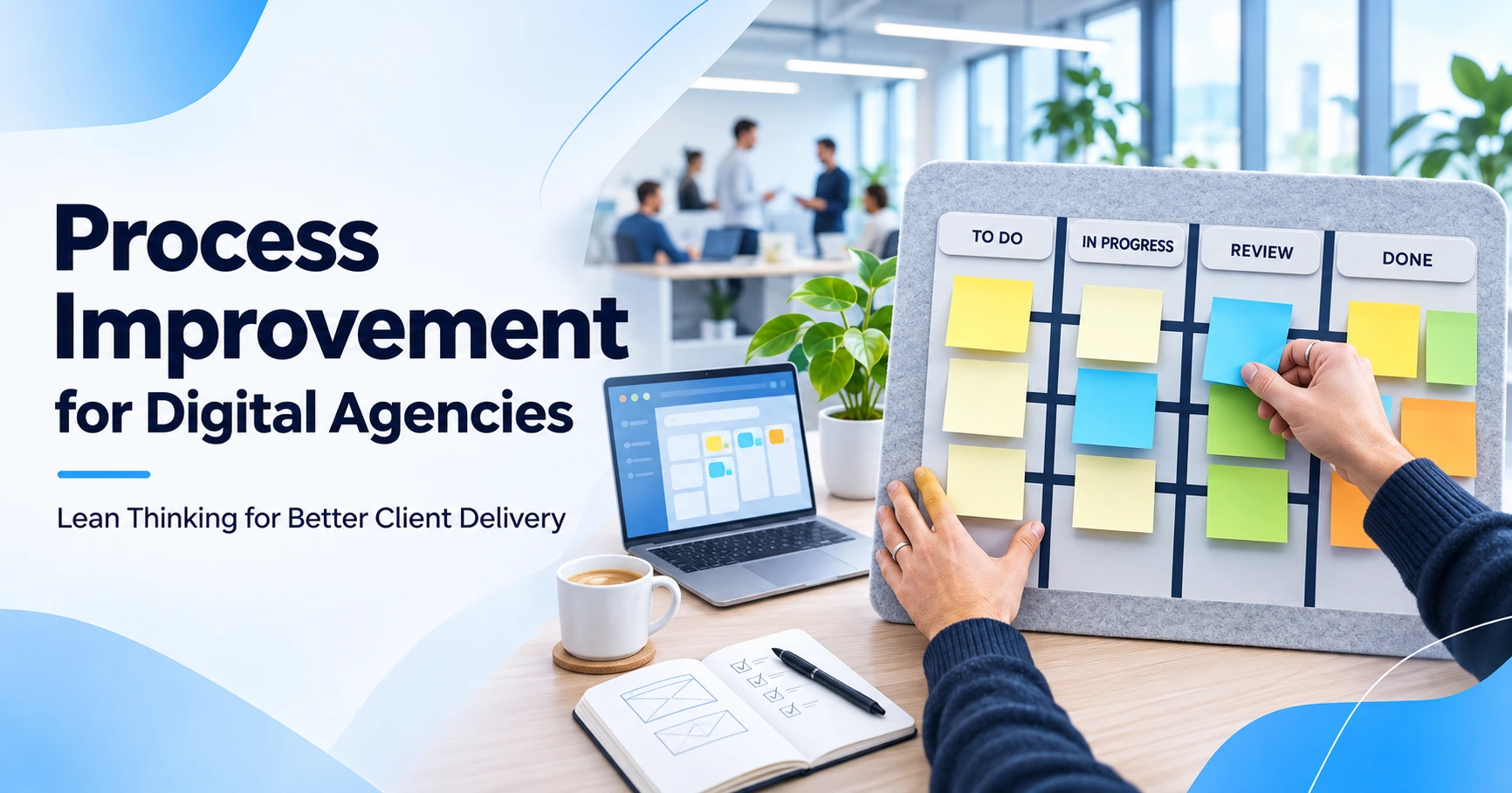
A digital agency can have talented designers, experienced developers, and a strong account management team yet still struggle to deliver projects on time. The problem often lies between individual tasks: delayed approvals, unclear responsibilities, repeated revisions, and information that gets lost as work moves between departments. Lean thinking offers practical methods to reduce unnecessary work, improve collaboration, and make client delivery more predictable.
These operational problems become more expensive as agencies take on additional clients. A small delay in one project can affect several others when team members share responsibilities across multiple accounts.
Process improvement gives agencies a structured way to identify these inefficiencies without sacrificing creativity.
Lean thinking helps digital agencies reduce unnecessary revisions, approval delays, and inefficient project handoffs. By mapping workflows, limiting work in progress, and establishing clear delivery standards, agencies can improve project consistency without adding excessive management overhead. Small, measurable process changes can also create more reliable timelines and better client communication.
The Delivery Challenge in Modern Digital Agencies
Digital agencies operate in an environment where client requirements change, technology evolves, and deadlines frequently overlap. Managing these moving parts can create operational friction, scope creep, and pressure on delivery teams.
When a website launch falls behind schedule, or a marketing campaign exceeds its budget, the cause is not always poor planning or insufficient technical expertise. The problem may be a slow approval process, an incomplete project brief, or a lack of coordination between creative and development teams.
Consider a typical website project. A designer completes a page layout, but development cannot begin until the client approves it. The client requests revisions that were never discussed during discovery, and the project manager must reorganize the schedule. Meanwhile, developers have already moved to another assignment.
Each delay may seem minor, but repeated interruptions make project timelines increasingly difficult to predict.
Traditional management responses sometimes introduce more meetings, approval stages, and reporting requirements. These additions can slow work further if they do not address the original bottleneck.
A more effective approach examines how work moves through the agency and identifies which activities genuinely contribute to the finished deliverable.
Core Principles of Lean Thinking in Agency Workflows
Originally developed in manufacturing, Lean methodology focuses on maximizing customer value while minimizing waste. Its principles also apply to knowledge-based services, including web development, digital marketing, content production, and creative design.
In an agency environment, waste doesn’t always involve physical resources. It often appears as time spent on work that adds little value to the client’s final outcome.
Common examples include:
- Excessive revisions: Reworking deliverables because requirements or approval criteria were unclear.
- Waiting time: Projects sitting idle while teams wait for client feedback, content, or internal decisions.
- Unnecessary handoffs: Information repeatedly moving between departments without clear ownership.
- Duplicate work: Team members recreating reports, documents, or assets that already exist.
- Excessive multitasking: Employees switching between too many projects and losing productive focus.
One useful Lean technique is value stream mapping, which documents the steps required to move a project from its initial request to final delivery.
For example, an agency might map its website production process as discovery, planning, design, client approval, development, testing, and launch.
The goal is not simply to document these stages. It is to identify where work waits, where errors occur, and which activities could be simplified or removed.
If design approval consistently takes longer than development, adding another developer will not solve the underlying delivery problem. Improving the approval workflow may have a much greater effect.
Practical Steps for Operational Refinement
Adopting Lean thinking does not require an agency to redesign every internal process simultaneously. Smaller changes are often easier to test, measure, and maintain.
A useful starting point is to focus on one recurring workflow, such as client onboarding, website production, or campaign approval.
Agencies can then introduce several practical improvements:
- Visualize active projects. Use Kanban boards to show which tasks are planned, in progress, awaiting approval, or completed. This makes bottlenecks visible before they affect deadlines.
- Limit work in progress. Avoid assigning too many simultaneous tasks to the same employees. Completing existing assignments before starting new ones can reduce context switching and unfinished work.
- Define completion criteria. Establish clear requirements for moving deliverables between teams. A design should not enter development until essential assets, specifications, and approvals are ready.
- Standardize recurring activities. Use reusable project templates, onboarding checklists, and quality assurance procedures to reduce repetitive administrative work.
- Review recurring delays. Hold short retrospective meetings that identify specific obstacles and assign responsibility for correcting them.
These improvements are particularly useful when an agency manages several projects with shared designers, developers, and account managers.
Organizations seeking a more formal approach may also invest in structured training. External providers such as The Lean Six Sigma Company offer group training programs that can help employees develop consistent process improvement and problem-solving practices.
Formal training is one option, but agencies can begin applying basic Lean principles through existing project management routines.
Measuring Whether Process Changes Actually Work
A new workflow is only useful if it improves delivery. Agencies should therefore establish a small set of performance measures before introducing major operational changes.
Four indicators are particularly relevant:
| Metric | What It Reveals |
|---|---|
| Project cycle time | How long a project takes from active work to completion. |
| Approval turnaround | How much time deliverables spend waiting for client or internal feedback. |
| Revision frequency | How often completed work requires additional changes. |
| On-time delivery rate | How consistently projects meet agreed deadlines. |
Interpret these measurements together rather than independently.
For example, reducing revision rounds may appear successful, but not if the final deliverable contains more errors. Similarly, faster production is not a meaningful improvement if employees must regularly work overtime to maintain the schedule.
Agencies should compare results across similar projects and investigate the reasons behind changes. A complicated website build should not be measured against a simple landing page without accounting for the difference in scope.
The objective is to improve the overall delivery process, not simply make individual tasks appear faster.
Sustaining Improvements and Strengthening Client Relationships
Process improvement works best when it becomes part of normal agency operations rather than a temporary management initiative.
Employees who work directly with clients, design assets, develop websites, or manage campaigns often recognize operational problems before senior management does. Giving these teams a practical way to report recurring obstacles can reveal improvements that would otherwise be overlooked.
Client communication also plays an important role.
Clear approval deadlines, documented change requests, and visible project milestones help prevent misunderstandings. When clients know what information is required and when decisions must be made, project teams can plan their work more reliably.
This does not mean eliminating flexibility. Creative projects frequently require experimentation and changes in direction. A well-designed workflow provides enough structure to manage those changes without allowing every new request to disrupt the entire schedule.
Over time, consistent delivery practices can improve client confidence. Predictable timelines, fewer unexpected delays, and clearer communication make working relationships easier to maintain.
Final Thoughts
Lean thinking gives digital agencies a practical framework for improving how projects move from initial planning to final delivery. Its greatest value comes from identifying unnecessary work, reducing delays, and making responsibilities clearer across teams.
Agencies don’t need complicated management systems to improve. Better approval procedures, realistic workloads, reusable templates, and regular workflow reviews can address many common delivery problems.
The strongest approach is to begin with one measurable bottleneck, test a targeted improvement, and use the results to guide the next change. Consistent operational refinement can help agencies deliver dependable work while preserving the creative flexibility their clients expect.
What is Lean process improvement in a digital agency?
Lean process improvement helps digital agencies identify and eliminate unnecessary work, delays, and repetitive tasks. It focuses on improving how projects move from planning to delivery while maintaining quality and creative flexibility.
How can Lean thinking reduce project delays?
Lean thinking reduces delays by identifying workflow bottlenecks, limiting work in progress, and improving communication between teams. Clear approval procedures and completion criteria also prevent projects from stalling between design, development, and client review.
What are common examples of waste in digital agency workflows?
Common examples include excessive client revisions, waiting for approvals, duplicate reporting, unnecessary meetings, unclear project requirements, and repeated handoffs between departments. These activities consume time without directly improving the final deliverable.
Can small digital agencies use Lean methodology?
Yes. Small agencies can apply Lean principles without expensive software or formal restructuring. Simple changes such as Kanban boards, reusable project templates, clear task ownership, and regular workflow reviews can improve delivery consistency.
How do agencies measure the success of process improvements?
Agencies can track project cycle time, approval turnaround, revision frequency, and on-time delivery rates. Comparing these metrics before and after workflow changes helps determine whether improvements are reducing delays without compromising quality.

Andrej Fedek is the creator and one-person owner of three blogs: InterCool Studio, CareersMomentum, and Bettegi. As an experienced marketer, he is driven by turning leads into customers with White Hat SEO techniques. Besides being a boss, he is a real team player with a great sense of equality.