It is a common scenario. You spend hours writing a newsletter, hit send, and wait for the website visits to roll in. A day later, the report shows a 43 percent open rate, but the traffic graph barely moves. The gap between email opens and actual email newsletter traffic is one of the most frustrating challenges in digital marketing.
When a newsletter fails to drive visits, the problem is rarely the topic. It is usually the execution. An email must do more than simply arrive in an inbox.
It needs to give the reader a clear, compelling reason to leave that inbox and engage with your site. The good news is that turning an email list into a reliable traffic source does not require a massive subscriber base. It requires a shift in how you measure success, segment your audience, and structure your campaigns.
This guide explains how to move past vanity metrics and build an email strategy that consistently delivers visitors to your pages. We will cover exactly what metrics to watch, how to divide your audience for maximum relevance, and why automation is the secret to a steady flow of returning readers.
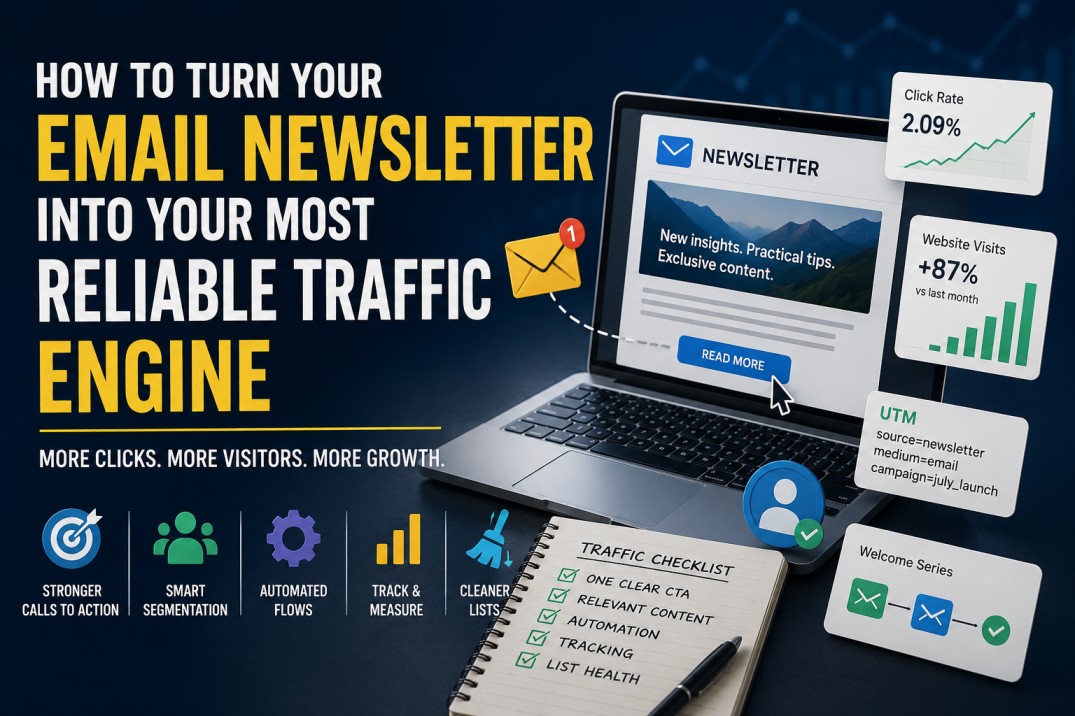
A reliable email newsletter traffic strategy should prioritize clicks over open rates, especially because privacy features can record emails as opened even when subscribers never read them. The median email click rate across industries was only 2.09% in 2025, while automated email flows reached an average click rate of 5.58% in 2026, showing how much timing and relevance affect website traffic. The strongest newsletter traffic engines combine one clear call to action, behavioral segmentation, automated follow-ups, UTM tracking, and regular list cleaning.
Stop obsessing over open rates and focus on clicks
Open rates are the most common email metric, but they are also the least reliable. When Apple introduced Mail Privacy Protection, it began downloading remote email content in the background by default. This means a message can register as opened even if the recipient never looked at it. If you rely on open rates to judge a newsletter, you are likely looking at inflated numbers that do not reflect genuine interest.
To measure actual traffic potential, you must focus on the click rate. A click is a deliberate action. It shows that a subscriber read the content, found it relevant, and decided to learn more.
According to MailerLite data from 2025, the median click rate across all industries is just 2.09 per cent. This highlights how difficult it is to earn a visit compared to an open.
Improving your click rate starts with giving the reader a single, obvious action to take. A newsletter packed with ten different links dilutes attention. When you offer too many choices, the reader often makes no choice at all.
Instead, highlight one primary destination per email. Make the link clear, use actionable text, and place it high enough in the message that readers do not have to scroll to find it.
Another effective tactic is to tease the content rather than giving everything away in the email. If you write a comprehensive guide, do not paste the entire text into the message body. Provide a strong introduction, highlight the key problem the guide solves, and then provide a clear link to read the rest on your website. This creates a natural transition from the inbox to your domain.
You should also consider the visual hierarchy of your emails. A clean layout with plenty of white space makes the primary link stand out. Avoid burying your call to action in dense paragraphs. By making the click the most obvious next step, you naturally increase the volume of traffic flowing to your site.
Segment your audience by behaviour and interest
Sending the exact same message to your entire list is the fastest way to lower engagement. Your subscribers have different needs, preferences, and histories with your business. When you treat them as a single group, your content becomes generic, and generic content rarely earns clicks.
Segmentation allows you to group subscribers based on shared characteristics. You can segment by the signup source, the dates they joined, or the specific links they have clicked in previous emails. For example, if someone consistently clicks on articles about website performance, you can place them in a technical segment and send them more of that content.
This approach ensures relevance. When an email matches a subscriber’s specific interests, they are far more likely to visit your site to read the full piece. You can also use segmentation to separate highly engaged readers from inactive ones. Sending your most important updates to the engaged group protects your sender reputation and ensures your best content reaches the people most likely to act on it.
A simple way to start segmenting is to ask for preferences during the signup process. A short form that asks what topics the subscriber cares about gives you immediate data to work with. If you run a marketing agency, you might ask if they are interested in search engine optimisation, social media, or paid advertising. This allows you to tailor the very first email they receive.
As your list grows, you can move to behavioural segmentation. Email platforms track which links each subscriber clicks. If you notice a group of people repeatedly engaging with content about a specific service, you can create a segment just for them. Sending a targeted email to a highly interested group will always generate a better click rate than a generic blast to your entire list.
Set up automated flows to capture returning visitors
A standard newsletter campaign is sent manually on a specific date. Automated flows, on the other hand, are triggered by a subscriber’s actions. Because automated emails are sent at the exact moment a person interacts with your brand, they consistently generate higher engagement and more reliable traffic.
Klaviyo data from 2026 shows that automated flows achieve an average click rate of 5.58 percent, which is roughly three times higher than the rate for standard campaigns. This difference exists because the timing is relevant. A welcome series sent immediately after signup catches a reader when their interest is highest. An email triggered by a specific page visit provides information exactly when the user is looking for it.
To build a traffic engine, start with a simple welcome sequence. Introduce your brand and link to your best-performing content. From there, add behaviour-based triggers. If a subscriber visits a specific service page but does not enquire, an automated follow-up can provide a case study or a guide related to that service, drawing them back to the site.
Another powerful automation is the re-engagement campaign. This flow targets subscribers who have not clicked or taken another meaningful action in several months. It usually offers a special incentive or asks if they still want to receive updates. While the primary goal is to clean the list, a well-crafted re-engagement email can often win back a reader and generate an unexpected spike in traffic.
Automated flows work quietly in the background. Once they are set up, they provide a steady, predictable stream of visitors without requiring you to write a new newsletter every week. This consistency is what transforms an email list from a sporadic marketing channel into a reliable traffic engine.
Track the quality of email traffic in Google Analytics
Earning the click is only the first step. You must also understand what those visitors do once they arrive on your website. An email platform will tell you how many people clicked, but it will not tell you if they stayed, read the content, or took a meaningful action. For that, you need Google Analytics.
To connect your email clicks to website behaviour, you must use UTM parameters. These are simple tags added to the end of your links. Google recommends always setting the source, medium, and campaign name. For a newsletter, setting the medium to email allows Google Analytics to correctly categorise the traffic in the User acquisition and Traffic acquisition reports.
Once the traffic is tracked, look beyond the raw session count. Review the average engagement time and the number of returning users. If your email traffic shows high engagement times, your newsletter is successfully delivering a relevant audience.
If visitors leave immediately, there is a disconnect between what the email promised and what the page delivered. If you need to test how your analytics setup handles incoming visits, you can get targeted website visitors from VisitorBoost, which says it supplies real human traffic rather than automated bot hits. Run it as a separately tagged test and measure that cohort against on-site outcomes rather than assuming quality.
It is also important to track key events. In Google Analytics, a key event is a specific action you want the user to take, such as filling out a contact form or downloading a resource. By tracking key events, you can see exactly which email campaigns are driving the most valuable traffic.
Consistent tracking allows you to refine your strategy. If a particular type of content generates high engagement and conversions, you know to feature more of it in future newsletters. If a campaign drives clicks but no meaningful on-site behaviour, you know you need to adjust your messaging or improve the landing page experience.
Clean your list regularly to protect deliverability
A large subscriber list is useless if your emails land in the spam folder. Email providers like Gmail and Yahoo actively monitor how recipients interact with your messages. If a large portion of your list ignores your emails or marks them as spam, the providers will start routing your future campaigns away from the inbox.
To maintain a strong sender reputation, you must clean your list. Start with subscribers who have not clicked, visited, purchased, or completed another meaningful action in several months, using opens only as a secondary signal. Send a re-engagement message, then suppress contacts who remain inactive rather than continuing to email them.
Yahoo requires all senders to keep spam complaint rates below 0.3 percent. To stay below this threshold, only send an email to people who explicitly opted in. Furthermore, make it incredibly easy to leave.
Gmail requires bulk senders to support one-click unsubscribe for marketing messages. An easy exit prevents frustrated readers from using the spam button, protecting your reputation and ensuring your traffic engine continues to run smoothly.
Regular list cleaning also improves your metrics. When you remove the people who never engage, your open and click rates naturally increase. This gives you a more accurate picture of how your content is performing among the people who actually care about your brand.
Ultimately, a smaller list of highly engaged subscribers is far more valuable than a massive list of people who ignore you. By focusing on quality over quantity, segmenting your audience, and tracking your results, you can turn your email newsletter into a consistent, reliable source of high-quality website traffic.
How can you turn an email newsletter into a reliable traffic engine?
Give readers one clear reason to click through to your website instead of placing several competing links in every email.
Combine that focused call to action with audience segmentation, automated email flows, UTM tracking, and regular performance reviews.
Is click rate more important than email open rate?
Click rate is usually a stronger indicator of genuine interest because a click requires the subscriber to take a deliberate action.
Open rates can be inflated by email privacy features that register a message as opened even when the recipient did not read it.
How does email segmentation increase website traffic?
Segmentation lets you send content based on a subscriber’s interests, signup source, previous clicks, or level of engagement.
More relevant emails are more likely to earn clicks than a generic campaign sent to everyone on the list.
Which automated emails can bring visitors back to a website?
Welcome sequences can introduce new subscribers to your best content while their interest is still high.
Behaviour-based follow-ups and re-engagement campaigns can also return readers to relevant pages without requiring a new manual newsletter each time.
How should you measure traffic from an email newsletter?
Add UTM parameters to newsletter links so Google Analytics can identify the source, medium, and campaign behind each visit.
Then review engagement time, returning users, key events, and conversions instead of judging success only by the number of sessions.

Andrej Fedek is the creator and one-person owner of three blogs: InterCool Studio, CareersMomentum, and Bettegi. As an experienced marketer, he is driven by turning leads into customers with White Hat SEO techniques. Besides being a boss, he is a real team player with a great sense of equality.