Cheap backlinks can look convincing in a spreadsheet. A report may show new referring domains, respectable DR scores, indexed placements, and a growing backlink count while organic performance barely changes.
The problem is that a live link is not automatically a useful link. A placement can come from a site with little organic traffic, weak topical relevance, poor editorial standards, or pages created mainly to sell links.
Price and DR are easy to compare. Traffic quality, editorial context, outbound-link patterns, and the linking page’s actual value require more work. Those signals often explain why two similarly priced backlinks produce very different results.
Cheap backlinks aren’t automatically bad, but price and Domain Rating alone say little about their SEO value. A useful backlink review should also consider organic traffic, relevance, editorial quality, outbound-link patterns, and whether the linking page has its own search visibility. Fewer relevant placements can be more useful than a large backlink report filled with weak sites.
Why Cheap Backlinks Can Look Better Than They Are
A backlink report usually emphasizes the easiest things to measure: Domain Rating, referring domains, placement status, anchor text, and whether the page is indexed.
Those numbers are useful, but they do not tell you whether anyone visits the linking site or whether Google considers its content worth surfacing in search.
A DR 40 domain can still publish dozens of unrelated guest posts every week. Another site with a lower authority score may have a smaller but genuine audience, focused topical coverage, and pages that consistently receive organic traffic.
That is why reviewing cheap placements requires looking beyond the headline metric.
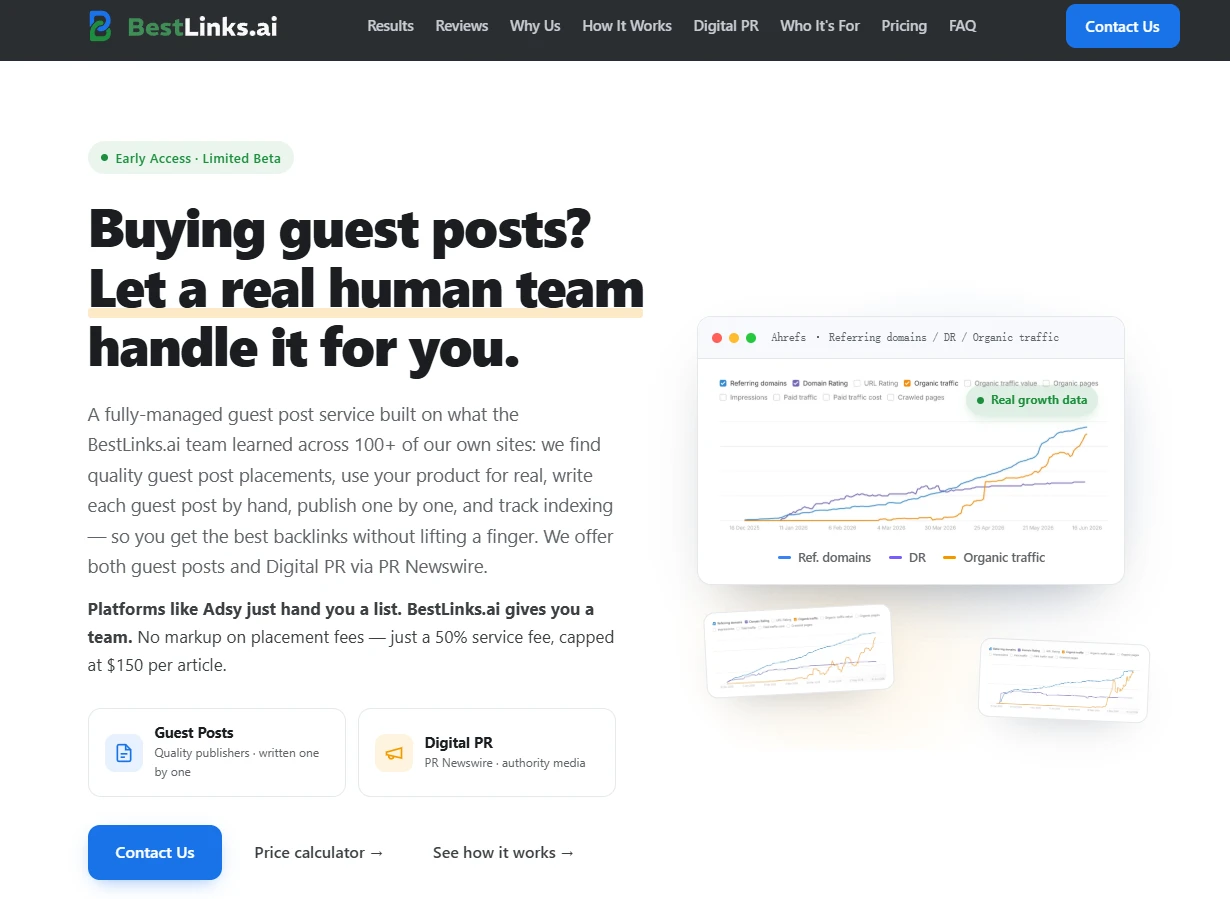
This is also the context in which services such as BestLinks AI position their managed guest-post model: instead of presenting a large publisher marketplace, the service says it builds shortlists using competitor backlink data, organic traffic, Domain Rating, and placement cost.
How the BestLinks AI Guest Post Workflow Works
Step 1: Share Your Domain and Competitors
The process starts with your domain and a list of competitors. BestLinks AI also looks for additional competitors that may be relevant to the search.
From there, the team uses Ahrefs data from your existing backlink profile and competitor link profiles to identify potential guest post sites. The shortlist includes metrics such as Domain Rating, organic traffic, and placement price, so you can review the options before selecting any publishers.
Step 2: Review the Shortlist and Pick the Placements
Once the shortlist is ready, you review the proposed sites and decide which placements are worth pursuing. The list includes the main comparison points, including Domain Rating, organic traffic, and placement cost, so the decision does not rely on one metric alone.
The useful part here is not that the service makes the decision for you. It reduces the manual prospecting and publisher research required before you decide. You still choose which sites move forward.
Step 3: Create a Separate Article for Each Publisher
Each approved placement gets its own article, rather than reusing one generic guest post across multiple sites. BestLinks AI says it tailors the writing process to the target publisher and its editorial context.
The service describes its workflow as human-led with AI assistance. The practical point is that the content is prepared for the specific site where it will appear, instead of treating every placement as another slot for the same rewritten article.
Step 4: Publishing, Monitoring, and GSC Indexing Transparency
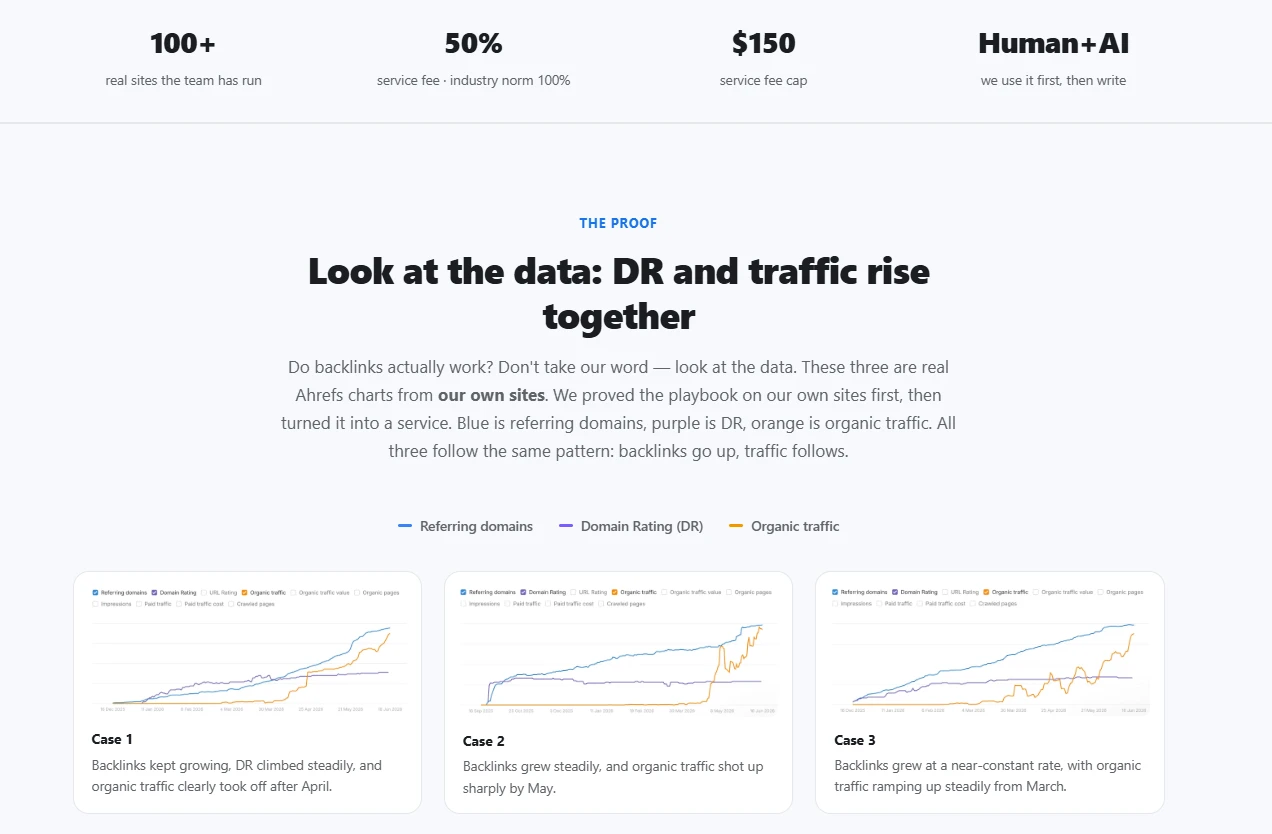
Once the article goes live, you still need to monitor the placement. The main checks are simple: whether the page remains live, whether the backlink still points to the correct destination, and whether the page is indexed.
Broken links are repaired at no additional cost, which matters because guest post placements can change over time as publishers update URLs, remove pages, or modify existing content.
You can also use Google Search Console to confirm whether the linking page is being discovered and indexed, giving you a clearer picture of whether the placement is still doing its job.
How BestLinks AI Pricing Works
BestLinks AI separates the publisher placement cost from its own service fee. The placement itself carries little to no markup, while the service fee is calculated at 50% of the placement price, with a $15 minimum and a $150 maximum per article.
That keeps the pricing easy to calculate. A $60 placement adds a $30 service fee, bringing the total to $90. A $400 placement would normally produce a $200 fee at 50%, but the cap limits it to $150.
The service fee covers the work around the placement: prospecting, shortlist preparation, writing, publishing, and follow-up. For higher-priced placements, the cap matters because the service cost stops increasing once it reaches $150.
| Placement Cost | Standard 100% Service Fee Model | BestLinks AI Service Fee | Total Difference |
|---|---|---|---|
| $30 | $30 | $15 (floor) | Save $15 |
| $60 | $60 | $30 | Save $30 |
| $120 | $120 | $60 | Save $60 |
| $300 | $300 | $150 (cap) | Save $150 |
| $500 | $500 | $150 (cap) | Save $350 |
For operators running 20 to 50 placements per quarter, the cap compounds into a meaningful budget difference. Groups placing 50 or more articles can inquire about additional rates beyond the published structure.
Where the Service Has Limits
The main limitation is language support. BestLinks AI currently focuses on English-language guest posts, so it is not a practical fit for campaigns targeting non-English search markets.
The service also targets established sites rather than brand-new projects. Its current model suits businesses with a working content strategy, existing revenue, and enough data to identify useful competitors and backlink opportunities.
Guest posting also has the usual limitation: a backlink is only one part of SEO performance. Strong placements cannot compensate for weak content, poor keyword targeting, technical problems, or a site that lacks topical depth.
The value of the service therefore depends on where the bottleneck actually is. If prospecting, publisher outreach, writing, and link monitoring are consuming too much time, outsourcing those steps can make sense. If the site itself still needs major work, more guest posts will not solve the underlying problem.
Is BestLinks AI Right for You?
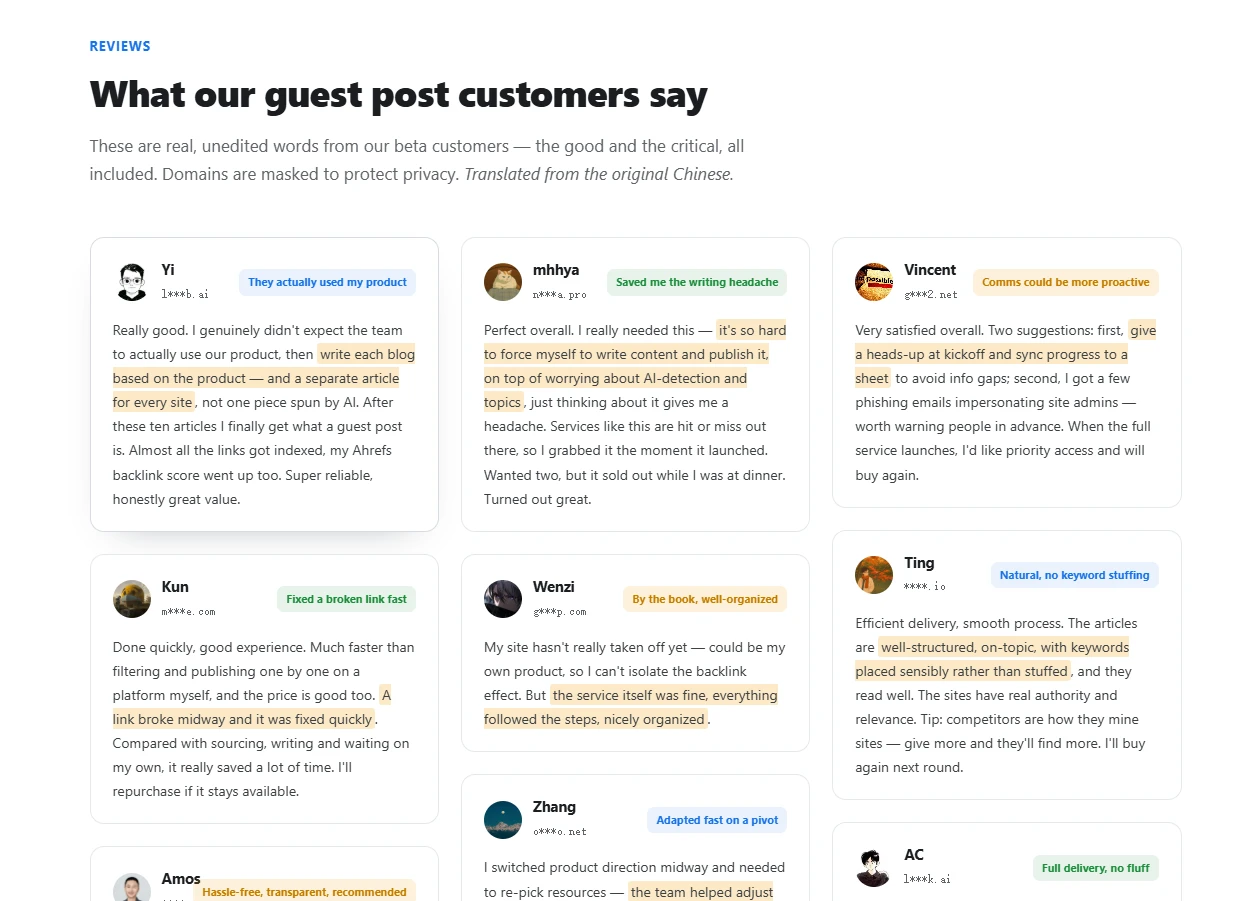
BestLinks AI may be a good fit if guest posting is already part of your SEO strategy, but the research and coordination around each placement take too much time.
If you already know which competitors matter, have a working content strategy, and can judge whether a publisher is worth paying for, the service removes much of the repetitive work. It handles prospecting, shortlist preparation, article creation, publishing, and link monitoring within the same workflow.
It can also make sense if you manage several websites or client campaigns at once. Instead of building publisher lists manually and coordinating separate writers and outreach contacts, you can focus on reviewing the proposed sites and approving the placements that match your goals.
It is probably less useful if your website is still early in its SEO development. If technical issues, weak content, or poor keyword targeting are holding the site back, spending more on guest posts is unlikely to fix the main problem.
Are cheap backlinks always bad for SEO?
Cheap backlinks are not automatically bad, but many low-cost placements come from thin sites with little real traffic or weak editorial standards.
The risk is that the link looks fine in a report but adds very little authority, relevance, or search value over time.
What should I check before buying a guest post placement?
Check the site’s organic traffic, topic relevance, recent content quality, outbound link patterns, and whether real articles rank or get discovered.
Domain Rating can help as one signal, but it should not be the only reason you choose a publisher.
Why do some backlinks get indexed but still fail to move rankings?
A backlink can be indexed and still have limited impact if the linking page has no audience, weak content, poor relevance, or sits on a site built mainly for selling links.
Indexing only means Google found the page. It does not mean the link is strong enough to improve search performance.
Is guest posting still useful for link building?
Guest posting can still be useful when the publisher is relevant, the article is written for real readers, and the link fits naturally inside the content.
It becomes much weaker when the placement is treated as a cheap slot for anchor text instead of a real editorial contribution.
What is the better approach to guest post link building?
A better approach is to prioritize fewer placements with stronger relevance, cleaner editorial standards, real organic traffic, and articles written for the specific publisher.
That usually takes more filtering upfront, but it avoids building a backlink profile that looks active while doing very little for actual growth.

Andrej Fedek is the creator and one-person owner of three blogs: InterCool Studio, CareersMomentum, and Bettegi. As an experienced marketer, he is driven by turning leads into customers with White Hat SEO techniques. Besides being a boss, he is a real team player with a great sense of equality.