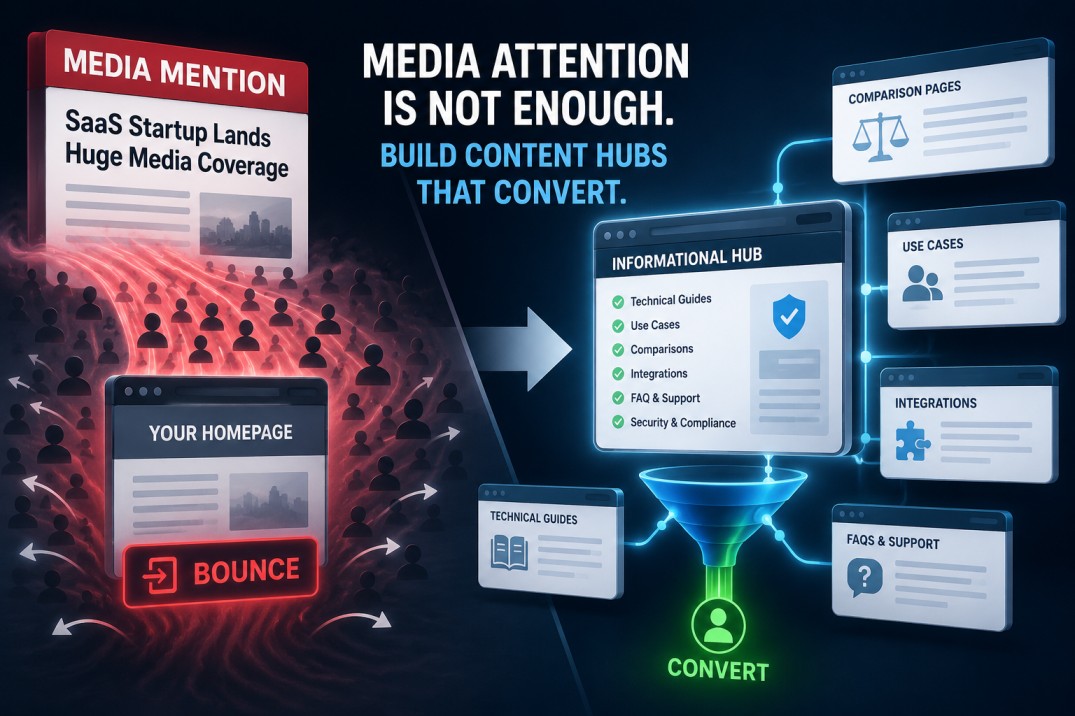
Digital PR can create a sudden wave of attention, but that attention often disappears fast when a brand has no informational hub ready to capture it. Last week, a SaaS founder was practically throwing digital confetti in our general Slack channel. His overpriced PR firm had finally bagged a contextual placement on a massive tech publisher.
Pure domain authority gold. The real-time traffic chart spiked straight to the ceiling. Five thousand concurrent visitors flooded the servers. The founder genuinely thought he had won the internet.
A week later, he checked his trial signups. Three.
He acquired exactly three free trials from a wave of fifty thousand unique visitors. The champagne went flat. The engineering team went back to fixing bugs. The PR agency sent an invoice for fifteen thousand dollars, entirely justified by the raw traffic metrics.
Here is my hot take. Most digital PR is an absolute waste of human attention. You pay a firm a small fortune for a high-authority backlink. The media hit pushes a massive wave of referral traffic straight to your domain. Visitors click through, look around your thin, empty website, and bounce straight back to their news feeds. You bought the spotlight. You forgot to build the stage.
Media mentions can bring attention, backlinks, and short traffic spikes, but they rarely create lasting value on their own. To capture that interest, brands need supporting informational hubs, comparison pages, technical content, and clean structured assets that answer the follow-up questions buyers search after discovering a company through PR.
The Anatomy of a Bounced Session
Let us break down the exact mechanics of this operational failure. A potential buyer reads a syndicated article about your new workflow automation software. They are intrigued. They click the contextual link. They land on your beautifully designed homepage. The homepage is packed with vague marketing copy and floating gradients.
They want specifics. They want to know if your API connects natively to their legacy database.
They click over to your blog to find technical documentation or use cases. Your blog contains exactly four posts. Two of them are company holiday updates. One is a welcome message from the CEO. The last one is a generic listicle written by an intern three years ago. The buyer immediately closes the tab. You just paid a premium acquisition cost for a highly qualified lead to read about your office Christmas party.
Traffic is completely useless without supporting infrastructure. When a major publication drops a link to your domain, it passes immense algorithmic trust. But trust alone does not convert a user. You need relevance. You need an exhaustive library of highly technical support content waiting to absorb that traffic, answer their immediate questions, and pull them deeper into your sales funnel.
The Second-Order Search Effect
The real value of a media mention is rarely the direct referral click. The true value lies in the second-order search effect.
That is where digital PR becomes more than a media placement; it becomes a search trigger that drives buyers to look for proof, comparisons, and practical product details.
When people read about your brand in a major publication, they do not always click the link. They open a new browser tab. They type your brand name alongside a specific technical modifier. They search for terms like “your software vs competitor” or “your software enterprise security features.”
If you have not built dedicated informational pages answering those exact queries, you lose the prospect immediately. Worse, you lose them to your direct competitors.
Your rival has already published a highly optimized comparison page targeting your brand name. The prospect searches for you, finds your competitor’s detailed breakdown, and buys their software instead. You literally just paid a PR firm to generate leads for your biggest competitor.
You must build a catching net. You need total topical saturation across every conceivable long-tail question related to your product.
The Assembly Line Bottleneck
This is precisely where traditional human editorial pipelines collapse. You cannot wait for a freelance writer to draft fifty technical tutorials while the media wave is crashing. The news cycle moves too fast. By the time your marketing committee approves the first draft, the referral traffic has completely evaporated.
You need raw speed. You need machines.
Intelligent growth teams bypass this human bottleneck entirely. They deploy an enterprise ai article writer to build out these catching nets instantly. They treat text production as a strict data structuring task rather than a creative writing assignment.
You feed a massive spreadsheet of highly specific, technical long-tail queries into the compilation engine. The software strips away the marketing fluff. It maps the necessary entity structures. It builds out precise technical answers, complete with semantic lists and structural tables. It outputs pure markdown code ready for your database.
You generate an entire ecosystem of highly relevant support documentation over a single weekend. When the PR piece finally drops, your domain is completely prepared to capture, educate, and convert every single visitor.
The Agency Fulfillment Disconnect
There is a massive strategic gap in the agency world right now. PR firms sell the initial media spike. SEO firms sell the slow crawl to the top of the search engine results page. Very few operations sell the actual intersection of the two.
If you run an agency, selling a high-authority backlink without upselling the supporting content architecture is professional malpractice. You are leaving the retention money on the table.
Agencies struggle with this because scaling content fulfillment traditionally destroys profit margins. Managing fifty freelance writers requires endless project management, heavy editorial oversight, and constant revision loops.
The math changes completely when you swap human labor for a programmatic text engine. This is why forward-thinking operations integrate a dedicated ai article writer for seo agencies directly into their fulfillment stack. The agency sells the digital PR placement for five figures. They then offer an automated topical cluster package to support the media hit. The compilation software generates the entire supporting web of content at a fraction of a cent per word.
The agency transforms a low-margin, high-stress fulfillment chore into predictable, high-margin monthly recurring revenue. The client actually gets a return on their public relations investment. Both sides win.
Structuring Assets for Autonomous Agents
We must also look at how this content is formatted. The web is rapidly evolving past simple visual reading. You are no longer just optimizing for human eyes. You are optimizing for autonomous extraction.
When your brand gets a mention in a major publication, AI search agents like Perplexity or ChatGPT immediately ingest that signal. They register your domain as an emerging entity. When a user asks an AI agent about your software, the agent attempts to crawl your site for facts.
These algorithmic agents despise heavy visual frameworks. They do not care about your drag-and-drop page builder. They cannot read information buried inside twelve layers of nested layout wrappers. They want clean, raw semantic data.
When you use automated compilation pipelines, you dictate the exact structure of the output. The generation tool drops pure, unbloated HTML straight into your server. Clean header cascades. Semantic bullet points. Proper schema markup. You feed the autonomous agents exactly the raw data structure they demand. The engine easily parses your technical specifications and quotes your software as the primary authoritative source.
Bypassing the CMS Rendering Trap
Compiling clean markdown off-server solves the visual bloat problem natively. However, you must also eliminate the administrative bottleneck. If your operations team still has to manually log into a content management dashboard, paste text strings into editor boxes, and hit publish, your pipeline remains painfully throttled.
True scale requires direct database ingestion.
Once your compilation workers finalize an asset package off-server, they format the compiled elements into secure JSON objects. You configure secure REST API routing inside your target server environments. The external generation service pushes the payload directly to your core storage endpoints instantly upon verification.
The optimized title string maps perfectly to your primary header database columns. Clean layout logic populates your main body templates natively. The transaction executes silently in the background. Static file generators trigger localized cache rebuilds instantly.
Your live staging environments update across global edge nodes without a single human clicking a publish button. Your site speed metrics remain absolutely pristine. Your mobile load times register in milliseconds because the browser parser receives nothing but pure, semantic text strings.
Reclaiming Your Digital Real Estate
Digital PR works best when the attention it creates lands on a site that already has the right informational assets in place. The era of empty digital storefronts is over. You can no longer buy your way to the top of a news feed and expect the market to figure out the rest. Attention is too fleeting. Competition is too severe.
If your operational strategy relies entirely on expensive external validation, you are renting your growth. A backlink on a major media site is a temporary billboard. The traffic it sends is transient. If you do not own the underlying informational real estate to capture that attention, you are simply funding the media company’s ad revenue.
Take a hard look at your analytics from your last major marketing push. Trace the user journey of the referral traffic. Identify exactly where they hit a dead end and abandoned your domain.
Stop paying for empty spotlights. Fire up an automated compilation engine. Deploy hundreds of razor-sharp informational nodes. Let the other founders set their Series A cash on fire chasing media logos. You just scoop up the stranded traffic they forgot to monetize.
Why do media mentions often fail to convert traffic?
Media mentions often fail to convert because the attention arrives before the website is ready to support it.
A backlink or referral spike may bring visitors in, but those visitors still need helpful pages, use cases, comparisons, documentation, and clear next steps before they can become qualified leads.
What is the second-order search effect in digital PR?
The second-order search effect happens when people see a brand mentioned in media, then search for that brand with extra questions instead of clicking directly.
Those searches may include comparisons, pricing, security, integrations, reviews, or technical details, so brands need informational pages ready before the media attention arrives.
Why are informational hubs useful after a PR campaign?
Informational hubs help capture the follow-up intent created by a PR campaign.
Instead of sending curious visitors to a thin homepage, brands can guide them toward deeper pages that answer product questions, explain use cases, compare alternatives, and support a more informed buying decision.
How can AI-generated content support PR traffic?
AI-generated content can support PR traffic when it is used to build structured, accurate, and relevant informational pages around real buyer questions.
It works best when the output is reviewed, edited, organized into a clear content architecture, and aligned with the product, audience, and search intent behind the media mention.
What should brands build before investing in digital PR?
Brands should build the pages that help visitors understand the product after the first moment of interest.
Useful assets include comparison pages, integration pages, technical explainers, customer use cases, pricing context, security information, and FAQ content that answers the questions buyers are likely to search next.

Andrej Fedek is the creator and one-person owner of three blogs: InterCool Studio, CareersMomentum, and Bettegi. As an experienced marketer, he is driven by turning leads into customers with White Hat SEO techniques. Besides being a boss, he is a real team player with a great sense of equality.