Choosing a digital marketing partner sounds simple until you actually start comparing options. Every agency says it can grow your brand. Every proposal mentions strategy, performance, content, paid ads, reporting, and some version of “long-term growth.” On paper, many of them look almost the same.
The difference usually shows up later.
It shows up when a campaign underperforms, and you need a clear explanation, not a polished excuse. It shows up when reports are full of numbers, but nobody can explain what those numbers mean for sales. It shows up when your team needs a partner who can think with you, not just complete a list of monthly tasks.
That is why choosing the right marketing agency is not only about services.
A strong digital marketing partner should understand your goals, challenge weak assumptions, communicate clearly, and connect their work to measurable business outcomes. They should feel less like an outside vendor and more like a practical extension of your team.
So, what should a growing brand actually look for before signing with an agency?
Here are the qualities that separate real growth partners from agencies that only look good in a pitch deck.
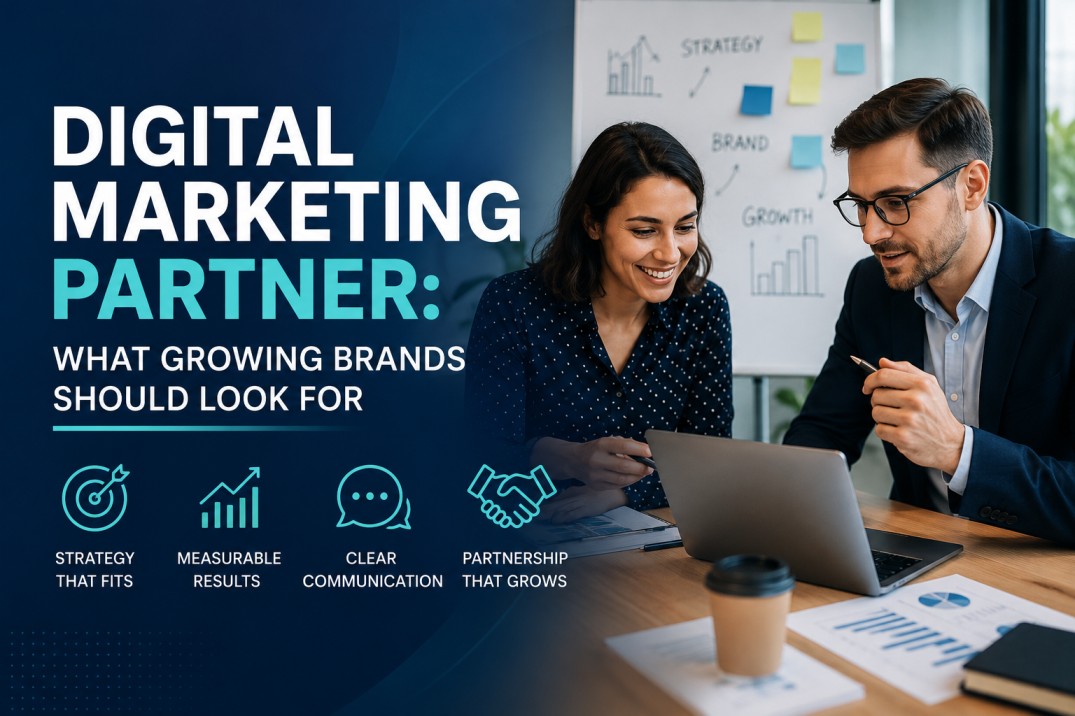
A results-driven digital marketing partner should do more than manage ads or post on social media. Growing brands should look for an agency that connects marketing activity to measurable outcomes, uses data to guide strategy, communicates clearly, understands multiple channels, and works like a long-term extension of the team. The best agency partner is transparent, accountable, and aligned with the brand’s current growth stage.
A Clear Focus on Measurable Results
A good agency should be able to explain what its work is supposed to change.
Not in vague terms. Not only through reach, impressions, clicks, or engagement. Those numbers can matter, but they do not always mean the business is actually growing.
For a growing brand, the better question is simple: what is this campaign doing for leads, sales, customer acquisition, retention, or revenue?
That pressure is real. Gartner’s 2025 CMO Spend Survey found that marketing budgets remained flat at 7.7% of overall company revenue, which means many teams are being asked to deliver greater impact with little additional room to spend. That makes accountability more than a nice extra. It becomes part of how smart marketing decisions get made.
That is where many agency conversations become clearer very quickly.
Ask how they track ROI. Ask what success should look like after the first 90 days. Ask which metrics they would use to decide whether a campaign is working or needs adjustment.
A results-driven agency should not hide behind broad claims about “brand awareness” when the business needs measurable progress. They should be able to showcase studies, dashboards, campaign reports, and performance data that connect marketing spend to real business outcomes.
Agencies like Gorilla 360 operate with this results-first mindset, using advanced tools and experienced marketers to help clients improve performance and make informed decisions. That level of accountability is exactly what growing brands should expect from the beginning.
Strategic Thinking Backed by Data
A strong digital marketing partner should not guess first and explain later.
Before they recommend campaigns, platforms, or monthly budgets, they should understand where the brand already stands. That means looking at traffic, rankings, paid ad performance, conversion rates, customer behavior, and the gaps competitors are leaving open.
This part matters because bad marketing often starts with assumptions.
The strange part is that many companies already have more data than they know what to do with. The CMO Survey reports that marketing analytics are used in decision-making far less often when companies do not formally evaluate their quality. In other words, having data is not the same as using it well.
An agency might push Meta ads because that is what they know best. Another might suggest SEO because it is easier to sell as a long-term play. But the right strategy should come from the numbers, not from whatever service the agency prefers to deliver.
A useful partner will usually start with an audit.
They should look at your website, search visibility, content, paid campaigns, landing pages, analytics setup, and customer journey. If your tracking is weak, they should say so. If your conversion rate is the bigger problem than traffic, they should not pretend more traffic will fix everything.
For brands in competitive markets, that same thinking should extend to competitors too.
The goal is not to copy what everyone else is doing. It is to find where your brand can realistically stand out, where budget is being wasted, and where growth opportunities actually exist.
That is the difference between a generic campaign plan and a strategy built around the business in front of them.
Expertise Across Multiple Channels
Growing brands rarely win from a single channel.
Someone might find you through Google, check your Instagram later, read a few reviews, click a retargeting ad, and only then decide to buy. That journey is messy, but it is how people actually behave online.
That is why a strong digital marketing partner should not treat every channel like a separate island.
Search, paid ads, content, email, social, and remarketing usually work better when they support the same customer journey. If one agency team is chasing clicks while another is writing content without a conversion path, the brand ends up with activity rather than momentum.
A capable agency should have proven experience across several key areas, including search engine optimization (SEO) to improve long-term visibility, paid advertising for scalable traffic, content marketing to build credibility, and email automation to nurture and retain customers. These channels tend to perform best when they support each other rather than operate independently.
The real question is whether the agency can connect those pieces.
A single-platform agency may still be useful in some cases, especially if one channel is clearly your biggest growth lever. But growing brands usually need a wider view. They need someone who can see how each channel affects the next one.
That is where a cohesive strategy matters.
The goal is not to be everywhere just for its own sake. The goal is to build a marketing system that scales with the brand, rather than running disconnected campaigns that look busy but never quite add up.
Transparent Communication and No Marketing Jargon
A bad agency report can look impressive and still tell you almost nothing.
There are charts, percentages, green arrows, screenshots from dashboards, maybe even a few lines about “ongoing optimization.” But after reading it, you still have one basic question: did this actually help the business?
That is where communication matters.
A good digital marketing partner should not make you decode your own results. If lead volume drops, they should say so clearly. If traffic is up but sales are flat, explain why that might be happening. If a campaign needs more time, explain what you are watching and when a decision should be made.
Plain English is not a bonus. It is part of the job.
The same goes for bad news. Every campaign will not work. Every test will not win. What matters is whether the agency can admit that early and show what comes next.
Vague updates are usually a warning sign.
If the sales process is already full of buzzwords, the monthly calls probably will be too. A strong partner should make the work easier to understand, not harder.
Cultural Fit and Long-Term Partnership Mindset
Some agency relationships look fine on paper, but never really click.
The reports arrive. The tasks get done. Meetings happen. Still, every call feels like you are explaining the business from the beginning again.
That gets old quickly.
A useful agency should remember context. They should understand what your team can handle, what kind of customers you want, which channels have already been tested, and where the brand is headed next.
Without that, even decent marketing work can feel disconnected.
This is where cultural fit matters more than many brands expect.
You do not need an agency that agrees with everything. That can actually be a warning sign. But you do need one that understands how your business thinks, how decisions are made, and when to push back.
Look for signs of a partnership mindset. Do they ask thoughtful questions about your business model? Do they seem genuinely interested in your customers? Do they approach challenges proactively rather than waiting for direction?
Over time, the difference becomes obvious.
A vendor waits for tasks. A partner notices problems before they become expensive.
A vendor sends deliverables. A partner asks why something matters in the first place.
That is usually the kind of relationship growing brands need: not someone who simply manages marketing, but someone who is actually paying attention.
Match the Agency to the Stage You Are Actually In
Not every agency is built for the same kind of brand.
Some are great with enterprise teams, big budgets, and slow approval cycles. Others are better for smaller or growing businesses that need sharper priorities, faster testing, and a more hands-on approach.
That difference matters.
A growing brand does not always need the biggest agency in the room. It needs a digital marketing partner that understands the stage the business is actually in.
That fit matters even more when budgets are tight. Gartner also reported that average marketing budgets fell from 9.1% of company revenue in 2023 to 7.7% in 2024, so many brands have less room for agency experiments that do not match their actual growth stage.
That means looking for agencies that have worked with similar brands, budgets, or growth challenges. Case studies help, but only if they feel relevant. A huge campaign for a global company does not always prove much if your business needs practical growth from a tighter budget.
Ask for examples that match your situation.
Have they helped brands improve lead quality? Reduce wasted ad spend? Turn content into a real acquisition channel? Build a stronger customer journey? These details say more than a polished logo wall.
The right agency should bring not only skills but also judgment.
They should know when to push for more investment, when to fix the basics first, and when a strategy sounds good but does not fit the business’s current stage.
That is what makes the partnership useful.
Not just services. Not just reports. A partner that understands where the brand is now and what needs to happen next.
The Agency You Choose Shapes the Growth You Get
A good agency will not solve every problem in the first month.
And honestly, any agency that promises that probably deserves a second look.
The better sign is whether they make your marketing feel less messy. You understand what is being tested. You know why money is going into one channel instead of another. Reports lead to decisions, not just another meeting.
That is what a useful digital marketing partner does.
They bring structure without making everything feel complicated. They spot weak points before they become expensive. They tell you when something is working, but they also tell you when something is not worth continuing.
For a growing brand, that kind of clarity matters.
You are not just buying campaigns, posts, ads, or reports. You are choosing the people who will help shape how your brand shows up, learns, and grows over time.
Pick the partner who makes that process clearer. Not louder. Not flashier. Clearer.
What should a growing brand look for in a digital marketing partner?
A growing brand should look for a digital marketing partner that understands its goals, tracks meaningful results, communicates clearly, and builds strategies around real business growth rather than surface-level activity.
The best partner should feel like an extension of the team, not just another outside vendor.
Why are measurable results important when choosing an agency?
Measurable results matter because marketing activity does not always equal business progress.
A strong agency should connect campaigns to leads, sales, customer acquisition, retention, revenue, or other outcomes that actually matter to the business.
How can a brand tell if a marketing agency is data-driven?
A data-driven agency usually starts by reviewing current performance before recommending campaigns or platforms.
They should look at traffic, rankings, paid ad results, conversion rates, analytics setup, competitors, and customer behavior before building a strategy.
Should a digital marketing partner manage multiple channels?
In most cases, yes. Customers often move between search, social media, paid ads, email, content, and retargeting before they take action.
A useful partner should understand how those channels support each other instead of treating each one as a separate campaign.
Why does clear communication matter in an agency relationship?
Clear communication matters because brands should not have to decode reports, jargon, or vague updates to understand what is happening.
A good agency explains what is working, what is not working, what the numbers mean, and what should happen next.
Is the biggest marketing agency always the best choice?
Not always. The best agency is the one that fits the brand’s current stage, budget, goals, and internal capacity.
A smaller or growing business may get better results from a partner that understands hands-on growth challenges rather than one built mainly for large enterprise campaigns.

Andrej Fedek is the creator and one-person owner of three blogs: InterCool Studio, CareersMomentum, and Bettegi. As an experienced marketer, he is driven by turning leads into customers with White Hat SEO techniques. Besides being a boss, he is a real team player with a great sense of equality.