There is a version of PR that most startups never experience. Not the press release version. Not the “we hired a firm for three months and got one article” version. The version where your name shows up consistently in the places your customers actually pay attention to. Where a podcast host whose audience is full of your ideal buyers has you on because you pitched them the right way. Where a newsletter author features your product because you reached out at exactly the right moment with something genuinely relevant to what they cover. That version of PR is not reserved for funded startups with communications budgets. Startup PR is available to anyone willing to approach it systematically. The tools to do it properly, without a retainer or an agency, have improved dramatically in the past two years.
This is a practical guide to building that kind of media presence in 2026.
Startup PR in 2026 is about building a consistent media presence through targeted stories, relevant outreach, podcast appearances, newsletter features, press mentions, and smart follow-ups. Instead of hiring an agency or sending generic pitches, startups can get better results by creating clear story angles, researching the right journalists and creators, personalizing each pitch, tracking response rates, and treating PR as an ongoing growth channel that supports credibility, referral traffic, backlinks, and long-term search visibility.
Start With the Story, Not the Pitch
The most common PR mistake startups make is jumping straight to outreach before they have a clear story. A pitch is just the delivery mechanism. What determines whether it lands is whether there is a story worth telling underneath it.
A story in PR terms is not the same as a product description or a company overview. It is an angle that makes a journalist, podcast host, or newsletter author think their audience would actually care. A few questions that help surface it:
• What problem are you solving that people in your space are actively talking about right now?
• What have you learned from building this that would be genuinely useful to others in your industry?
• What does your traction or customer data show that contradicts conventional wisdom?
• What is happening in your market right now that creates a timely reason to cover your angle?
Startups with strong products often have three or four distinct story angles available to them. The funding story. The founder story. The market perspective. The customer success story. Each one plays differently depending on the outlet and the audience. Getting clear on which angles you have before you start outreach makes everything that follows significantly more effective.
Understand the Landscape You Are Pitching Into
Journalists, podcast hosts, and newsletter authors are not a monolithic group. They have different beats, different audiences, different preferences for how they want to be approached, and different timelines for when they publish.
Pitching a journalist who covers enterprise software with a story about consumer apps is a waste of both your time and theirs. Sending a podcast host a pitch for a topic they covered six months ago signals that you have not done your research. These mistakes happen constantly in startup PR and they are entirely avoidable.
Before reaching out to anyone, understand three things about them: what they have covered recently, who their audience is, and what kind of stories tend to resonate with their readership or listenership. That research is what turns a generic pitch into one that feels like it was written specifically for that person because it was.
Building Your Media Contact List the Right Way
Most startup founders approach media contact lists the wrong way. They search for generic lists of tech journalists, download a spreadsheet, and start emailing. The response rate from that approach is predictably low.
A better approach is to build your list around your specific angles rather than around general media categories. For each story you want to tell, identify the journalists, podcast hosts, and newsletter authors who have shown a demonstrated interest in that specific topic.
• Which publications have run stories about companies solving similar problems to yours in the past six months?
• Which podcast hosts have had guests in your space and what angles did those conversations take?
• Which newsletter authors regularly feature tools or companies in your category?
Building a smaller, more targeted list around specific angles will consistently outperform a large, generic list. Fifty highly relevant contacts with well-researched pitches will generate more coverage than five hundred contacts receiving the same template.
The Personalisation Problem and How Magic Pitch Solves It
Here is the tension at the heart of startup PR. You need to reach enough contacts to generate meaningful results. But reaching each contact properly requires research and personalisation that takes significant time per contact. The math rarely works out in favour of doing it manually at scale.
Magic Pitch is the most complete solution we have come across for this exact problem. It is a dedicated PR, podcast, and media outreach platform that handles the full workflow from contact discovery to personalised pitch generation to automated follow-ups.
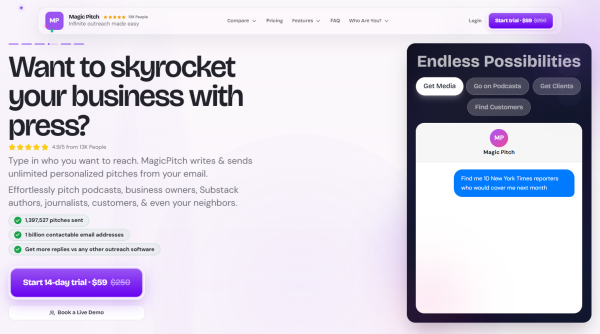
The database alone is impressive. 700,000 plus journalists, 3.8 million podcasts, and every Substack newsletter author with a verified email, all searchable in one place by topic, beat, location, and audience type. Finding the right contacts for any story angle goes from hours of manual research to minutes.
But the contact database is just the starting point. What makes Magic Pitch genuinely powerful is the AI layer on top of it. For every contact you want to reach, Magic Pitch researches their recent work and generates a personalised pitch that references what they have actually been covering. Not a template with their name dropped in. A pitch that reads like someone sat down, read their last ten articles or podcast episodes, and wrote something specifically for them.
The pre-send intelligence makes a real difference too. Before anything goes out, Magic Pitch shows you the predicted response rate for each contact, the ideal pitch length, the best day and time to send, and the preferred tone. All of this is drawn from over a million real pitches sent through the platform. You are not guessing at what works. You are following data from pitches that were actually converted.
Follow-ups run on autopilot after the initial send. The right timing, the right spacing, no contacts falling through the cracks. For a solo founder or a small team juggling everything at once, Magic Pitch turns media outreach from something that gets done inconsistently into something that runs like a proper workflow.
If you have been putting off media outreach because it felt too time-consuming to do properly, Magic Pitch is the specific tool that removes that excuse.
Podcast Outreach: The Underrated PR Channel
Most startup PR thinking focuses on press coverage. Podcast outreach is consistently underrated and often produces better results for early-stage companies.
The reasons are worth understanding. A podcast episode is typically twenty to sixty minutes of a host and their audience spending time with your perspective. The format lends itself to nuance in a way that a three-paragraph news mention does not. Podcast audiences tend to be highly engaged and loyal. And the barrier to getting booked as a guest, while still requiring good outreach, is often lower than landing a major press feature.
The key to effective podcast outreach is matching your story to the host’s recent content and framing your pitch around what you can offer their audience rather than what coverage means for you. A pitch that leads with “here is what my episode would give your listeners” consistently outperforms one that leads with “here is who I am and what my company does.”
Newsletter Features: Smaller Audience, Higher Conversion
Newsletter features are another channel that startup founders often overlook in favour of chasing big publication coverage. The reality is that a feature in a niche newsletter with ten thousand highly engaged subscribers in your exact target market will often outperform a mention in a general tech publication with a million readers who have mixed interests.
Newsletter authors are also often more accessible than journalists at major publications. They tend to be individuals building a personal brand around a specific topic, which means they are actively looking for good content to feature. A well-researched, genuinely useful pitch that connects your story to what they cover regularly has a reasonable chance of getting a positive response.
The compounding benefit of newsletter features is that they also tend to generate backlinks to your website, which builds search authority over time alongside the direct traffic the feature generates.
Following Up Without Being Annoying
The follow-up is where most startup PR efforts fall apart. Either founders follow up too aggressively and damage the relationship, or they do not follow up at all and leave placements on the table that a single well-timed message would have converted.
A few things that make follow-ups work:
• Wait five to seven business days after the initial pitch before following up
• Add something new in the follow-up rather than just bumping your previous message. A new data point, a recent development, a piece of coverage you have already received
• Keep it short. One or two sentences is enough. The goal is to resurface the pitch, not relitigate it
• After two follow-ups with no response, move on. Sending a third or fourth follow-up rarely converts and risks damaging future outreach to the same person
When outreach is handled through Magic Pitch, follow-up sequences run automatically with the right timing and spacing. No manual tracking, no forgotten contacts, no guesswork about when to send. It is one of the most underrated parts of the platform and one of the main reasons teams using it consistently outperform teams doing it manually.
Measuring Whether It Is Working
Startup PR is often measured on vanity metrics. How many pitches were sent. How many publications were targeted. These numbers feel meaningful but they do not tell you whether your outreach is actually generating the kind of coverage that moves the business.
The metrics worth tracking:
• Response rate: What percentage of contacts are engaging with your pitch at all
• Positive response rate: Of those who respond, how many are expressing genuine interest rather than asking to be removed
• Coverage earned: How many actual features, mentions, or interviews resulted from the outreach
• Traffic from coverage: How much referral traffic is coming from the coverage you are getting and how does it convert
• Backlinks generated: How many links to your site are being created through media mentions
Tracking these numbers over time tells you which angles are landing, which types of outlets are most receptive, and where to focus your outreach effort going forward.
One thing worth pairing with your media outreach from the start is a focused link building strategy. Press coverage earns backlinks naturally, but supplementing that with a dedicated SEO link building services approach compounds your domain authority significantly faster. The two together build search visibility that neither achieves as quickly on its own.
The Long Game
Building a media presence takes longer than most startup founders expect and pays off more than most of them anticipate. The businesses that stick with it consistently, that treat outreach as an ongoing activity rather than a launch-week sprint, end up with something genuinely valuable: a recognisable name in their category, a library of third-party credibility, and a backlink profile that compounds their search visibility over time.
The tools to do this without an agency now exist. Magic Pitch handles the research, the personalisation, the sending, and the follow-ups. The approach is learnable. The main thing standing between most startups and the media presence they deserve is deciding to build the habit and then actually building it.
What is startup PR in 2026?
Startup PR in 2026 is about building a consistent media presence in the places customers already pay attention to.
The article focuses on podcasts, newsletters, press coverage, targeted outreach, personalised pitches, and ongoing follow-ups.
What is the biggest PR mistake startups make?
The article says the most common PR mistake startups make is jumping straight to outreach before they have a clear story.
A pitch is only the delivery mechanism, while the real factor is whether there is a story worth telling underneath it.
How should startups build a media contact list?
Startups should build media contact lists around specific story angles instead of downloading generic lists of tech journalists.
The article explains that a smaller, targeted list with well-researched pitches will outperform a large generic list.
Why is podcast outreach useful for startup PR?
Podcast outreach is useful because an episode gives a founder more time to share their perspective than a short news mention.
The article also notes that podcast audiences tend to be engaged and loyal, while the barrier to getting booked can be lower than landing a major press feature.
Why can newsletter features work well for startups?
Newsletter features can work well because niche newsletters often have highly engaged subscribers in a specific target market.
The article says a niche newsletter with a smaller audience can outperform a general tech publication with a much larger but less focused readership.
How should startups follow up after a PR pitch?
The article recommends waiting five to seven business days after the first pitch before following up.
It also says to add something new, keep the follow-up short, and move on after two follow-ups with no response.
Which startup PR metrics are worth tracking?
The article highlights response rate, positive response rate, coverage earned, traffic from coverage, and backlinks generated.
These metrics help startups understand which story angles are working, which outlets are receptive, and where to focus future outreach.

Andrej Fedek is the creator and one-person owner of three blogs: InterCool Studio, CareersMomentum, and Bettegi. As an experienced marketer, he is driven by turning leads into customers with White Hat SEO techniques. Besides being a boss, he is a real team player with a great sense of equality.