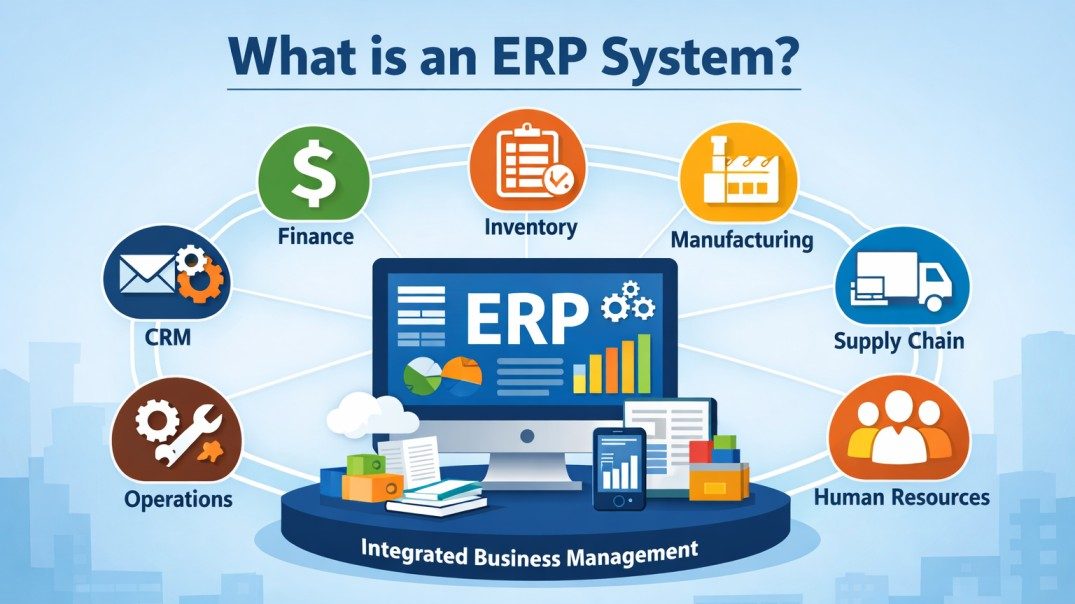
Enterprise resource planning ERP systems are business software platforms that connect finance, inventory, operations, purchasing, and other core processes in one place. Instead of using disconnected tools across departments, companies use ERP systems to centralize data and improve visibility.
That definition sounds broad, so the practical question is simpler: what do real ERP systems actually look like in the market?
The best way to answer it is with examples, because ERP is not a single product category with a single standard shape. Some platforms are built for global enterprises with layered compliance requirements, while others are designed for mid-sized companies that want a cleaner path out of disconnected accounting, inventory, and operations tools.
In this guide, I will walk through clear examples of enterprise resource planning ERP systems, explain what each one is known for, and show where each platform tends to fit best.
Enterprise resource planning (ERP) systems are integrated business platforms that connect core functions such as finance, purchasing, inventory, operations, and HR in one shared system. Examples of enterprise resource planning ERP systems include SAP S/4HANA Cloud, Oracle Fusion Cloud ERP, Oracle NetSuite, Microsoft Dynamics 365 Business Central, Infor CloudSuite, Acumatica, Epicor Kinetic, IFS Cloud, and Sage X3.
What makes a system an ERP platform?
A true ERP system does more than handle bookkeeping or reporting. It serves as a central operational layer that aggregates data from multiple departments into a single environment, helping companies reduce manual handoffs, improve visibility, and coordinate decisions across teams. Many businesses also rely on ERP platforms alongside IT support and services to maintain system performance, security, and operational continuity across departments.
That usually means the platform includes a mix of financial management, procurement, inventory control, supply chain functions, project management, manufacturing support, analytics, and workflow automation. Not every vendor emphasizes the same modules, but the core idea stays the same: one system, shared data, connected processes.
Enterprise Resource Planning ERP Systems
| ERP System | What It Is Best Known For | Best Fit |
|---|---|---|
| SAP S/4HANA | Deep enterprise process control across finance, supply chain, manufacturing, and large-scale operations. | Large organizations with complex workflows, strict governance, and multi-country operations. |
| Oracle Fusion Cloud ERP | Strong cloud-based financial management, planning, analytics, and enterprise-wide standardization. | Enterprises focused on finance transformation, scalability, and modern cloud architecture. |
| Oracle NetSuite | Unified cloud ERP that combines financials, operations, inventory, and business visibility in one platform. | Growing businesses moving beyond entry-level accounting and disconnected business tools. |
| Microsoft Dynamics 365 Business Central | Practical ERP functionality with close integration across the wider Microsoft business ecosystem. | Small and midsize businesses that want familiar tools and easier day-to-day adoption. |
| Infor CloudSuite | Industry-specific ERP depth for sectors that need specialized workflows instead of generic software. | Manufacturing, distribution, healthcare, and other businesses with strong vertical requirements. |
| Acumatica | Flexible cloud ERP with broad business management coverage and modular industry editions. | Mid-market companies that want modern cloud control without the heaviest enterprise footprint. |
| Epicor Kinetic | Manufacturing-focused ERP built around production, inventory, supply chain, and shop floor visibility. | Manufacturers that need tighter operational coordination and stronger production planning. |
| IFS Cloud | ERP strength for asset-intensive operations that need service, project, and operational depth. | Industrial, engineering, construction, and field-service-driven organizations. |
| Sage X3 | Balanced ERP structure for finance, operations, and supply chain without extreme enterprise complexity. | Established mid-sized businesses that need more control, visibility, and room to scale. |
1. SAP S/4HANA Cloud
SAP S/4HANA Cloud is one of the clearest examples of a modern ERP system, especially for larger organizations or fast-growing companies that need broad process coverage. SAP positions it as cloud ERP with real-time visibility, automation across core finance, and embedded AI support across finance and supply chain operations.
This is the kind of ERP platform people often picture when they think of large-scale enterprise software. It is built for organizations that need structured processes, multi-country support, strong governance, and the ability to connect finance, logistics, production, and asset-related workflows in one place.
SAP is usually a serious contender when the business is complex enough that spreadsheets, stand-alone finance software, and separate operational tools have already become a bottleneck.
2. Oracle Fusion Cloud ERP
Oracle Fusion Cloud ERP is another major example, and it sits firmly in the top tier of cloud ERP platforms. Oracle describes it as a complete, modern cloud ERP suite with AI capabilities, analytics, and automatic updates designed to help organizations stay current and respond faster to change.
What makes Oracle especially relevant in ERP discussions is its broad enterprise orientation. It is often considered by organizations seeking deep financial controls, robust planning, procurement support, and enterprise-grade scalability without relying on legacy on-premises architecture.
If a company is prioritizing large-scale finance transformation, process standardization, and cloud-first modernization, Oracle almost always enters the conversation.
3. Oracle NetSuite
NetSuite is one of the most recognized cloud ERP examples for growing businesses and upper mid-market organizations. Oracle’s NetSuite documentation describes it as a unified business management suite that brings together ERP, financials, CRM, and ecommerce.
That matters because many companies do not need the same ERP footprint as a global multinational. They need one platform that can replace scattered tools, improve financial visibility, and support inventory, order management, and operational reporting without turning implementation into a multi-year project.
NetSuite is often attractive to firms that have outgrown entry-level accounting systems and want a cloud-native platform with a wider operating scope.
4. Microsoft Dynamics 365 Business Central
Microsoft Dynamics 365 Business Central is a strong ERP option for small and midsize businesses looking for a familiar ecosystem. Microsoft describes it as an AI-powered ERP for small and midsize organizations, and its documentation also frames it as a complete ERP solution that is fast to implement, easy to configure, and simple to use. Understanding Dynamics 365 pricing is also important, as it helps businesses choose the right licensing tier and features to match their operational needs and budget.
One reason Business Central appears so often on ERP shortlists is that it integrates seamlessly with companies already using Microsoft tools. Microsoft highlights integration across its ecosystem, and the platform is positioned to connect finance, operations, sales, and reporting with the broader Microsoft environment.
For many mid-market firms, that combination of ERP capability and ecosystem familiarity makes Business Central a practical rather than flashy choice.
5. Infor CloudSuite
Infor CloudSuite is a useful example because it shows that not all ERP systems are meant to be generic. Infor emphasizes industry-specific cloud ERP, combining cloud technology, AI, and machine learning with deep vertical focus across sectors such as manufacturing, healthcare, aerospace, and distribution.
That industry angle is important. Some businesses do not just need finance and purchasing in a single dashboard; they need workflows that reflect how their sector actually operates, including manufacturing logic, supply chain demands, compliance complexity, and product-centric operations.
Infor is a strong example of ERP software built around that reality rather than forcing every company into the same standard mold.
6. Acumatica Cloud ERP
Acumatica Cloud ERP is another solid example, especially for growing companies that want adaptability without the baggage of legacy infrastructure. Acumatica describes its product as a true cloud-based ERP and a fully integrated business management system covering finance, manufacturing, construction, distribution, professional services, and retail.
That breadth makes Acumatica relevant for companies that need cross-functional visibility but still want flexibility in how the system is configured. The platform is often discussed in the context of growing businesses that want modern cloud access, modular capabilities, and industry-aligned editions rather than a one-size-fits-all stack.
In plain terms, Acumatica is the kind of ERP example that makes sense when a business wants modern operational control without moving straight into the heaviest enterprise tier.
7. Epicor Kinetic
Epicor Kinetic is a clear ERP example for manufacturing-centric organizations. Epicor describes Kinetic as a global cloud ERP solution designed for manufacturers, with real-time business intelligence and collaboration tools meant to support modern industrial operations.
That manufacturing focus matters because ERP requirements change rapidly when a company has production scheduling, shop-floor coordination, supply chain volatility, and inventory accuracy problems all happening at once. A manufacturer does not just need accounting software with a few add-ons; it needs operational depth.
Epicor is a good example of ERP software where industry fit is not an afterthought. It is the core value proposition.
8. IFS Cloud ERP
IFS Cloud ERP is a strong example for asset-intensive and mission-critical industries. IFS says its ERP capabilities are tailored to sectors that need industry-specific processes, built-in best practices, and support for complex operations, while the broader IFS Cloud platform spans ERP, asset management, supply chain, and field service.
That makes IFS especially relevant in environments where operations extend beyond standard back-office control. Companies in sectors such as engineering, industrial services, construction, energy, or heavy asset management often need an ERP connected to operational assets and service workflows, not just internal finance functions.
IFS is a good reminder that some ERP systems are chosen not because they are famous, but because they are structurally closer to the business itself.
9. Sage X3
Sage X3 rounds out the list as an ERP example often associated with established mid-sized businesses. Sage describes it as a comprehensive ERP platform that helps companies manage finances, operations, and supply chain processes while improving efficiency, profitability, and agility.
Sage also positions it for businesses that need stronger control over global operations, greater visibility, and the ability to expand into new markets or geographies. That makes it a relevant ERP example for firms that have grown beyond basic accounting software but do not necessarily want the overhead of the largest enterprise suites.
In other words, Sage X3 fits the market segment that needs a serious ERP without automatically joining the largest vendor ecosystem.
How to choose between ERP system examples
Looking at examples is useful, but picking an ERP system is not about chasing the most recognizable brand. It is about matching business complexity, industry requirements, company size, deployment preferences, integration needs, and internal implementation capacity to the right platform.
A manufacturer with complex production processes will likely evaluate ERP differently than a professional services firm. A global business managing multiple entities, currencies, and compliance layers will also have a very different shortlist than a mid-sized distributor trying to unify finance, inventory, and purchasing.
That is why “best ERP” is usually the wrong question. The better question is which ERP system aligns with how the business actually runs.
Final Thoughts
When people search for examples of enterprise resource planning ERP systems, they are usually not looking for a textbook definition. They want to see what ERP looks like in the real market and which names matter.
The clearest examples today include SAP S/4HANA Cloud, Oracle Fusion Cloud ERP, Oracle NetSuite, Microsoft Dynamics 365 Business Central, Infor CloudSuite, Acumatica Cloud ERP, Epicor Kinetic, IFS Cloud ERP, and Sage X3. Each one qualifies as an ERP platform, but each serves a slightly different segment, operating model, or level of business complexity.
That is the real takeaway. ERP is not a single tool for a single audience. It is a category of systems built to unify operations, and the right example depends on what the business needs to connect, control, and scale.
What are enterprise resource planning ERP systems?
Enterprise resource planning ERP systems are software platforms that connect core business functions such as finance, inventory, purchasing, operations, and reporting.
Instead of relying on separate tools for each department, businesses use ERP systems to manage data and workflows inside one shared environment.
What are some examples of enterprise resource planning ERP systems?
Common examples of enterprise resource planning ERP systems include SAP S/4HANA, Oracle Fusion Cloud ERP, Oracle NetSuite, Microsoft Dynamics 365 Business Central, Infor, Acumatica, Epicor, IFS, and Sage X3.
Each platform is built for slightly different business sizes, industries, and operational needs, which is why companies usually compare several options before choosing one.
What is the main purpose of an ERP system?
The main purpose of an ERP system is to give a business one central platform for managing operations, data, and workflows across departments.
That helps reduce manual work, improve visibility, and make it easier for teams to coordinate decisions using the same information.
Who uses enterprise resource planning ERP systems?
Enterprise resource planning ERP systems are used by manufacturers, distributors, retailers, service companies, and large organizations that need stronger process control.
They are especially useful for businesses that have outgrown separate accounting, inventory, procurement, and reporting tools.
How do businesses choose the right ERP system?
Businesses usually choose the right ERP system by comparing company size, industry requirements, budget, deployment preferences, and the features they need most.
The best ERP system is not always the biggest or most famous one, but the platform that fits the company’s workflows, growth plans, and operational complexity.

Andrej Fedek is the creator and one-person owner of three blogs: InterCool Studio, CareersMomentum, and Bettegi. As an experienced marketer, he is driven by turning leads into customers with White Hat SEO techniques. Besides being a boss, he is a real team player with a great sense of equality.